I stood frozen in my backyard, watching the excavator bucket pull away from my cottage wall, leaving a gaping hole where white siding used to be.
Roger Finley crossed his arms and waited for my response.
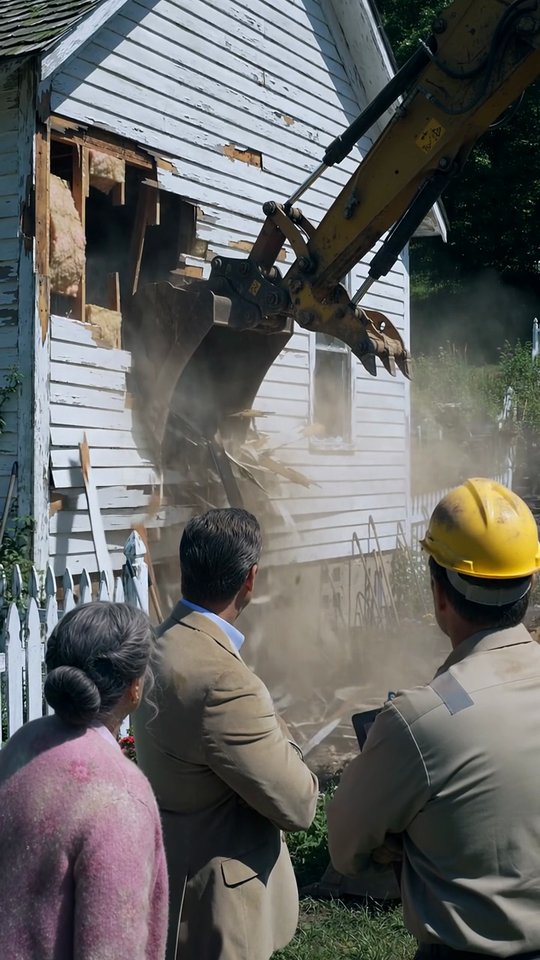
The man in the hard hat climbed down from the excavator cab and walked over to inspect the damage.
I could see exposed wooden studs and crumbling plaster through the hole.
My pantry wall. The wall Martin had reinforced himself in 1989 when we’d added extra shelving.
I pulled out my phone with shaking hands and dialed the county planning office again.
This time I asked to speak to a supervisor.
Roger watched me, his expression shifting from smug confidence to irritation.
“Mrs. Gallagher, you’re wasting everyone’s time,” he said. “This is a legal renovation.”
“Then you won’t mind when the county inspector comes to verify your permits,” I said quietly.
The hard-hat man glanced nervously at Roger.
Roger’s jaw tightened. “Turn off the machine,” he snapped.
The excavator engine died, leaving an eerie silence broken only by the wind rustling through the trees.
I gave the planning office my address and Roger’s name, then hung up.
“They’re sending someone within the hour,” I said.
Roger stepped closer, his voice dropping to a harsh whisper. “You’re making a mistake. I’m offering you nearly ten thousand dollars. Take it and let me do what I need to do, or I’ll make sure your cottage becomes unlivable.”
“You’ve already damaged my home,” I said, my voice steadier than I felt. “And you lied to get access. I don’t think the county is going to look kindly on that.”
He stared at me for a long moment, then turned and walked back to his truck without another word.
The hard-hat man followed, glancing back at the damaged wall.
I went inside and made myself a cup of tea with hands that wouldn’t stop trembling.
Fifty minutes later, a white county vehicle pulled into my driveway.
A woman in her forties stepped out, carrying a clipboard and a camera.
“Mrs. Gallagher? I’m Patricia Yates, county health and safety inspector.”
I showed her the hole in my pantry wall.
She took photographs from multiple angles, her expression growing darker with each shot.
“This is structural damage,” she said. “And you’re saying it was caused by unpermitted construction next door?”
I nodded and told her everything—Roger’s offer for the telescope, his lies about the historical society, his confession that he needed access to my pantry for his renovation project.
Patricia walked to the fence line and surveyed the Pritchard property.
The excavator sat silent now, its bucket still caked with dirt.
Fresh trenches scarred the yard, some of them less than eight feet from my cottage foundation.
“I’m going to need to inspect their site,” Patricia said. “And I’m issuing an immediate stop-work order until they produce valid permits and an engineer’s report on your shared foundation.”
She walked next door and knocked on the door of the construction trailer.
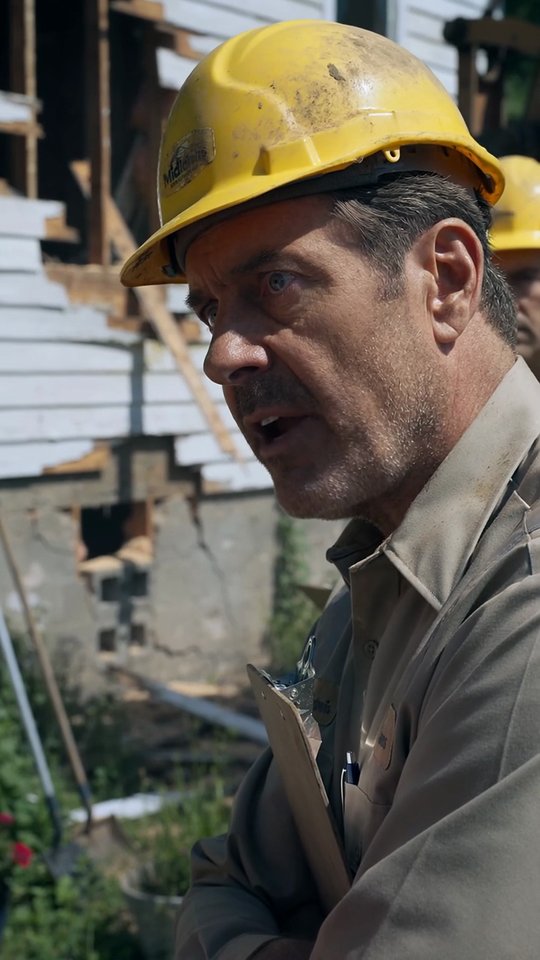
Roger emerged, his face flushed.
I couldn’t hear their conversation from my yard, but I saw Patricia hand him a sheet of paper.
He read it, crumpled it in his fist, and shouted something I couldn’t make out.
Patricia remained calm, taking more photographs of the excavation site.
Then she walked back to my cottage.
“Mrs. Gallagher, they have no permits on file,” she said. “No engineer’s assessment. No environmental review. This is a completely illegal operation.”
“What happens now?” I asked.
“I’m shutting them down,” Patricia said. “And I’m recommending the county building inspector open a full investigation. If they’ve damaged your foundation, they’ll be liable for all repairs.”
Relief washed over me, so strong my knees went weak.
Patricia handed me her card. “Call me if they try to restart work. In the meantime, I’m going to have our structural engineer assess your pantry wall to make sure it’s safe.”
She left, and I sat down at my kitchen table, staring at the brass telescope still wrapped in Martin’s wool blanket.
I unwrapped it slowly, running my fingers over the tarnished surface.
It wasn’t worth $9,150.
It probably wasn’t worth even five hundred dollars.
But it had been Martin’s, and it had sat quietly in my pantry for forty-one years, and in a strange way, it had saved my home.
Two days later, Patricia called me.
“Mrs. Gallagher, I wanted to update you,” she said. “The county engineer inspected your pantry wall. It’s structurally sound, but it was close. Another few hours of excavation and they would have destabilized your entire foundation.”
My stomach turned. “What about Roger Finley?”
“He’s facing fines and possible criminal charges for unpermitted construction and property damage,” Patricia said. “The owner of the Pritchard lot claims he hired Finley as a contractor and had no idea he was operating without permits. They’ve terminated his contract.”
“So the renovation is stopped?”
“Completely. And the owner has agreed to pay for repairs to your cottage wall as part of a settlement to avoid further legal action.”
I thanked her and hung up, feeling a weight lift from my chest that I hadn’t realized I’d been carrying.
That evening, I carried Martin’s telescope out to the hilltop behind my cottage for the first time in twenty-one years.
I set it up on its squeaky brass legs and pointed it at the early stars just beginning to appear in the dusk sky.
The eyepiece was scratched, and the focus took some adjusting, but when I finally found Jupiter, bright and clear against the darkening blue, I felt Martin’s presence so strongly I had to sit down in the grass.
“You always said this old thing was worth more than money,” I whispered.
And for the first time in four decades, I understood exactly what he meant.
The telescope hadn’t been valuable because of its brass or its craftsmanship.
It had been valuable because it was ours—a quiet piece of our life together that no amount of money could ever replicate.
And when Roger Finley had tried to use it as a key to unlock my home for his own gain, the very act of refusing him had set in motion the protection I needed.
Sometimes the things we hold onto, even when we don’t fully understand why, hold onto us right back.