I stood in Leonard’s garage under the bare bulb, reading his note for the third time while my hands shook.
The handwriting was shaky but clear, blue ink on lined paper torn from a drugstore spiral pad.
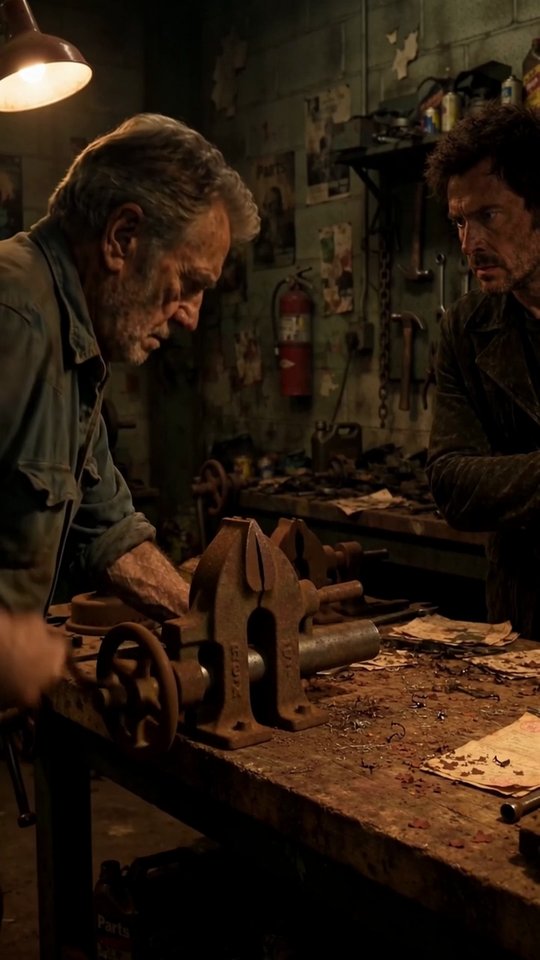
“Franklin, if you’re reading this, I’m gone and you finally opened the vice. Good. You were always stubborn enough to figure out the mechanism. I hid these receipts twenty-three years ago because I didn’t want Margaret to know what I’d done. Not because I was ashamed, but because I knew it would hurt her to think I’d chosen sides.”
I lowered the note and stared at the stack of invoices spread across the workbench.
Bayside Masonry: $1,240 for emergency foundation repair, January 14th, 2000.
Prescott Plumbing: $890 for burst pipe replacement and subfloor work, January 18th, 2000.
Granite State Electric: $1,470 for kitchen panel rewiring after fire damage, June 3rd, 2000.
Three more contractors I didn’t recognize, smaller amounts for roof patching, sump pump installation, chimney repointing.
Every invoice stamped PAID IN FULL in red block letters.
Every check stub signed by Leonard Howell.
I went back to the note.
“You and Margaret were just starting out. You had nothing. When that pipe burst in January, you called me at six in the morning, panicking. I drove over and saw the water pooling in the basement, the foundation crack spreading like a lightning bolt. You told me you’d gotten a quote for twelve hundred dollars and didn’t have it. You were going to take out a credit card cash advance at twenty-two percent interest.”
I remembered that morning.
The cold, the smell of wet concrete, Margaret crying in the kitchen because we’d already maxed one card fixing the car.
Leonard had stood in the basement in his canvas coat, hands in his pockets, and said, “Let me make a call.”
Two hours later a mason crew showed up and started work.
The foreman told us Leonard had recommended them and negotiated a payment plan: two hundred a month for six months, no interest.
Margaret and I had paid that bill faithfully, two hundred every month, until it was done.
Or so we thought.
I looked at the invoice again.
Leonard had paid the full $1,240 up front, in cash, the day the work was completed.
The payment plan had been a fiction.
The two hundred a month we’d sent to the mason had gone… where?
I kept reading Leonard’s note.
“I told the contractors to send you fake payment schedules and to deposit your checks into a savings account I opened in your name. Every month you sent two hundred dollars to Bayside Masonry, they put it in that account. Same with Prescott, Granite State, all of them. I wanted you to feel like you were standing on your own feet. I wanted Margaret to be proud of you both for handling it. By the time the last invoice was paid off in 2001, that account had $4,190 in it.”
My throat closed.
I set the note on the bench and pressed my palms flat against the scarred pine.
He’d secretly paid our debts, then secretly funneled our payments into a savings account we didn’t know existed.
Why?
I picked up the note again.
“The account is still open. It’s at Piscataqua Savings on Market Street, under your name and Margaret’s. The balance today is $91,408. I never touched a dime. I added a thousand a year on your anniversary, and the interest did the rest over twenty-three years. The account number is written on the back of this paper. It’s yours. It was always yours.”
I flipped the note over.
A nine-digit account number, written in the same shaky blue ink.
Ninety-one thousand dollars.
I sat down hard on the wooden stool, the tube rolling off my lap and clattering onto the concrete floor.
Margaret and I had struggled for years.
We’d driven used cars, skipped vacations, eaten rice and beans to save fifty dollars a month.
And the whole time, Leonard had been quietly building us a nest egg we never knew about.
I heard footsteps on the gravel outside.
The side door creaked open.
Ethan stepped into the garage, hands shoved in his jacket pockets, face tight and suspicious.
He was forty-three now, lean and unshaven, hair starting to gray at the temples.
He glanced at the workbench, at the scattered invoices, at the steel tube on the floor.
“What’s all this?” he said.
I handed him Leonard’s note without a word.
He read it slowly, lips moving, then looked up at me with an expression I couldn’t parse.
“He gave you ninety-one thousand dollars,” Ethan said flatly.
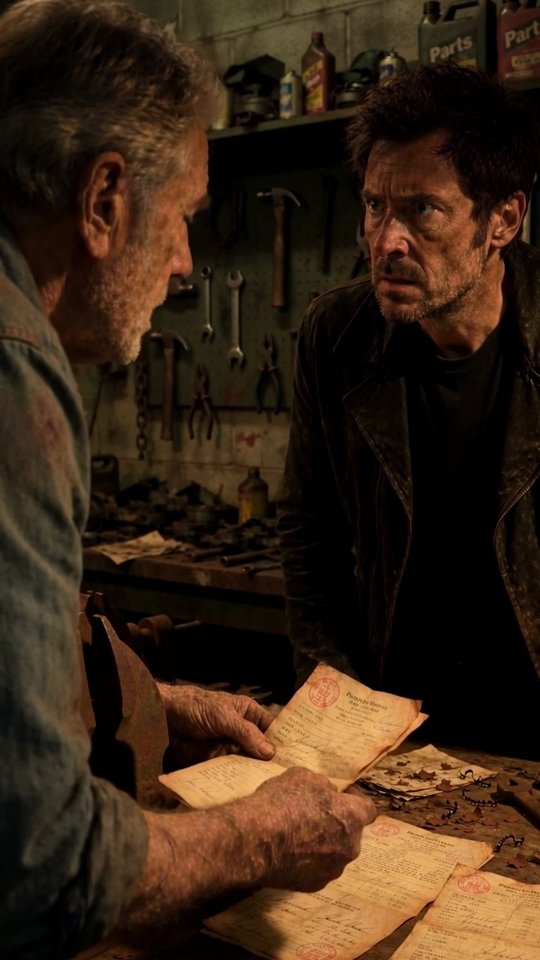
“He gave us four thousand,” I said. “The rest was interest and his anniversary deposits.”
“Same thing.”
“No,” I said. “It’s not.”
Ethan dropped the note on the bench and turned toward the door.
“I knew it,” he muttered. “I knew he played favorites.”
“Wait,” I said.
He stopped but didn’t turn around.
I picked up the tube from the floor and unscrewed the bottom cap again.
There was a second piece of paper inside, smaller, folded into a tight square.
I’d missed it the first time.
I unfolded it.
Another note, dated the same day in March.
“Ethan, if Franklin shows you this, don’t walk away. There’s a second account at Piscataqua Savings in your name. I opened it the same week I opened Franklin’s. Every time you sent me a birthday check or a Christmas card with twenty dollars inside, I deposited it and matched it ten-to-one. You stopped sending them after your mother died, but I kept adding a thousand a year anyway. The account has $68,240 in it now. The number is below. I never told you because I knew you’d refuse it out of pride. But pride doesn’t keep you warm when you’re seventy. Take it. Build something. Stop being angry at ghosts.”
I handed Ethan the second note.
He read it twice, face blank, then crumpled it in his fist.
“He could’ve just told me,” Ethan said quietly.
“He tried,” I said. “You stopped listening.”
Ethan’s jaw worked.
He smoothed the note out on the bench, staring at the account number.
“Sixty-eight thousand,” he whispered.
“He loved you,” I said. “He just didn’t know how to say it in a way you’d hear.”
Ethan stood there for a long time, one hand on the workbench, the other still holding the crumpled note.
Finally he looked at me.
“Margaret never knew?”
“No.”
“Why not?”
“Because he wanted her to be proud of us,” I said. “And he wanted you to find your own way without feeling like you owed him.”
Ethan exhaled slowly and nodded.
We stood in the dim garage under the bare bulb, two middle-aged men holding pieces of paper that rewrote twenty-three years of family history.
Outside, a neighbor’s dog barked.
A truck rumbled past on Deer Street.
Ethan folded the note carefully and slipped it into his jacket pocket.
“I’m sorry,” he said.
“For what?”
“For being an idiot at that cookout. For blaming you and Margaret. For not talking to him before he died.”
I gripped his shoulder.
“He forgave you a long time ago.”
Ethan nodded, eyes wet.
We locked up the garage together and drove separately to Piscataqua Savings on Market Street.
The accounts were real.
Every word Leonard wrote was true.
I used my share to fund a scholarship at the local trade school in Margaret’s name.
Ethan bought a small woodshop in Maine and started building custom furniture.
He calls me every Sunday now.
We talk about Leonard, about Margaret, about the things we should have said when we had the chance.
And every time I pick up a wrench or tighten a vice in my own workshop, I think about the quiet way love works sometimes—hidden in steel tubes, locked in iron jaws, waiting for the right moment to be found.