I stood in that turret room clutching Samuel Whitmore’s letter while the lawyer’s footsteps echoed up the wooden stairs.
Iris had already disappeared down the back staircase.
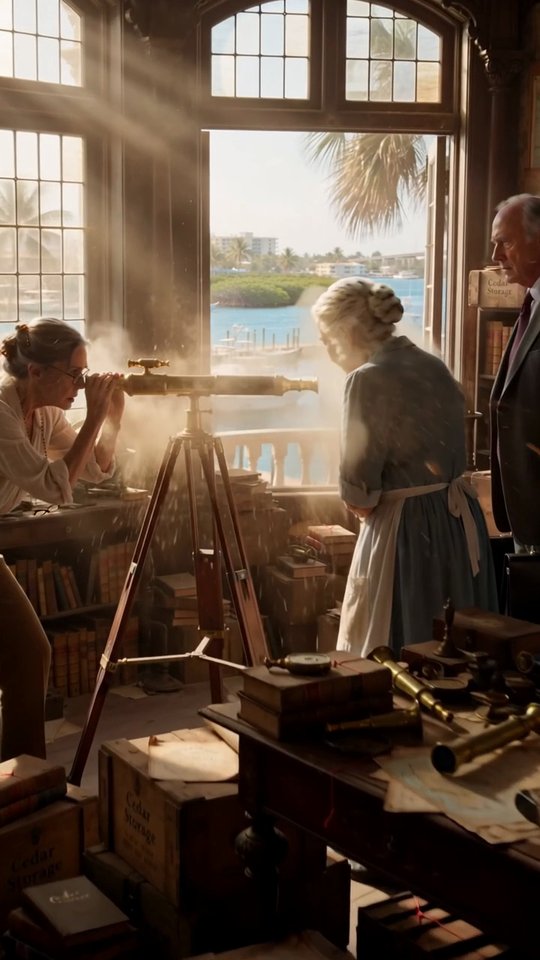
The lawyer appeared in the doorway. His name was Mitchell Grayson. Mid-fifties, charcoal suit, briefcase that cost more than my car.
“Miss Fairbairn,” he said briskly. “I need you to witness the demolition contract. The crew starts Monday morning.”
I folded the letter carefully and slipped it into my cardigan pocket.
“Mr. Grayson, I need to show you something first.”
He frowned. “I’m on a tight schedule.”
“It’s important.”
I led him to the brass telescope. Showed him the catalog entry. Explained its value.
Then I pulled out the letter.
“I found this inside a scroll case. It’s dated March 1954. Written by Samuel Whitmore.”
Grayson’s face went pale as he read it.
“This is impossible,” he muttered. “Samuel Whitmore had no children. The estate records are clear.”
“Your records are incomplete,” I said quietly. “Iris Caldwell is his daughter.”
“The housekeeper?” He laughed. “That’s absurd.”
“Her mother was Anna Caldwell. She worked here from 1919 until her death in 1947. Iris was born in 1951. Samuel was her father.”
Grayson’s jaw tightened. “Even if that were true, this letter isn’t a legal will. It holds no weight in probate court.”
“Then we’ll need to find more evidence.”
I spent the next three days searching the estate.
I went through every cedar box, every leather journal, every drawer in every desk.
Iris avoided me.
She stopped bringing me tea.
I’d see her in the hallways, but she’d turn and walk the other way.
On Wednesday afternoon I was cataloging the library when I found a locked drawer in Samuel’s mahogany desk.
I pried it open with a letter opener.
Inside was a leather journal.
Samuel’s private diary.
I sat on the floor and read it cover to cover.
Page after page of entries about Anna Caldwell. How he’d fallen in love with her in 1919. How society would never accept their relationship. How they’d kept their love secret for twenty-eight years.
There was an entry from February 1951: “Anna told me today she’s carrying our child. I am terrified and overjoyed in equal measure. I cannot marry her. The scandal would destroy everything my family built. But I will provide for them both. I swear it.”
Another entry from March 1954, just weeks before his death: “Iris is three years old now. She has Anna’s eyes and my stubborn chin. I take her to the turret when no one is watching. We look at the stars through my telescope. She calls me ‘Uncle Samuel.’ It breaks my heart every time.”
The final entry was dated April 2, 1954: “I am dying. The doctors give me two months at most. I have rewritten my will in secret. Everything goes to Iris. The house, the land, the telescope, all of it. I have hidden the document where only she will find it. Anna will know where to look.”
My hands trembled.
I ran to find Iris.
She was in the kitchen, scrubbing the counters.
“Iris, your father hid a will. A legal will. Do you know where your mother kept important documents?”
She stopped scrubbing.
Stared at the soapy sponge in her hand.
“There was a cedar box,” she whispered. “Mama kept it under her bed. After she died, I moved it to my room.”
“Where is it now?”
“In my cottage. Out back.”
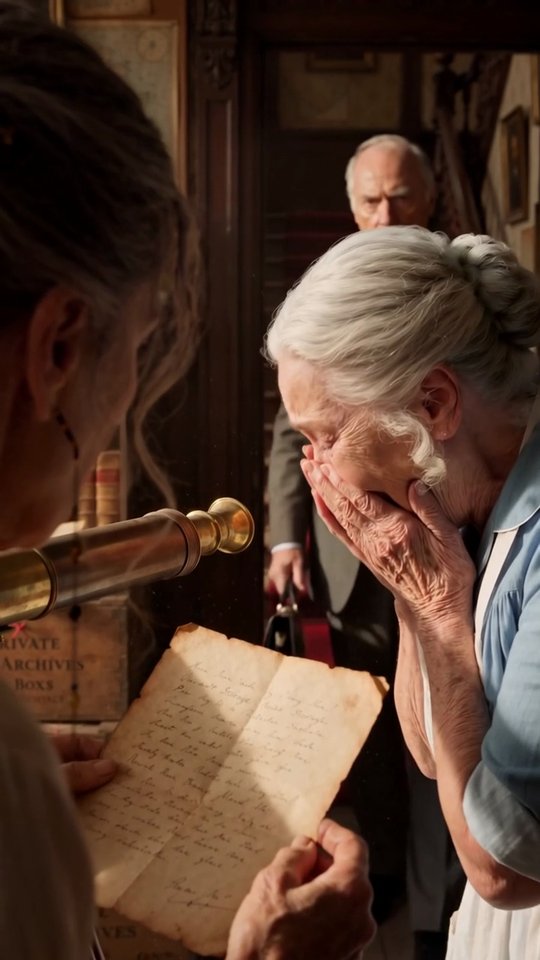
We walked together across the overgrown lawn to a small cottage behind the main house.
Iris’s home for fifty-one years.
One room with a narrow bed, a wooden table, a cast-iron stove.
She knelt and pulled the cedar box from under the bed.
It was covered in dust.
She opened it slowly.
Inside were photographs. Letters. A baby blanket. And at the bottom, wrapped in oilcloth, a legal document.
Last Will and Testament of Samuel James Whitmore.
Dated April 10, 1954.
Witnessed by two signatures I didn’t recognize.
It left everything to “my daughter, Iris Anna Caldwell.”
I called Mitchell Grayson immediately.
He arrived within the hour.
Examined the will with a magnifying glass.
Checked the signatures against county records.
His face grew darker with every page.
“This is legitimate,” he finally admitted. “The witnesses were Samuel’s doctor and his accountant. Both deceased now, but their signatures are notarized.”
He looked at Iris.
“Miss Caldwell, you are the legal heir to the Whitmore estate. The house, the land, all assets. Total value approximately nine hundred thousand dollars.”
Iris sat down hard on her narrow bed.
“I don’t want the money,” she said quietly. “I just want people to know the truth. That my father loved me. That I wasn’t a secret to be ashamed of.”
Grayson cleared his throat. “The demolition is canceled, of course. What you do with the property is entirely your decision.”
Iris looked at me.
“Eleanor, you’ve spent forty-two years cataloging other people’s histories. Would you help me preserve this one?”
I felt tears sting my eyes.
“It would be an honor.”
That was six months ago.
We turned the Whitmore estate into a museum.
The turret is now a planetarium. The brass telescope sits in the center, polished and gleaming.
Iris gives tours every Saturday afternoon.
She tells visitors about her father. About the stars he showed her. About the love that couldn’t be spoken aloud but was written in every line of his journals.
Last week a reporter from the Apalachicola Times came to interview her.
They took a photograph of Iris standing beside the telescope, her weathered hand resting on the brass barrel.
The headline read: “Lost Heiress Reclaims Her Father’s Legacy.”
I framed a copy and hung it in the museum entrance.
Right next to an oil portrait of Samuel Whitmore.
Sometimes I catch Iris standing in front of that portrait, just looking at it.
She doesn’t say anything.
But I can see the peace in her eyes.
The peace of a daughter who finally came home.