I stood in my workshop holding Otto Brenner’s letter, the paper thin as onionskin between my shaking fingers.
The handwriting was careful, each letter formed with the same precision Otto brought to every dovetail joint.
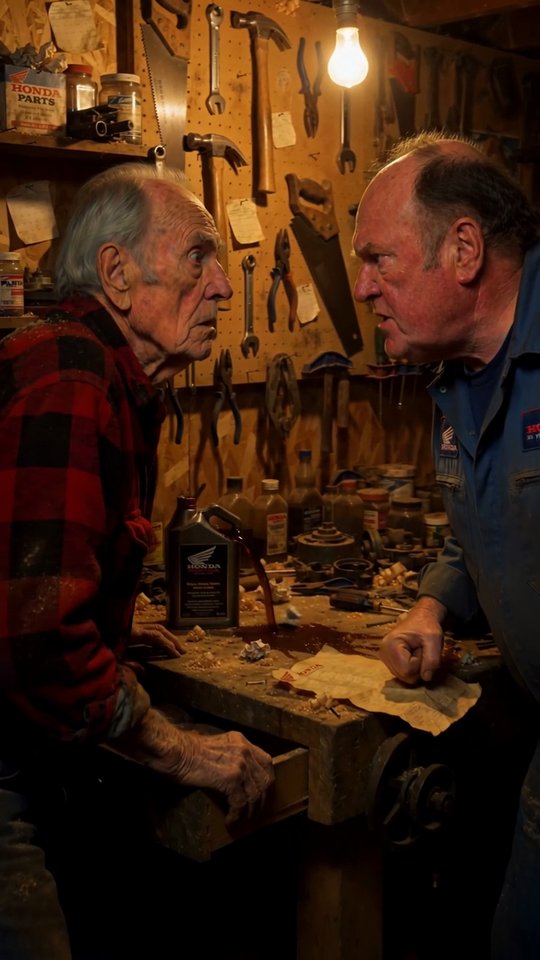
I read it three times before the words fully settled.
“If my son ever tries to collect on this table, show him this letter. Tell him I forgive him for what he did, but the table belongs to the family who loved it.”
What had Roger done?
I carefully refolded both documents and slipped them into my shirt pocket.
Then I walked up my driveway in the cool October darkness.
Roger’s porch light was on four houses down.
I could see his silhouette through the front window, pacing.
I knocked twice.
He opened the door still holding a beer, his face harder now, defensive.
“Come to write me a check?” he said.
I pulled out the settlement agreement. “Your father was paid in full. October 1962. Notarized.”
Roger snatched it from my hand, carried it to the kitchen table under the overhead light.
He stared at it for a long time.
His jaw worked but no sound came out.
Finally he set down his beer. “Where did you find this?”
“Hidden in the table leaf. Your father put it there.”
Roger’s face changed. Something crumpled behind his eyes.
He sat down heavily in a kitchen chair that creaked under his weight.
“There’s more,” I said quietly, and handed him Otto’s letter.
Roger read it twice.
His hands started shaking.
He set the letter down and covered his face.
I waited.
After a long moment he spoke, his voice muffled. “I stole from him.”
I said nothing.
“I was seventeen. Fall of 1980. He kept cash in a toolbox in his workshop, money he was saving to buy Mom a new stove for Christmas. Six hundred dollars. I took it to buy a motorcycle.”
Roger’s shoulders shook.
“He never said a word. Never accused me. Just quietly gave up the stove plan. Mom cooked on that old Kenmore another eight years before it finally died.”
He looked up at me, his eyes red.
“I told myself he never knew. That I’d gotten away with it. But he knew. Of course he knew.”
I pulled out a chair and sat across from him.
“Your father was a good man, Roger. He built beautiful things. He forgave you.”
“I never apologized,” Roger whispered. “Never paid him back. He died in 2003 and I never said a goddamn word.”
We sat in silence.
The refrigerator hummed.
Somewhere down the street a dog barked twice and stopped.
Finally Roger stood and walked to a drawer by the sink.
He pulled out a checkbook, wrote carefully, tore off the check and handed it to me.
It was made out for two hundred forty dollars.
“That’s what the original bill was, right? Before I added my bullshit interest?”
I looked at the check. “Roger, your father was paid—”
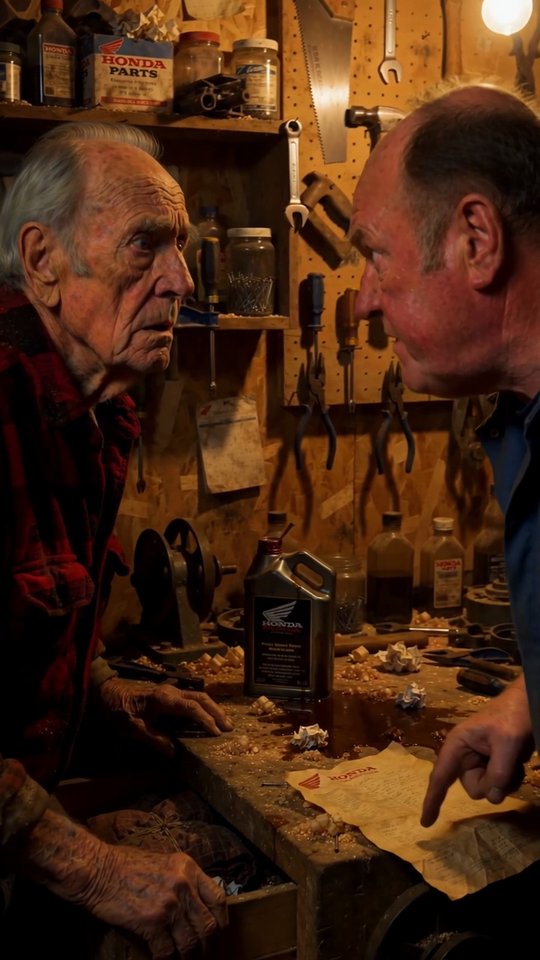
“I know. But I wasn’t. I owe somebody something and Dad’s gone so you’re what I’ve got.”
He pushed the check toward me. “Take it. Give it to your granddaughter. Tell her it’s from a man who’s trying to learn what his father already knew.”
I folded the check and put it in my wallet.
Roger walked me to the door.
At the threshold he stopped. “Stanley? Would you let me see the table? When you’re done restoring it?”
“Of course.”
“Dad was a master. I never learned. Didn’t have the patience. But I’d like to see his work one more time before your granddaughter takes it to Columbus.”
I nodded.
Three weeks later, the night before Lily came to pick up the table, Roger knocked on my workshop door.
I’d just finished the final coat of oil.
The walnut glowed like it was lit from within, the grain flowing like water.
Roger stood in the doorway for a long moment, just looking.
Then he walked slowly around the table, running his hand along the edge, bending to examine the joinery.
“He made this the year I was born,” Roger said quietly. “1962. I was three months old.”
He traced a finger along one of the legs.
“Look at these chamfers. Perfect. He did those with a hand plane, no jig, just his eye and his hands.”
Roger straightened and looked at me.
“Thank you for showing me this. And for not telling me what a jackass I was.”
“We all carry things,” I said.
Roger pulled something from his jacket pocket.
It was a small wooden box, cherry wood, dovetailed corners, about the size of a deck of cards.
“Dad made this for me when I graduated high school. I forgot I had it until I started going through his old shop last week.”
He opened the lid.
Inside was a folded note.
Roger’s voice shook as he read it aloud. “Son, you’ll make mistakes. I made plenty. What matters is what you build after. Love, Dad.”
He closed the box carefully.
“I’m going to start building something,” Roger said. “Don’t know what yet. But something with my hands. Something he’d recognize.”
The next morning Lily arrived with her fiancé and a borrowed truck.
We loaded the table carefully, wrapped in moving blankets.
I gave her Roger’s check along with the settlement papers and Otto’s letter.
“Grandma’s table comes with a story,” I said. “Keep these with it. They’re part of the wood now.”
Lily hugged me hard, crying a little.
After they drove away I walked back down to my workshop.
The space felt empty without the table.
But on my workbench I found a note Roger must have left.
“Stanley—I’m signing up for the woodworking class at the community college. Starts next month. Thought you might want to know. Maybe we could grab coffee sometime and you could tell me about the projects you’ve built. —Roger”
I folded the note and put it in my wallet next to a photo of Catherine.
Then I swept the sawdust, turned off the light, and climbed the stairs.
Some debts get paid in wood and time and the courage to forgive yourself.
Otto Brenner knew that.
He built it into every joint, every hidden space, every piece that left his hands.
And thirty-two years after he died, his son finally heard him.