The woman standing in my doorway wasn’t just any visitor.
Her name was Margaret Lindstrom, and she introduced herself as Lillian Crane’s niece.
But more importantly, she was Eveline Marsh’s great-great-granddaughter.
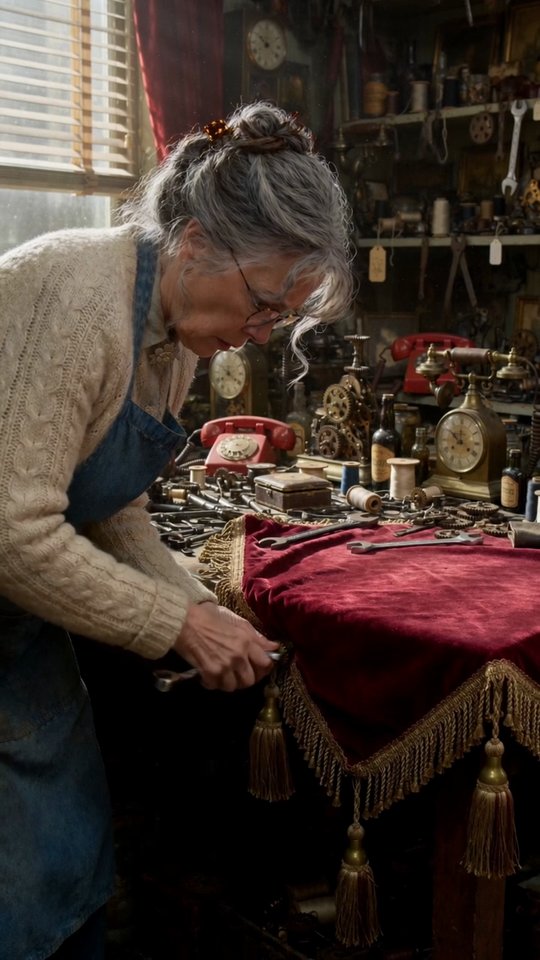
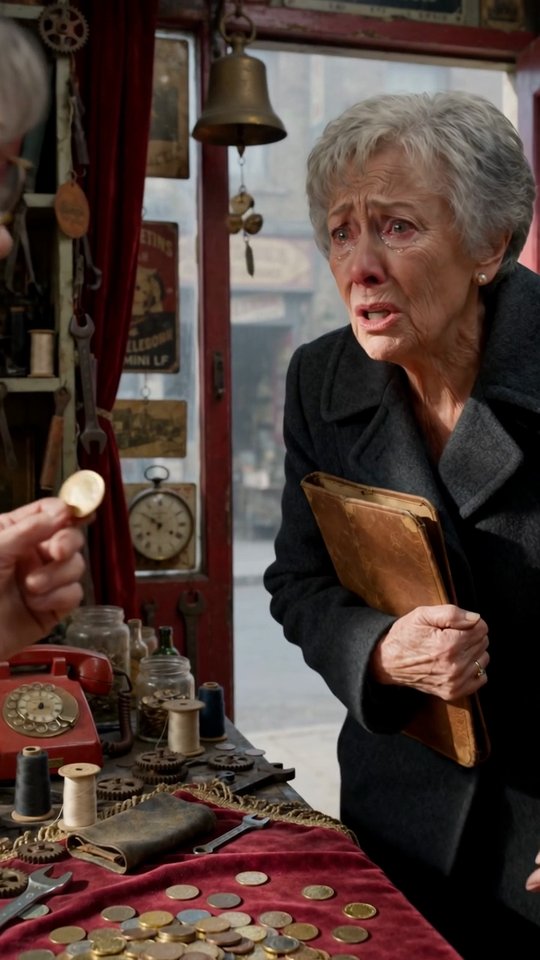
Margaret set her leather portfolio on the edge of my worktable, carefully avoiding the scattered gold sovereigns.
Her hands trembled as she unbuckled the straps.
“I’ve been searching for these coins for thirty years,” she said quietly.
“Ever since my grandmother told me the story on her deathbed.”
She pulled out a stack of yellowed letters tied with a faded ribbon.
“Eveline Marsh was my great-great-grandmother. She worked as a seamstress in Seattle in the 1880s, sewing curtains for theaters and dance halls.”
Margaret’s voice steadied as she spoke, as if she’d rehearsed this story a thousand times in her head.
“She witnessed terrible things. Women trapped in contracts they couldn’t escape, beaten if they tried to keep their earnings.”
“So Eveline started sewing secret pockets into the hems and linings of the curtains she made. The women would hide their money there, a few coins at a time, until they had enough to run.”
I looked down at the gold sovereigns glinting on my table.
“But these weren’t someone else’s savings,” I said slowly.
Margaret shook her head.
“No. These were Eveline’s. She saved every penny she earned for seven years, hiding the coins in the curtain tiebacks she kept in her own sewing room.”
“She planned to use them to open a dress shop on Bainbridge Island, somewhere safe and far from the city.”
“But then the Great Seattle Fire happened in 1889. Eveline’s workshop burned. She barely escaped with her life.”
Margaret carefully unfolded one of the letters.
The ink was faded brown, the handwriting elegant and slanted.
“This is from Eveline to her sister, dated August 1891. She writes about moving to the island and starting over.”
“She mentions bringing ‘the tassels that hold my future’ with her.”
I felt a chill run down my spine.
“So she did make it here,” I whispered.
“She did,” Margaret confirmed. “She bought a small cottage near the harbor and opened a modest sewing business.”
“But she never opened the tassels. According to family letters, she became convinced that using the coins would bring bad luck.”
“She’d seen too many women destroyed by money, by greed, by men who wanted to control their wealth.”
“So she kept the tassels on a pair of drapes in her parlor, untouched, for forty years.”
Margaret’s eyes filled with tears.
“When Eveline died in 1931, the drapes passed to her daughter, then to her granddaughter, then eventually to my aunt Lillian.”
“Each generation was told the same thing: ‘Never sell the burgundy drapes. They’re a family heirloom.’”
“But no one knew why.”
“The secret died with Eveline.”
I stared at the coins, understanding flooding through me.
“Until your grandmother told you,” I said.
Margaret nodded.
“She was ninety-one, dying of pneumonia. She pulled me close and whispered, ‘The gold is in the tassels. Find it before it’s lost forever.’”
“But by then, Aunt Lillian had already developed dementia. She couldn’t remember where the drapes were stored.”
“I searched her house a dozen times over the years, but I could never find them.”
“I thought maybe she’d donated them, or they’d been thrown away.”
Margaret’s voice cracked.
“And then Lillian passed, and the estate attorney started liquidating everything, and I got a call last week saying a box of curtains had been sent to a repair shop on the island.”
“I drove here as fast as I could.”
I looked at this woman, this stranger who’d carried a family mystery for three decades, who’d never stopped searching.
And I looked at the coins on my table, Eveline’s life savings, hidden for 130 years.
“These belong to you,” I said quietly.
Margaret shook her head, tears spilling down her cheeks.
“No. They belong to Eveline’s dream. The dream she never got to live.”
She reached into her portfolio and pulled out a faded photograph.
It showed a young woman in a high-collared dress, standing in front of a small cottage, holding a pair of scissors.
“This is Eveline in 1892, a year after she moved here.”
“She looks happy, doesn’t she?”
I studied the photo.
Eveline’s face was serene, her eyes bright with quiet determination.
“She does,” I agreed.
Margaret carefully gathered the gold sovereigns, placing them one by one back into the velvet pouch.
“I’m going to use this money the way Eveline intended,” she said. “I’m going to open a sewing co-op here on the island.”
“A place where women can learn tailoring, mending, embroidery. A place where they can earn fair wages and keep every penny they make.”
“I’m going to call it Eveline’s House.”
My throat tightened.
“That’s beautiful,” I whispered.
Margaret smiled through her tears.
“And I’d like you to be part of it. We’ll need someone to teach curtain restoration and lamp repair.”
“Someone who understands the value of old things, the stories they carry.”
I looked around my cramped, dusty shop.
I thought of my empty cottage, my unused greenhouse, the quiet years I’d spent mending other people’s heirlooms while my own life gathered dust.
“Yes,” I heard myself say. “I’d be honored.”
Margaret clasped my hands.
“Eveline would be so grateful. You found her dream when everyone else had forgotten it existed.”
We stood there together in the afternoon light, two women separated by generations but connected by the thread of one seamstress’s quiet courage.
Yesterday at 12:18 p.m., I thought I’d found a fortune.
But what I really found was something far more valuable.
I found proof that the dreams we carry, the sacrifices we make, the hope we stitch into the fabric of our lives—none of it is ever truly lost.
It’s just waiting, hidden in plain sight, for the right hands to unspool the thread and bring it back into the light.
Eveline’s House opened six months later in a renovated storefront two blocks from my shop.
On opening day, we hung the burgundy drapes in the front window, the brass tassels—now empty but polished bright—catching the sun.
And beneath them, we placed a small brass plaque engraved with Eveline’s words from her 1891 letter: “Every stitch is a step toward freedom.”