Nathan twisted the lid harder. The metal groaned. Rust flaked onto his palm.
I stepped back. My heel crunched on broken glass.
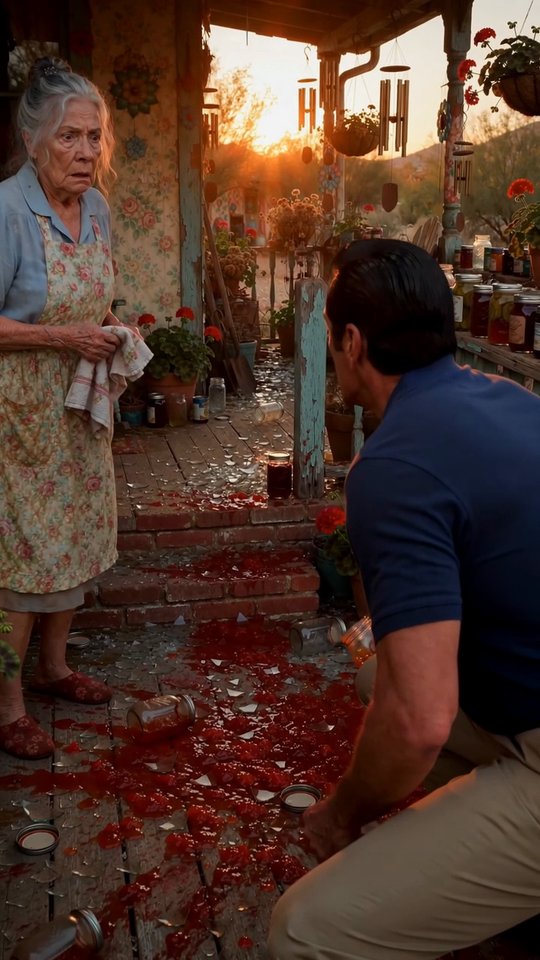
He finally got the lid off. The seal broke with a soft pop.
Inside wasn’t preserves. It was folded paper. Yellowed. Brittle.
He pulled it out carefully. Unfolded it on the porch railing.
I saw handwriting. Fountain pen. The ink had faded to brown.
Nathan’s face changed. The anger drained out.
He read it twice. Then he looked at me with different eyes.
“This is my grandmother’s handwriting,” he said quietly.
I moved closer. The letter was dated April 1967.
It started: “My dearest Lorraine.”
Nathan’s hand shook as he held it. “My grandmother died when I was eight. I barely remember her.”
The letter was addressed to Lorraine. But Lorraine would’ve been a teenager in 1967.
I said, “I don’t understand.”
Nathan kept reading aloud. His voice cracked halfway through.
The letter was an apology. His grandmother had accused Lorraine’s mother—Nathan’s great-aunt—of stealing a diamond ring at a family gathering in 1966.
The accusation had split the family. Lorraine’s mother was shunned. She died two years later without reconciliation.
The letter explained that the grandmother had found the ring months later. It had fallen behind a dresser drawer.
She wrote that she’d tried to apologize in person but Lorraine’s mother wouldn’t see her.
So she wrote this letter. Sealed it in a mason jar. Left it in the pantry of the family home with instructions for Lorraine to find it after her death.
But Lorraine never found it. The house was sold. The jar ended up in a box of canning supplies that moved with the new owners.
Then those owners sold their things at an estate sale years later.
And Lorraine bought the jar. Never knowing what was inside.
Nathan set the letter down gently. He looked at the shattered glass around us.
“My mother,” he said slowly, “has told me that story my entire life. How her grandmother destroyed her mother’s reputation over a ring that was never stolen.”
He sat down on the porch step. Put his head in his hands.
“She’s carried that for sixty years,” he whispered.
I didn’t know what to say. I picked up a piece of broken glass and set it aside.
Nathan looked up at me. “The ring. She said you took it. But she didn’t, did she?”
I shook my head. “I never had a key. I never went through her things.”
He nodded. “She’s been confused lately. Forgetting things. I thought it was just age.”
He stood up. Brushed off his khakis. “The ring is probably in one of the boxes we already packed. She just forgot where she put it.”
I said, “You accused me in front of the whole street.”
He looked at the broken jars. The preserves drying on the wood. “I know. I’m sorry.”
It wasn’t enough. But his face looked hollow.
He picked up the jar. The false bottom was visible now—a thin disk of tin that had kept the letter dry for decades.
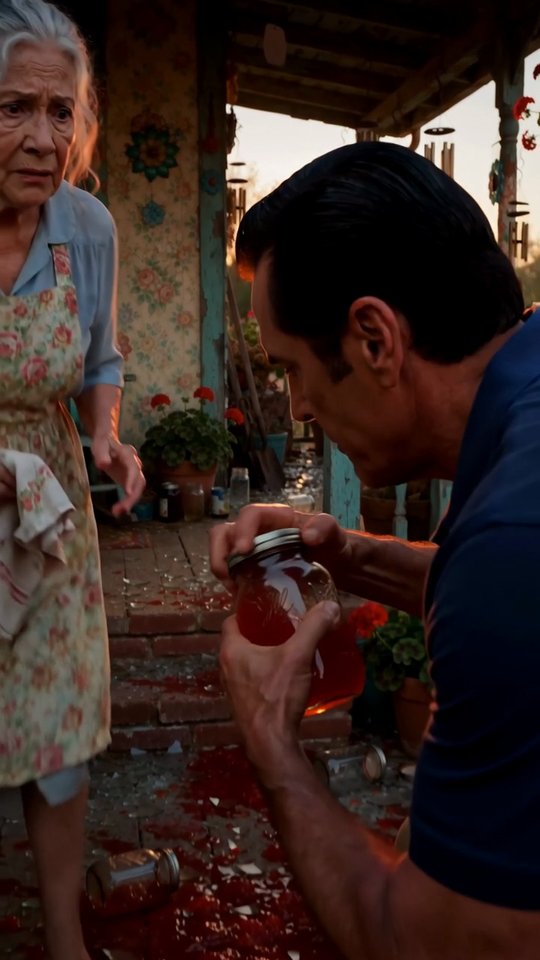
“Can I take this to her?” he asked.
I nodded. “It was never mine.”
He walked back to Lorraine’s house. I started cleaning up the glass.
An hour later, he came back. He was carrying a checkbook.
“My mother told me what you did. The porch. The greenhouse. The $1,790.”
I waved him off. “I didn’t do it for repayment.”
“I know,” he said. “But I’m writing you a check anyway. For the repairs to your porch. And the jars I broke.”
He wrote it out. $2,200. Handed it to me.
I didn’t want to take it. But I saw something in his face. He needed me to.
“She read the letter,” he said. “She cried for an hour. Then she asked if we could delay the move.”
I looked up. “Delay?”
He nodded. “She said she’s not ready to leave. That she has unfinished business here.”
The next evening at sunset, Lorraine came out to her porch. She lit a menthol cigarette.
I walked over with two glasses of iced tea.
She patted the seat beside her. “Nathan told me what he did.”
I sat down. “It’s okay.”
She shook her head. “It’s not. But thank you for saying so.”
We sat in silence. The sun turned the desert pink.
“I never knew that letter existed,” she said finally. “My whole life, I thought my grandmother hated my mother. Hated me.”
I sipped my tea. “Now you know different.”
She nodded. “Nathan’s bringing the ring by tomorrow. He found it in a shoebox marked ‘winter scarves.’”
We both laughed. It felt good.
“I’m sorry I let him accuse you,” she said. “I was confused. I couldn’t remember where I’d put anything.”
I reached over and squeezed her hand. “You were scared.”
She squeezed back. “I’m staying. Nathan’s hiring someone to check on me twice a week. But I’m staying in my house.”
I smiled. “Good. I just fixed that porch.”
She laughed again. Then she pulled something from her pocket. An index card.
“My grandmother’s recipe for peach preserves,” she said. “It was tucked in the letter. I thought you might want it.”
I took the card. The handwriting matched the letter. Careful. Looping.
“I’ll make a batch,” I said. “We can share it.”
Lorraine stubbed out her cigarette. “I’d like that.”
We sat on that Victorian porch until the stars came out. Two old women who’d found forgiveness in a mason jar.
The kind of forgiveness that crosses generations. That waits sixty years in a pantry. That breaks everything open just when you think it’s too late.
My husband would’ve loved this story. He always said the best things grow in unexpected places.
He was right. They do.