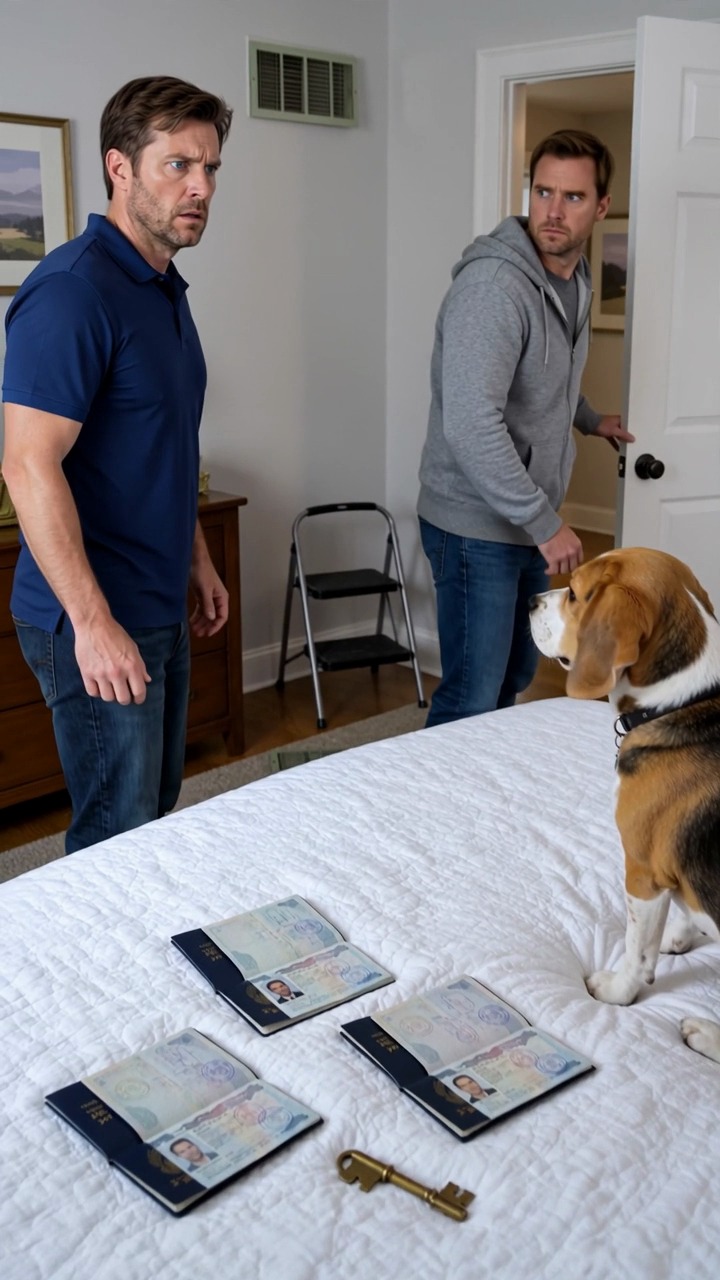
Leo’s hand stayed in the bag, and Cooper’s growl climbed into something I’d never heard from him before.
“Easy, buddy,” Leo said softly, but he wasn’t talking to the dog.
He pulled out a folded envelope, not a weapon, and let it drop on the quilt beside the passports.
“Before you call anyone, Elias, you should know what those cost me,” he said, his voice flat and tired.
I stepped back until my shoulder hit the closet door, passports still clenched in my fist.
“Who are you?” I asked, and my own voice sounded strange in the room.
“Still Leo,” he said. “Legally, anyway. The rest of it is a very long story about a bad loan.”
He sat on the edge of the bed like a man who had run out of places to stand.
“A private security firm fronted my startup money in Seattle,” he said. “Then the startup died and the money didn’t.”
Cooper planted himself between us, and Leo had the decency not to reach toward him.
“Three passports is not a loan, Leo,” I said. “That’s an exit strategy.”
“You’re right,” he said quietly. **”It’s not a loan anymore, Elias. It’s a countdown, and I’m the one being counted.”**
The Thing Taped Inside the Vent
I turned back to the open vent because I couldn’t look at him anymore, and that’s when I saw it.
Taped to the back of the brass grate, small and flat and matte black, sat something that was definitely not duct tape.
It had a tiny pinprick light, blinking green, slow and patient and completely indifferent to my heart rate.
“What is that?” Sarah would ask later, and I still wouldn’t have a good answer.
Leo stood up fast. “Don’t touch it,” he said, and for the first time all day he sounded genuinely afraid.
“You put this here?” I asked, and he shook his head with a slow, miserable motion.
“I found it two weeks ago,” he said. “That’s when I stopped sleeping in this room.”
Which meant the vent wasn’t his hiding place at all. It was somebody else’s listening post.
Cooper sniffed at the stepstool and whined, one long note, the way he did when a storm was coming.
“How long has it been recording?” I asked, and Leo did the math in his head and didn’t like the answer.
“Long enough,” he said. “Every phone call in this house. Every conversation at your kitchen table.”
I thought about all the dinners we’d had, all the things Sarah and I said when we thought we were alone.
What Sarah Already Knew
The front door opened downstairs, and Cooper bolted for the stairs before I could stop him.
Sarah’s keys hit the bowl, then her footsteps came up fast, like she already knew something was wrong.
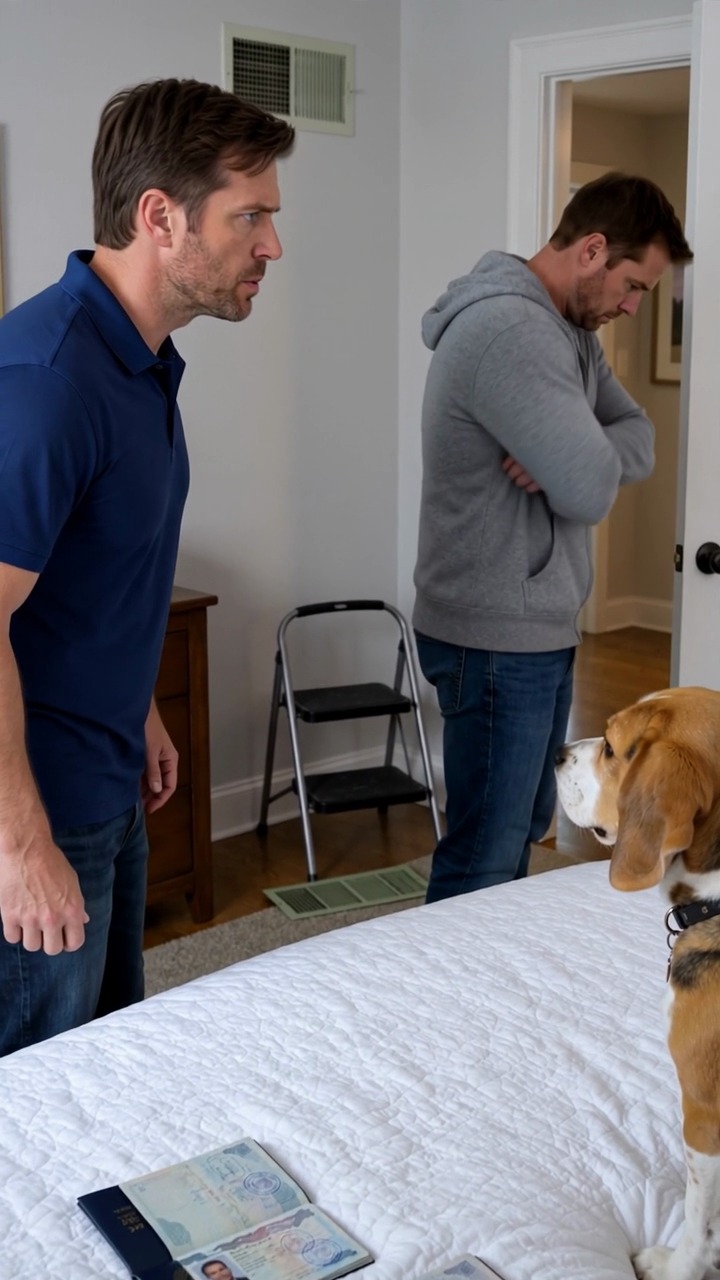
She stopped in the doorway, took in the passports, the open vent, the two of us standing like suspects.
“Which name?” she asked, and the question landed on me harder than anything Leo had said.
Leo closed his eyes. “The Lisbon one,” he said. “She helped me renew it in June.”
I turned to my wife, and she didn’t look surprised. She looked cornered.
“You knew,” I said. It wasn’t a question, and she didn’t insult me by pretending otherwise.
“I knew about one passport,” Sarah said. “He told me he was helping a friend get documents. I believed him.”
“For four months?” I asked, and my voice cracked in a way that made Cooper press against my leg.
“I told him to come clean, Elias,” she said. “I told him a hundred times. I was trying to keep the peace.”
“You were keeping a secret,” I said. “There’s a difference, and it’s a big one.”
The three of us stood in that spare room, and the silence felt like a third thing in the house with us.
The Truth Under the Bed
Leo cleared his throat. “There’s one more thing,” he said, “and I’d rather you hear it from me than from them.”
“Them,” I repeated. “Them who, Leo?”
“The firm has a name, and it’s not on any of those passports,” he said, and pulled a card from his wallet.
It was plain white, no logo, just a phone number and a single line: WE COLLECT WHAT WAS LENT.
“I didn’t borrow from a bank,” Leo said. “I borrowed from people who lend to banks.”
Sarah sat down on the bed. “How much?” she asked, and her voice was very quiet.
“Four hundred thousand,” Leo said. “And the interest is not money anymore. They want me.”
He crouched and slid a flat black case out from under the bed, the kind of case you don’t keep receipts in.
“I’ve been building a way out for six months,” he said. “The passports, the key, the coordinates. **But the tracker wasn’t mine, Elias, which means they’ve been listening the whole time I’ve been buying my way out.**”
The green light on the vent blinked once, then twice, almost like it agreed with him.
“Then why stay here?” I asked. “Why drag us into it?”
“Because a man with a family looks less like a man on the run,” Leo said, and I wanted to be sick.
The Phone That Wouldn’t Stop Ringing
The doorbell rang, and Cooper barked once, sharp and certain, the way he does when he’s right.
Through the front window I saw a gray sedan at the curb and two people in dark coats who moved like they had done this before.
“Police?” Sarah asked, and Leo laughed, short and humorless.
“Not exactly,” he said, and then he was moving, bag on his shoulder, key in his hand.
I grabbed his sleeve. “You are not leaving me holding this,” I said.
“I’m leaving so you’re not holding it,” he said, and he was down the stairs and out the back door before I could argue.
By the time I reached the kitchen, the side gate was swinging and the yard was empty.
The two people in coats knocked, polite and patient, and asked whether Leo had been staying with us.
Sarah told them he’d left an hour ago, and I didn’t correct her, and I still don’t know why.
They handed me a card and left, and the sedan pulled away like nothing had happened at all.
Then something buzzed under the guest room quilt, and I pulled out a cheap burner phone I’d never seen before.
I answered, and a calm voice said, **”Mr. Whitaker, thank you for flushing Leo out. We’ll take it from here.”**