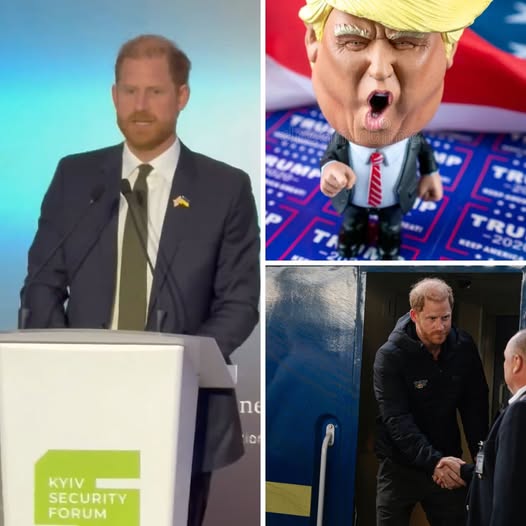
 Prince Harry’s unexpected visit to Ukraine has quickly escalated from a humanitarian gesture into an international political talking point, drawing reactions from both sides of the Atlantic. Appearing at the Kyiv Security Forum, the Duke of Sussex delivered a passionate speech emphasizing the importance of global support for Ukraine. He framed the conflict as a matter of values and sovereignty, urging continued international commitment and specifically highlighting the role of the United States in maintaining global stability.
Donald Trump launched a blistering attack on Prince Harry after the Duke urged America to honour its obligations in the Ukrainian conflict
In his remarks, Harry stressed that the U.S. has a “special role” in the conflict, referencing past international agreements tied to Ukraine’s security. He called on American leadership to “honour its obligations” and demonstrate its long-standing commitment to global security. While he did not directly name Donald Trump, the message was widely interpreted as a call for stronger U.S. involvement and responsibility.
Harry delivered a lengthy, impassioned speech at the Kyiv Security Forum on Thursday, saying he was ‘not here as a politician’ but as ‘a soldier who understands service’ and a ‘humanitarian’
Trump’s response came swiftly and bluntly. Speaking to reporters, he dismissed Harry’s position, stating: “I know one thing for sure, Prince Harry does not speak for the United Kingdom, that I can tell you.” He went even further, adding: “I think I speak for the United Kingdom more than Prince Harry.” Although delivered with a hint of sarcasm, the comment underscored a clear rejection of Harry’s perceived authority on international matters.
Britain’s Prince Harry embraces a woman as he arrives, amid Russia’s attack on Ukraine, at the railway station in Kyiv, Ukraine, on April 23
Trump did not stop there. In a more casual but pointed remark, he added: “But I do appreciate his advice,” before asking reporters, “How is he doing? How is his wife doing? Please send them my regards.” The tone, while seemingly light, was widely interpreted as dismissive, reinforcing the idea that Harry’s intervention was not being taken seriously at the highest political level.
The exchange has sparked debate in the UK, where many are questioning the implications of Harry’s statements. Having stepped back from his role as a senior working royal, he no longer represents the British monarchy in any official capacity. Yet his global visibility and royal title continue to give his words weight, creating a grey area that has become increasingly difficult to navigate.
A political analyst noted that “when someone with Harry’s profile speaks about international obligations, it inevitably carries diplomatic overtones—even if that’s not the intention.” This ambiguity is at the heart of the controversy. While Harry insists he is speaking as a former soldier and humanitarian, critics argue that the perception of representation cannot simply be separated from his identity.
The situation is further complicated by the timing of his visit. Coming shortly after a high-profile tour in Australia with Meghan Markle, and just days before King Charles was expected to travel to the United States, Harry’s intervention has been seen by some as poorly timed. Whether intentional or not, it has drawn attention at a moment when official royal diplomacy was already in focus.
Public reaction has been sharply divided. Supporters argue that Harry is using his platform to draw attention to a critical global issue and that his military background gives him a unique perspective. “He’s not wrong to speak up,” one supporter commented. “If anything, more public figures should be highlighting what’s happening in Ukraine.”
However, critics see the situation differently. Some believe that his actions risk complicating diplomatic relationships, particularly when his comments provoke responses from figures like Trump. “This is exactly the problem,” one observer remarked. “He may think he’s acting independently, but the consequences don’t exist in a vacuum. The UK gets pulled into the conversation whether it wants to or not.”
The silence from the British Royal Family has only added to the intrigue. As expected, Buckingham Palace has not commented on Harry’s visit or the subsequent remarks from Trump. This absence of response is consistent with the monarchy’s long-standing policy of political neutrality, but it also leaves space for speculation about how such situations are viewed behind closed doors.
Ultimately, Harry’s visit to Ukraine has once again highlighted the complexities of his current role. No longer a formal representative of the monarchy, yet still globally recognized as a prince, he operates in a space that is both influential and undefined. His intentions may be rooted in advocacy and awareness, but the reactions they generate show how difficult it is to separate personal voice from public identity.
As the debate continues, one thing is clear: Harry’s actions are no longer just personal choices—they are global events that carry political weight, whether he intends them to or not.