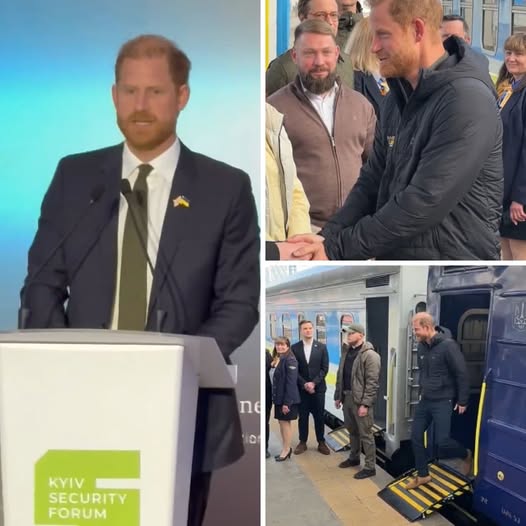
 Prince Harry’s surprise visit to Ukraine has sparked intense debate, not only because of the message he delivered but also due to the contradictions many observers believe it exposes. Arriving quietly in Kyiv, the Duke of Sussex positioned himself as both a former soldier and a humanitarian voice, calling for an end to the war and urging global leaders to take stronger action. His words were direct, even confrontational at times, as he appealed to Russian President Vladimir Putin to “stop this war” and emphasized the immense human cost of the ongoing conflict.
It is Harry’s second visit to Kyiv and third to Ukraine since war with Russia began
During his visit, Harry spoke at a security forum, framing the war as not merely a territorial dispute but a struggle over values such as sovereignty and democracy. He stressed that the world must not grow numb to the suffering of the Ukrainian people, highlighting reports of civilian casualties, displacement, and alleged war crimes. His tone suggested urgency, as though he believed global attention was beginning to drift away from the conflict. For many, this was a powerful reminder of the ongoing crisis.
‘It ¿s good to be back in Ukraine’, Harry said as he arrived this morning
However, not everyone has received his actions positively. Critics argue that Harry’s intervention raises questions about his role and authority. Since stepping back from official royal duties, he no longer represents the British monarchy in any formal capacity. Yet, his statements in Ukraine—especially those directed at world leaders—have led some to question whether he is overstepping boundaries. One commentator noted that while his intentions may be sincere, “there is a fine line between advocacy and assuming a role that carries diplomatic implications.”
The timing of the visit has also added to the controversy. Just days before traveling to Ukraine, Harry had been in Australia with Meghan Markle on a high-profile tour that blended charitable work with commercial engagements. That trip itself drew criticism, with some accusing the couple of attempting to balance royal-style appearances with private business interests. Against this backdrop, his sudden appearance in a war zone has been interpreted by some as an attempt to reinforce his image as a serious global figure.
Prince Harry has arrived in Ukraine for an unannounced visit to Kyiv
Perhaps the most contentious issue remains the question of security. Harry has previously argued that he requires publicly funded protection when in the UK due to the risks associated with his status. Yet, his decision to visit an active conflict zone has led critics to point out what they see as a contradiction. “If he can choose to enter one of the most dangerous environments in the world,” one observer remarked, “then the argument about needing taxpayer-funded security at home becomes harder for many people to accept.”
Prince Harry has made a surprise appearance at the Kyiv security forum where he made a direct plea to Vladimir Putin for peace
Supporters, however, see things differently. They argue that Harry’s military background and long-standing commitment to veterans and humanitarian causes give him a unique perspective. His involvement with initiatives supporting injured soldiers, including in Ukraine, has been well documented. From this viewpoint, his visit is not about politics but about solidarity and drawing attention to those affected by war. A former serviceman interviewed by local media suggested that “Harry understands what conflict does to people, and if he uses his platform to highlight that, it shouldn’t be dismissed outright.”
The broader public reaction appears divided. While some applaud his willingness to speak out and take risks, others remain skeptical of his motives and the consistency of his actions. The image of a prince who has distanced himself from royal duties yet continues to engage in globally visible interventions has created a complex narrative—one that is difficult to interpret in simple terms.
Ultimately, Harry’s visit to Ukraine has reignited debates about identity, responsibility, and influence. Is he a private citizen using his voice for good, or a public figure navigating a role that still carries royal weight, whether he intends it or not? The answer likely depends on perspective. What is clear, however, is that his actions continue to attract attention and provoke discussion, ensuring that his place on the global stage remains as contested as ever.