The rain had turned the roadside into a long strip of mud by the time most people noticed the dog and then chose not to notice her again.
She stood beside an old wooden utility pole with rough rope wrapped around her neck and body, tied so tightly that even lowering her head looked painful.
Her fur was soaked flat against her thin frame. Mud climbed up her legs. Every breath came small and careful, as if the rope had taught her not to move more than she had to.
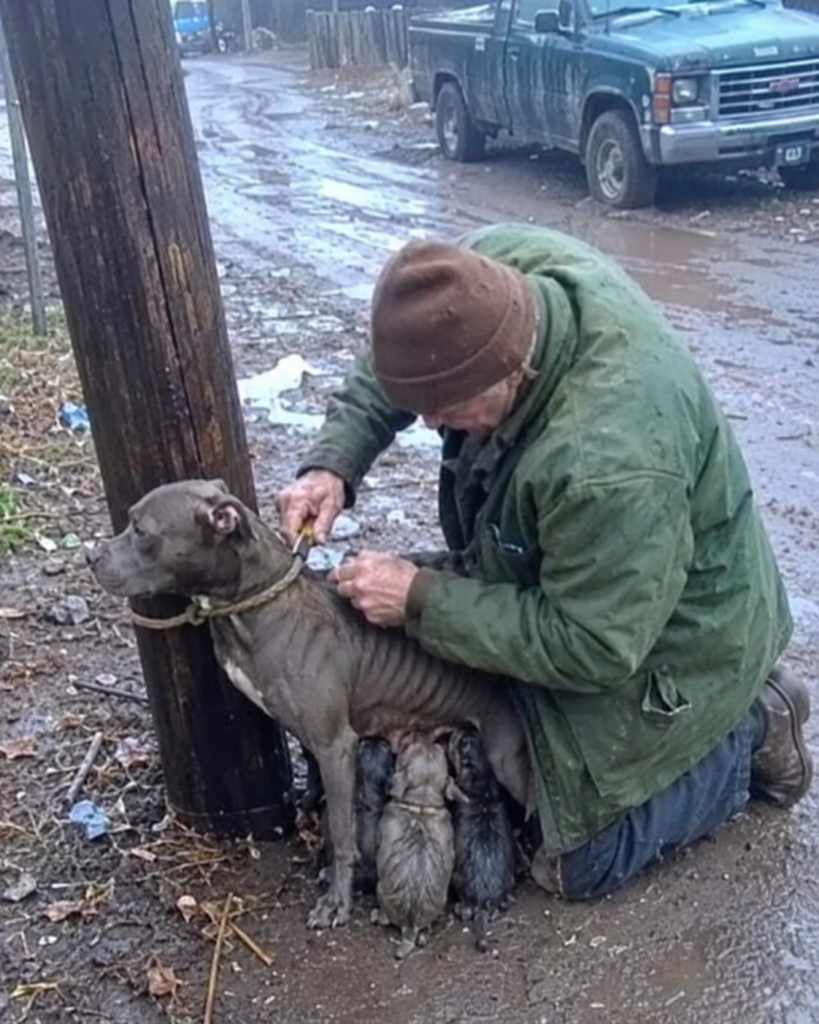
Beside her sat three tiny puppies, wet and trembling in the dirt. They were too young to understand roads, people, or why their mother could not simply walk them somewhere dry.
Whenever a car passed, the puppies lifted their heads. Whenever a motorcycle rattled by, one of them would shift in the mud, as if the sound might mean help.
But the vehicles kept going.
A pickup rolled past. A family SUV moved around a puddle and disappeared. People walking along the roadside glanced once, then fixed their eyes on the direction they had already been heading.
The mother dog did not bark anymore. If she had ever cried out, the sound had been used up before the morning came.
She only watched the road with tired eyes.
When the cold rain came harder, she fought the rope just enough to reach her puppies. Not enough to save herself. Not enough to get free. Just enough to curve her body toward them.
The rope scraped against the raw place under her wet fur. Still, she pulled until one puppy could tuck itself against her front leg and another could press its tiny face into her side.
That was the kind of care she had left.
No food. No shelter. No dry place. Only her body between the puppies and the cold.
Through the night, the puppies cried softly from hunger. The mother dog lowered her head again and again, licking mud from their faces as if each small touch could tell them to hold on.
By morning, the road had quieted into a gray, damp hush. Water dripped from the wooden pole. The mud beneath the dogs had been churned by paws, tires, and passing feet.
One puppy tried to stand, but its legs folded quickly. Another stayed pressed against its sibling without making a sound.
That was when the old vegetable seller came down the road.
He was pushing his cart toward the market, his jacket pulled close and his hands tight on the handle. The wheels bumped through the mud with a tired wooden creak.
He looked like a man with a full day ahead and no room for anything extra. Vegetables were stacked in the cart. His shoes were already dirty. His shoulders were bent from routine, not drama.
Then he saw the puppies.
He stopped.
The cart rocked once and settled in the mud. For a moment, he did not move at all. He looked at the three small bodies beside the pole, then at the mother dog tied above them.
The mother dog looked back.
There was no growl in her. No bark. No warning. She did not pull away or show her teeth. She only stood there, wet and worn down, with a kind of sadness that made the old man take one slow breath before stepping closer.
He moved carefully, setting his cart aside where it would not roll. A car passed behind him. A tire hissed through a puddle. Still, he kept his eyes on the dog.
He knelt in the mud.
At first, the puppies pressed closer to their mother’s legs. The mother dog shifted only slightly, then froze again, as if any sudden movement might make the rope hurt worse.
The old man held one hand low, palm open. He did not grab her. He did not rush. He let her see every inch of his movement before his fingers touched the rope.
It was soaked and rough. The rain had made it tighter. Mud had stiffened parts of it. The knot near her body was pulled so hard that his fingers could barely get underneath.
When he tried to lift it, the dog flinched.
The old man stopped immediately.
He waited until her breathing settled, then tried again more gently. The puppies whimpered beneath her, their little bodies shaking in the cold.
His face changed then. Not in a loud way. Not in a way that needed a speech. It was the face of someone realizing that the road had been asked a question for days, and everyone had answered by walking past.
He reached into his pocket and pulled out a small knife.
It was not a dramatic thing. It was just a working blade, the kind a man might use to cut twine, open boxes, or trim a stubborn tie around a crate.
But beside that pole, in that mud, it became the only tool that mattered.
He slid the blade under the first strand of rope. His hand shook. The dog was close enough to bite him if fear took over, but she stayed still, watching him with those exhausted eyes.
He cut one strand.
Then another.
The rope did not come away easily. It had tightened from rain and pressure, from the mother dog pulling again and again toward her puppies. Each small cut took patience.
A woman passing along the road slowed. She stood a few steps away and looked down at the puppies. A man in work boots stopped behind her. Someone else came from a nearby porch and stood near a mailbox.
No one said much.
The old man did not turn around.
He kept cutting.
The mother dog trembled, but she did not move away. The puppies shifted under her belly, still too weak to understand that the sound of the knife was not danger this time.
One by one, the strands loosened.
The old man worked the rope away from her body, careful not to drag it across the tender places where it had rubbed. He paused whenever she flinched. He lowered his voice once, not with big words, just a quiet murmur to keep her from panicking.
The final knot was the worst.
It sat close against the wet fur near her neck, packed with dirt and tightened by days of strain. He slid two fingers beneath it, held the rope away from her skin, and pressed the little blade through what was left.
For a second, nothing happened.
Then the knot snapped.
The rope dropped into the mud.
The mother dog was free.

Everyone standing by the road seemed to hold their breath at once. The puppies pressed against her legs. The old man stayed kneeling, as if he understood that freedom could frighten an animal almost as much as capture.
The mother dog did not run.
She did not bark. She did not leap away from the pole. She simply stood there, shaking, staring at the man who had cut the rope.
Then she took one slow step toward him.
He did not reach out. He did not try to claim the moment. He let her decide what came next.
The dog lowered her wet head and gently pressed it against his arm.
That small movement did what no speech could have done. The people on the roadside fell completely quiet. The puppies crowded around their mother’s legs, and for the first time, their tails began to move.
Tiny, uncertain little wags.
The old man closed his knife and wiped his hand on his jacket. Then he stood carefully and went to a nearby shop for food and water.
He came back quickly, carrying what he could. He set it down low, not too close, and stepped back. The mother dog sniffed first. She looked at him once, then bent her head.
The puppies pushed in beside her.
They ate like they had forgotten food could be real. The old man stayed nearby while they did, not crowding them, not rushing them, just making sure the bowl and water stayed where the mother could reach them.
More villagers gathered.
Some looked at the broken rope. Some stared at the mother dog’s thin body, her soaked coat, the place where she had been tied. Others looked down at the puppies and could not keep their eyes there long.
They all knew the same thing.
This had not happened in a hidden place. It had happened by the road, where people passed every day. The suffering had been visible. The crying had been close enough to hear.
And still, it had taken one old man with a vegetable cart to kneel in the mud.
He did not scold anyone.
He could have. Maybe some people expected him to. The shame was already sitting heavy around that pole, heavier than any words he might have added.
Instead, he looked at the mother dog, then at the puppies pressed against her, and said quietly, “Even animals wait for kindness longer than humans do.”
No one answered him.
Sometimes a sentence does not need an answer. Sometimes it only needs to land in the place where excuses used to be.
From that day on, the roadside changed. The villagers built a small shelter near the road for stray animals. It was not fancy. It was not a grand rescue center. It was simply a dry place where an animal could get out of the rain.
For the mother dog and her three puppies, that small shelter meant the first night without the rope. It meant the puppies could sleep against her without sinking into mud. It meant their mother could stand, turn, lie down, and lift her head without fighting a knot.
Every morning, the old vegetable seller came back.
His cart still creaked down the road. His shoes still picked up mud. He still had work to do and a market to reach. But he brought food, and he stopped long enough to make sure the mother dog and her puppies had water.
The dog learned the sound of his cart before anyone else did.
Long before he reached the shelter, her ears would lift. Her thin tail, stronger now than it had been that first morning, would begin to wag.
Not because she forgot the rope.
Because she remembered the hand that cut it.
She remembered the man who knelt when others stood by. She remembered the food placed low in the mud. She remembered being given a choice, even in the smallest way, after days of having none.
And every time that vegetable cart came down the roadside, past the pickup with the little flag decal, past the mailbox, past the place where the mud had once held her puppies, the mother dog began wagging before he arrived.
She knew that sound.
It was the sound of someone stopping.