The nurse tried not to show pity when she stepped into the waiting room and found Jordan Williams sitting alone.
He noticed anyway.
It was the slight pause at the doorway.
The quick glance toward the empty chairs.
The way her eyes softened when she realized there were no grandparents, no uncle, no nervous family circle taking turns with coffee and whispered encouragement.
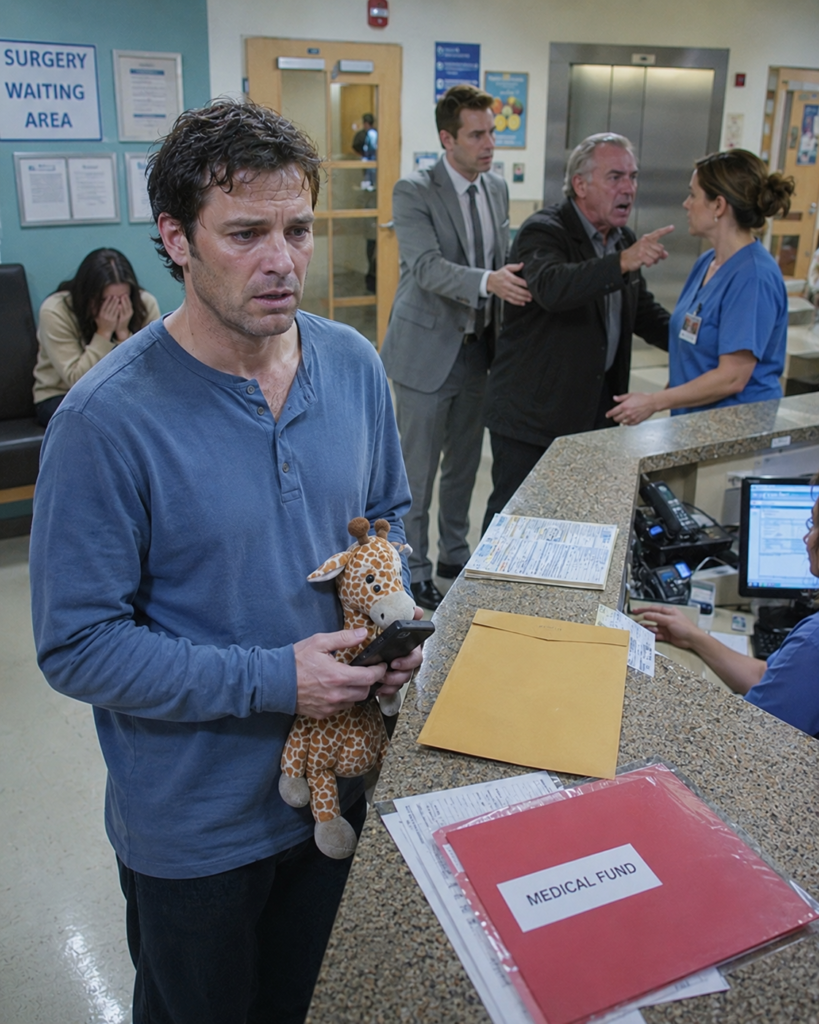
Just Jordan, hunched in a plastic chair, holding a stuffed giraffe with one bent ear.
The waiting room felt too bright and too empty.
A morning show played silently on the television mounted in the corner.
The subtitles talked about a spring salad recipe while Jordan’s six-year-old daughter lay under anesthesia behind double doors.
‘Mr. Williams?’ the nurse asked.
Jordan stood too quickly.
‘That’s me.’
‘Emma is doing well so far,’ she said.
‘The surgeon is repairing the ligament now.
It will still be a little while.’
He nodded, because nodding was easier than speaking.
Right arm reconstruction.
The phrase had sounded enormous from the first moment the surgeon said it.
Emma had fallen from the monkey bars at school and landed wrong.
The injury was not life-threatening, everyone kept reminding him.
Children healed quickly.
The procedure was routine.
Jordan wanted to believe every calm word they offered him, but routine did not matter when the child on the operating table was yours.
Before they took Emma back, she had pressed Marvin the giraffe into his hands and whispered, ‘Daddy, you’ll be here when I wake up, right?’
He had leaned close, touched his forehead to hers, and said, ‘I’ll be the first thing you see.’
He meant it.
Jordan always meant what he said to Emma.
His family, he was learning, treated promises differently.
Two weeks earlier, he had texted the family group chat with the surgery date.
He had kept the message polite, almost painfully polite.
Emma was scared.
Anyone who could visit, send a note, or record a little message for her would mean the world.
No one replied.
A week later, he sent the hospital time and address.
Nothing.
The night before surgery, after Emma had fallen asleep with her injured arm propped on a pillow, he sent one final message asking them to keep her in their thoughts.
Still nothing.
His parents lived forty minutes away.
His brother Caleb lived in the finished guesthouse behind their house because he was, as his mother liked to say, between things.
Caleb had been between things for most of his adult life.
Between jobs.
Between launches.
Between opportunities.
Between other people’s money and the next disaster.
Jordan had stopped expecting much from them, but some small, foolish part of him had hoped Emma would be different.
Children were supposed to soften people.
A hospital was supposed to matter.
Instead, he sat alone.
Jordan had been a single father since Emma was a toddler.
Her mother, Claire, had not stormed out.
She had faded.
First she missed bedtime.
Then parent-teacher night.
Then whole weekends.
One afternoon, while Emma napped, Claire packed a small bag and said she was not built for motherhood.
Jordan remembered staring at her, waiting for the panic to break through her calm voice.
It never did.
She kissed Emma on the forehead and left.
From that day on, Jordan became the constant.
He worked IT support at a law firm, took freelance network jobs at night, learned school forms, prescription doses, laundry rhythms, and how to make breakfast with one hand while answering work emails with the other.
He was not perfect, but Emma never had to wonder who would be there when she opened her eyes.
His parents had never respected that.
His mother called it admirable in a tone that made it sound like a warning.
She said Emma needed a woman’s influence.
She questioned his grocery choices, his work schedule, his messy apartment, his haircuts for Emma, his bedtime routines.
His father was quieter but colder.
He praised Jordan only when the praise could still hurt.
‘You’re doing your best,’ he would say, as if Jordan’s best were barely acceptable.
Caleb, meanwhile, could lose thousands on a bad idea and still be called visionary.
His parents paid for his failed sneaker resale business, his watch-flipping phase, his podcast equipment, his luxury coaching program, and finally his wedding, which had somehow become the entire family’s emergency.
When Jordan needed money, his father gave him paperwork.
Two years earlier, a pipe burst under Jordan’s sink during the same week Emma needed a dental procedure.
Jordan asked his parents for eight hundred dollars to get through the emergency.
His father sent a loan agreement with interest.
Jordan signed it because Emma needed care.
He paid it back early.
His parents still mentioned it whenever they wanted credit for being generous.
When the surgeon finally came out and said Emma’s procedure had gone well, Jordan nearly folded in half from relief.
He thanked the doctor too many times.
He sent one more message to the family chat.
Emma is out.
Surgery went well.
No one answered.
In recovery, Emma woke with heavy eyes and dry lips.
The first thing she did was search for him.
When she found him sitting beside her bed with Marvin in his lap, her face softened.
Then she looked past him.
‘Did Grandma come?’
Jordan felt the question settle in his chest like a stone.
He brushed damp hair from her forehead.
‘Not today, sweetheart.’
Emma blinked slowly.
She was six, but she had already learned how to protect adults from her disappointment.
‘Maybe she’s getting me a bigger balloon,’ she whispered.
Jordan smiled because Emma needed him to smile.
Inside, something broke.
He brought her home that evening and slept on the floor beside her bed, one hand resting on the mattress so she could find him in the dark.
Twice she woke in pain.
Twice her fingers closed around his before her eyes opened.
His mother did not call.
His father did not call.
Caleb posted a photo the next afternoon from a tailor’s showroom.
Champagne glasses sparkled on a small table.
Caleb wore polished shoes and an unfinished suit jacket, grinning at himself in the mirror.
His caption read: Big week.
Big moves.
Jordan stared at the picture for five seconds, then put the phone down before anger made him careless.
On the third day after surgery, he was helping Emma eat applesauce while arguing with an insurance portal on his laptop.
Emma was tucked under a blanket on the couch, her bandaged arm balanced on a pillow.
Marvin was wedged beside her shoulder like
a tiny guard.
Jordan’s phone buzzed.
Dad.
For one humiliating second, hope lifted in him.
Maybe his father had finally remembered.
Maybe guilt had arrived late but arrived.
It was only a text.
Can you send $4,000 today? Caleb’s wedding suit balance is due.
We’re stretched after covering vendors.
Jordan read it once.
Then again.
There was no question about Emma.
No apology.
No mention of the surgery.
No attempt to pretend they cared.
Just four thousand dollars.
For Caleb.
For a suit.
Jordan opened his payment app and sent twenty-five cents.
In the note, he wrote: Buy him a tie.
Then he set the phone down and began cutting them off.
He had been careless for years, partly from exhaustion and partly from the childish hope that family access meant family safety.
His father was still listed as an emergency contact on his oldest checking account.
His mother’s email remained a recovery option on an old savings profile.
The family phone plan touched a credit line Jordan used for freelance work.
Worst of all, the medical fund he had built for Emma still had his parents listed as trusted contacts from years earlier, when his father had insisted it would make things easier if Jordan were ever incapacitated.
Trusted contacts could not simply withdraw money, but they could receive information, pressure staff, and create confusion.
Jordan saw that clearly now.
He changed every password.
Removed every device.
Updated every recovery email.
Transferred Emma’s medical fund into a newly protected account.
He shut down the old permissions one by one until there was nothing left for his family to touch.
His hands shook by the end.
Not from fear.
From the strange, clean force of finally understanding.
Ten minutes later, his father called.
Jordan let it ring.
His mother called next.
He let that ring too.
Caleb texted one word: Seriously??
Jordan blocked him.
That night, after Emma fell asleep, Jordan sat in the dark kitchen and listened to the refrigerator hum.
He thought about his daughter waking from anesthesia and asking for a grandmother who had not even sent a sticker.
He thought about Caleb standing in a tailor’s mirror, celebrating himself while Emma learned how to hold a spoon with her left hand.
He thought the worst had passed.
At 7:12 the next morning, an unknown number called.
Jordan almost ignored it, then answered.
‘Mr. Williams?’ a woman said.
Her voice was careful and professional, which made Jordan’s stomach drop before she finished the sentence.
‘This is Marisol from Greenridge Community Bank.’
Jordan straightened.
‘I’m calling because your father and your brother came in as soon as we opened,’ she continued.
‘They are demanding access to your daughter’s medical fund.’
For a moment, Jordan could not speak.
Marisol lowered her voice.
‘Your father claims the money was promised to the family.
Your brother is upset.
He said the surgery was a waste because Emma is only—’
She stopped.
But Caleb’s voice carried in the background, loud and furious.
‘She’s not even a real Williams!’
Jordan went cold from the inside out.
Then he heard his father snap at Caleb to shut up.
Marisol came back on the line, quieter now.
‘Mr. Williams, I think you should come here.
They brought personal documents.’
Jordan called his neighbor, Mrs. Alvarez,
who adored Emma and had already brought soup twice since the surgery.
He explained only enough.
She was at his door in ten minutes, wearing house slippers and the expression of a woman ready to fight someone’s entire bloodline.
‘Go,’ she said.
‘I’ve got your baby.’
Jordan kissed Emma’s forehead while she slept, then drove to the bank with both hands locked around the steering wheel.
When he entered the lobby, his father stood at a desk in his church coat, face red with contained fury.
Caleb stood beside him in an expensive jacket that still had tailor’s chalk near one cuff.
His mother sat in a chair near the wall, crying silently into a tissue.
Marisol rose from behind the desk.
‘Mr. Williams.’
His father turned.
‘You embarrassed this family.’
Jordan laughed once, not because anything was funny.
‘Emma had surgery three days ago.’
His mother flinched.
Caleb rolled his eyes.
‘Here we go.’
Jordan looked at him.
‘Say it again.’
Caleb’s confidence flickered.
‘Say what?’
‘What you shouted about my daughter.’
His father stepped between them.
‘This is not the place.’
‘You made it the place when you walked into a bank to take money from a child’s medical fund.’
Marisol slid a folder toward Jordan.
‘They attempted to use these to support their claim.
To be clear, they have no access.
We did not release funds or information beyond what your old trusted-contact settings allowed, and those appear to have been revoked yesterday.’
Jordan opened the folder.
Inside was a copy of Emma’s birth certificate, an old hospital form, and a sealed envelope with his mother’s handwriting on the front.
Jordan can never know.
His lungs stopped working for a second.
He knew before he opened it.
Maybe he had known for years in some buried place where pain waits until you are strong enough to name it.
Inside was a letter dated two months before Emma was born.
It was from Claire to Jordan’s mother.
Claire had confessed that there was a chance Jordan was not Emma’s biological father.
She said she was terrified Jordan would leave her.
She said Jordan was the only stable person in her life.
She begged his mother not to tell him until after the baby was born.
Jordan looked up slowly.
His mother covered her mouth.
‘You knew?’ he asked.
She cried harder.
‘I thought I was protecting you.’
His father’s jaw tightened.
‘We were protecting the family.
You were twenty-seven.
You would have thrown your life away for another man’s child.’
Jordan stared at him.
‘I did throw my life into raising her.
That is called being her father.’
Caleb scoffed.
‘Convenient speech now, but you expect us to treat her like blood while you hoard money Caleb needs for his wedding.’
Jordan turned toward him so quickly Caleb stepped back.
‘Hoard?’ Jordan said.
‘That money is for Emma’s appointments, therapy, medication, and emergencies.
You wanted a suit.’
‘It is one day,’ Caleb snapped.
‘My wedding matters too.’
‘Your wedding mattered more to you than a child’s surgery.’
The sentence landed hard enough that even his father looked away.
Jordan looked back at the letter.
His hands had stopped shaking.
‘You are late,’ he said quietly.
His mother blinked.
‘What?’
‘I already knew there was a possibility Emma was
not biologically mine.’
All three of them froze.
Jordan folded the letter carefully.
‘When Claire left, she sent me an email.
She admitted everything.
I had a DNA test done because I needed to know what legal steps to take if she ever tried to come back and use it against Emma.’
His mother whispered, ‘You knew?’
‘Yes.’
His father looked almost offended.
‘And you said nothing?’
‘I did not owe you my daughter’s private life.’
Caleb’s mouth opened, then closed.
Jordan continued, voice steady now.
‘The test said I am not Emma’s biological father.
So I adopted her legally.
Completely.
Quietly.
Years ago.
Her birth certificate was amended.
Her medical decisions are mine.
Her fund is hers.
Her name is Williams because I gave it to her, and because I earned the right every night I held her while she cried for a mother who left.’
His mother sobbed into her hands.
His father looked stunned, then angry, because anger was easier than shame.
‘You should have told us,’ he said.
Jordan shook his head.
‘You just proved exactly why I did not.’
Marisol asked if he wanted bank security involved.
Jordan looked at his father, then at Caleb, then at the folder they had carried in like a weapon.
‘Yes,’ he said.
‘I want a report filed.
I want their names permanently flagged.
I want documentation that they attempted to access a minor child’s medical fund under false pretenses.’
His mother whispered, ‘Jordan, please.’
He looked at her, and for a second he saw the woman who had held him when he was little.
Then he saw Emma in a hospital bed asking if Grandma had come.
‘You let her think you might bring a balloon,’ he said.
‘That was the last soft thing I had left for you.’
Security escorted his father and Caleb out.
His mother followed, crying, but Jordan did not stop her.
Caleb shouted from the lobby that Jordan was ruining his wedding.
His voice echoed off the marble like a child denied candy.
By noon, Jordan had spoken to the bank manager, frozen every old connection, and contacted an attorney.
By evening, Caleb’s fiancée, Natalie, called him.
Her voice shook.
‘Did he really try to take money from Emma’s medical fund?’
Jordan did not embellish.
He told the truth.
There was a long silence.
Then Natalie said, ‘He told me you were jealous and refusing to help because he was finally happy.’
Jordan closed his eyes.
‘Emma had surgery.
They knew.’
Natalie exhaled like the air had left her body.
‘I am so sorry.’
The wedding did not happen that weekend.
Jordan heard that through a cousin, not because he asked.
His father sent one email two days later, formal and cold, accusing Jordan of tearing the family apart over a misunderstanding.
His mother left three voicemails, each one more broken than the last.
Caleb found a way to message him from a new number and wrote that Jordan had always wanted to play martyr.
Jordan saved everything for his attorney and replied to none of it.
Emma’s recovery was not easy, but it was steady.
Physical therapy made her cry the first week, then furious the second, then proud by the fourth.
She learned to squeeze a foam ball.
She learned to
lift her arm higher.
She learned that healing could hurt and still mean she was getting stronger.
One afternoon, she asked, ‘Is Grandma mad at us?’
Jordan sat beside her on the couch.
Marvin was wedged between them, his stitched smile repaired after Jordan finally loosened the seam his own hands had bent in the hospital.
‘Grandma made some choices that hurt us,’ he said carefully.
‘So we are taking space.’
Emma looked down at her brace.
‘Did I do something?’
Jordan’s heart cracked open again, but this time he knew exactly what to put into the wound.
He turned her gently toward him.
‘No.
Adults are responsible for how they love people.
You are not responsible for making them better at it.’
She considered that with a seriousness far beyond six years old.
‘You came,’ she said.
‘I will always come.’
She leaned into him, careful of her arm.
‘Then that is enough.’
Jordan held her and looked across the living room at the quiet, ordinary evidence of their life: the school drawings on the fridge, the unpaid bills stacked beside paid ones, the giraffe on the couch, the tiny pink therapy ball on the floor.
His family had tried to turn blood into a verdict.
They had treated love like an inheritance account, something to be claimed only by the people they considered legitimate.
But Jordan knew the truth now more clearly than he ever had.
Fatherhood was not a lab result.
It was not a favor.
It was not a name other people got to revoke when money became inconvenient.
It was showing up in the waiting room when no one else did.
It was being the first face your child saw when she woke up scared.
It was choosing her, fully, even after the world handed you every excuse not to.
Years later, Jordan would still wonder which warning sign should have made him cut them off sooner: the silence during surgery, the loan agreement with interest, the suit money, or the way they thought a secret could make a little girl worth less.
But whenever that question returned, Emma would reach for his hand without looking, trusting it would be there.
And every time, Jordan knew he had answered the only question that mattered.