Part 2
Then Dr. Caroline Pierce leaned into the microphone and said, very calmly, “I had a speech prepared today.”
A soft laugh moved through the stadium, the kind of polite ripple an audience gives a respected speaker before she has even earned it.
She did not smile.
“I spent three weeks writing it,” she continued. “It was about perseverance, excellence, compassion, and the long road from student to physician. All appropriate themes for a day like this.”
She rested one hand on the closed folder in front of her.
“But I’m not going to give that speech.”
The stadium quieted.
Not abruptly. Not all at once. But in a strange, rolling hush that started near the faculty seats and spread outward until even the families in the upper tiers stopped rustling programs and whispering over cameras.
I stopped breathing.
Dr. Pierce’s gaze found me again. Not for long. Just long enough to make my stomach twist.
“In medicine,” she said, “we teach our students to identify absence. A missing pulse. A missing reflex. A missing breath. Sometimes what is not there tells us more than what is.”
My fingers tightened around my phone beneath the folds of my robe.
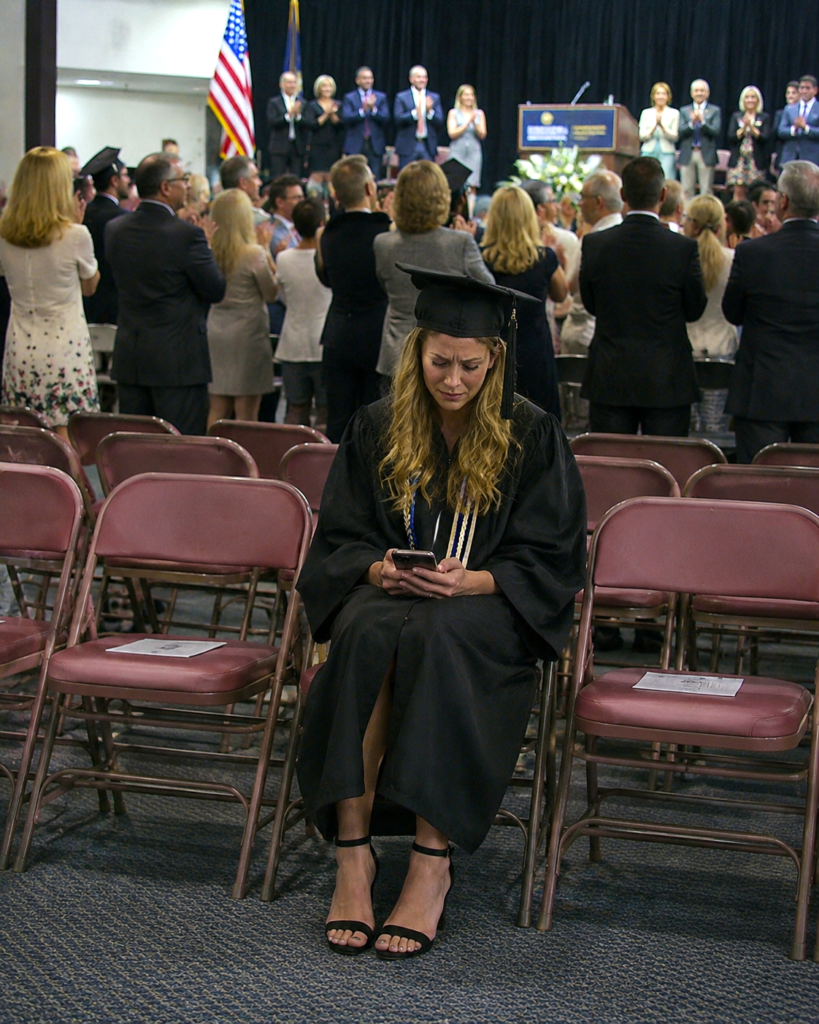
Beside me, my empty VIP seats seemed to grow larger.
“I was reminded of that just now,” she said, “when I looked out at this extraordinary class and saw one of the finest young physicians I have ever trained sitting beside four empty seats.”
A hot wave climbed my neck.
No.
Please don’t.
Please don’t make everyone look.
But of course people looked. Not the whole stadium, not dramatically, but enough. Heads turned. Eyes shifted. I felt them graze my face, my empty chairs, the folded name cards printed with my family’s names.
David Evans.
Valerie Evans.
Tiffany Evans.
Michael Evans.
My brother Michael was away at a tech conference, which was the excuse he’d given three weeks ago. My parents had not bothered with excuses once the cruise tickets were booked. Tiffany had posted a story at sunrise in a bikini, holding a coconut drink and captioning it, “Celebrating my milestone with the people who actually show up for me.”
That one had gotten over six hundred likes before I even put on my graduation robe.
I stared down at my lap, willing the earth to open.
Dr. Pierce’s voice did not change.
“I will not embarrass that student by naming her without permission. But I will say this: some people arrive at this day carried by families who sacrificed for them, cheered for them, believed in them, and reminded them they were capable when the burden became too heavy.”
She paused.
“And some arrive here after carrying themselves.”
There was no laughter now.
There was only the deep, aching silence of ten thousand people being forced to consider something uncomfortable on a day meant to be clean and triumphant.
“Some worked overnight shifts and attended anatomy lab on no sleep. Some counted coins for groceries while classmates went home to warm meals. Some hid bruising exhaustion under pressed white coats. Some were told, by people who should have known better, that their dreams were inconvenient, excessive, unrealistic, or not impressive enough to matter.”
My eyes burned.
I hated that she knew.
I loved that she knew.
And I hated that I loved it.
Because when you spend your whole life starving, even one hand offered across the table can feel like too much.
Dr. Pierce turned slightly, addressing the rows of graduates behind me.
“You are all here because you learned medicine. But some of you also learned something harsher. You learned that applause is not always waiting at the finish line. You learned that people can benefit from your strength and still resent the evidence of it. You learned that neglect can wear perfume, smile in holiday photos, and call itself family.”
Something in my chest cracked.
Not broke.
Cracked.
There is a difference.
Breaking means collapse.
Cracking means light gets in.
She lifted her chin.
“So today, before I speak of medicine, I want to speak of witnesses. Because achievement does not become real only when the right people clap for it. Your degree does not lose weight because someone failed to attend. Your name does not become smaller because someone refused to say it with pride.”
Her voice sharpened just enough that I could feel every word settle like a blade placed carefully on velvet.
“And to anyone here who has been made to feel difficult for wanting to be loved properly, let me be very clear: needing someone to show up for you is not drama.”
My mother’s text flashed in my mind.
Don’t be too dramatic.
The words dissolved into something ugly and small.
Dr. Pierce looked down briefly, then back up.
“In a few minutes, these graduates will be hooded. They will walk across this stage as doctors. Not someday. Not after residency. Not when someone finally decides their accomplishment is convenient. Today.”
The applause began somewhere far behind me.
One person.
Then ten.
Then an entire section.
Then the stadium shook.
I didn’t lift my head.
I couldn’t.
My face was wet. Silent tears slid down my cheeks and disappeared beneath the stiff collar of my regalia. I pressed my lips together so hard they hurt.
I was not crying because my parents were absent.
I had cried about that enough.
I was crying because, for the first time in my life, someone had seen the absence and called it what it was.
Not misunderstanding.
Not busyness.
Not me expecting too much.
Absence.
When Dr. Pierce finally continued, her prepared speech remained closed.
She spoke for twenty minutes without notes.
She talked about children in hospital beds who would need doctors brave enough to tell the truth gently. She talked about the humility of cutting into a body and the arrogance required to believe you could help. She talked about failure, sleeplessness, fear, and the sacred terror of being trusted.
But woven beneath all of it was a message I felt against my skin like a pulse.
You are not invisible.
When she finished, the standing ovation lasted so long the dean had to step forward twice before the crowd quieted.
The ceremony moved on.
Names were called alphabetically by specialty. Graduates crossed the stage, were hooded, shook hands, smiled for photographs.
My hands shook as my row stood.
The closer I got to the stage, the less real my body felt. My feet moved. My robe swayed. My classmates whispered congratulations around me. Somewhere above us, families screamed names into the air.
I heard mine before the announcer said it.
Not from the seats.
From the stage.
Dr. Pierce had stepped away from her place beside the faculty and moved to the hooding line.
The dean looked startled. Then amused. Then he simply nodded, because even deans knew when not to argue with Caroline Pierce.
“Clara Evelyn Evans,” the announcer read. “Doctor of Medicine. Graduating with highest honors. Matched in pediatric surgery at St. Anselm Children’s Hospital.”
For one impossible second, the entire stadium seemed to inhale.
Then my classmates erupted.
Not politely.
Not with standard applause.
They stood.
Every student in my row, then the row behind, then the row behind that. I heard someone shout, “That’s our Clara!” and someone else yell, “Dr. Evans!”
My vision blurred so badly I almost missed the first step.
Dr. Pierce waited at center stage.
She held the hood in both hands.
When I reached her, she did not say congratulations right away.
She looked at my face, at the tears I had failed to hide, and her expression softened in a way almost nobody ever got to see.
Then, low enough that only I could hear, she said, “You did not get here alone. You got here with the dead weight of them tied to your ankles. That makes this more impressive, not less.”
My breath trembled.
“I don’t know what to do with that,” I whispered.
“You don’t have to do anything with it today,” she said. “Today you let it be true.”
Then she placed the hood over my head.
The velvet settled across my shoulders, heavy and warm.
Doctor.
For one instant, the little girl in me who had studied spelling words alone at the kitchen table, who had watched Tiffany open gifts for achievements that would have been footnotes in my life, who had learned not to run toward the door when her father came home because he never looked for her first—that girl stood still inside me.
And she finally looked up.
Dr. Pierce gripped both of my hands.
“Congratulations, Dr. Evans.”
The crowd was still standing.
I should have smiled.
I tried.
What came out was something smaller and more honest.
A broken little laugh.
After the ceremony, the stadium spilled into chaos. Families flooded the aisles with balloons and flowers. People cried into one another’s shoulders. Fathers lifted daughters off their feet. Mothers adjusted crooked hoods and took too many pictures.
I walked alone through the noise, holding my diploma tube like evidence from a trial.
My phone buzzed nonstop.
For one foolish second, I thought maybe my parents had watched the livestream. Maybe my mother had heard the speech. Maybe guilt had finally crossed the ocean and found her poolside chair.
But the first message was from Tiffany.
What the hell did you do?
I stopped near a concrete pillar beneath the stadium concourse.
Another message came in.
Mom is freaking out. People are tagging us.
Then another.
Did you seriously have some doctor lady publicly humiliate us at your graduation?
I stared at the screen.
Not congratulations.
Not I’m sorry.
Not we saw you.
Only damage control.
My mother called next.
I let it ring.
Then my father.
Then Tiffany again.
Then my mother.
The phone vibrated in my hand like an angry insect.
I declined every call.
A moment later, a voice behind me said, “You are allowed not to answer.”
I turned.
Dr. Pierce stood there in her black academic robes, now holding a bouquet of white peonies wrapped in brown paper.
For me.
She held them out.
“I’m afraid the gift shop was overrun by grandparents,” she said, “so these came from the arrangement in the faculty reception area. I have stolen from a university centerpiece on your behalf.”
I took the flowers and nearly cried again.
“That’s probably a violation of something.”
“Almost certainly.”
A laugh escaped me. It sounded rusty.
Her eyes flicked to my phone as it buzzed again.
“Family?”
“Biologically.”
“Ah.”
That was all she said, but the word contained a full diagnosis.
I looked down at the flowers. “They’re angry.”
“I assumed they would be.”
“You knew they’d see it?”
“The ceremony was livestreamed. Your class is full of people with phones. And your sister appears to document breakfast with the urgency of a wartime correspondent.”
Despite everything, I snorted.
Dr. Pierce’s mouth twitched.
Then she became serious.
“Clara, I did not intend to make you a spectacle.”
“You didn’t.”
“I drew attention to pain you were trying to survive privately.”
I swallowed.
“Yes.”
“If I overstepped, say so.”
I looked past her at the families moving around us. A mother kissed her son’s cheek while he pretended to be embarrassed. An older man clutched a diploma frame to his chest as if it were sacred. A little girl held a sign that read, My aunt saves lives.
I thought of my mother in a swimsuit, texting cruelty between margaritas.
Then I looked back at Dr. Pierce.
“You didn’t overstep,” I said. “You just said it out loud before I was ready to.”
She nodded once.
“That is not always the same thing as kindness.”
“No,” I said. “But sometimes it’s the closest thing to justice.”
Her eyes warmed.
Then my phone buzzed again.
This time it was my mother’s voice message.
I don’t know what you think you’re doing, Clara, but you need to call us right now. Your father is furious. Tiffany is crying. People are accusing us of abandoning you. Do you understand how humiliating this is for us? On our vacation?
I played it on speaker before I could stop myself.
Dr. Pierce listened without expression.
The message ended.
For a second, neither of us spoke.
Then she said, “Interesting use of the word humiliating.”
Something inside me, something old and obedient, flinched at the thought of my father’s fury.
I could picture him perfectly. David Evans at a cruise ship bar, jaw clenched, wearing the linen shirt my mother bought him, angry not because he had hurt me but because other people now knew he had.
My phone lit up again.
Dad.
This time, I answered.
I don’t know why.
Maybe reflex.
Maybe rage.
Maybe because Dr. Pierce was standing beside me and I wanted, for once, to not sound like a child.
“Hello?”
My father did not greet me.
“What the hell was that?”
His voice hit me with such familiar force that my spine straightened automatically.
Behind him, I could hear music. Laughter. Wind. The cheerful noise of a deck party.
“Was what?” I asked.
“Don’t play stupid with me.”
Dr. Pierce’s eyes narrowed.
I turned slightly away, lowering my voice. “I just graduated.”
“You embarrassed this family in front of thousands of people.”
“No,” I said, and the word felt strange in my mouth. “You embarrassed this family. I sat in a chair.”
“You think you’re clever now because some surgeon gave a speech?”
“I think I’m a doctor now because I spent twelve years getting here.”
A pause.
Then my mother in the background, sharp and panicked: “Ask her if she told that woman about the cruise.”
My father came back colder.
“Did you tell her?”
“I didn’t have to.”
“That is not an answer.”
“It’s the only one you deserve.”
Silence.
My heart slammed so hard I felt it behind my eyes.
I had never spoken to him like that.
Not once.
As a child, I had learned that anger in our house belonged to my father. Tears belonged to my mother. Attention belonged to Tiffany.
I got whatever was left.
Usually the blame.
His voice dropped.
“You listen to me carefully. You are done making us look bad. You will post something immediately clarifying that we support you, that there was no issue, and that Dr. Whoever misunderstood.”
“No.”
The word came faster this time.
Cleaner.
“What did you say?”
“I said no.”
“You ungrateful little—”
Dr. Pierce extended her hand.
Not forcefully.
Just palm up.
An offer.
I placed the phone in it before fear could talk me out of it.
She lifted it to her ear.
“Mr. Evans,” she said.
The change on the other end was immediate. I couldn’t hear his words clearly, only the stunned shift in tone.
“This is Dr. Caroline Pierce,” she continued. “I understand you are upset.”
A beat.
“No, I will not apologize.”
Another beat.
“No. I do not believe your daughter manipulated me. I have known Clara for four years. In that time, I have seen her work herself past every reasonable human limit while demonstrating more discipline, grace, and moral courage than most trained attendings twice her age.”
My knees went weak.
Dr. Pierce’s voice remained surgical.
“If your concern is reputational, then I suggest you consider why the truth of your behavior is so damaging when spoken plainly.”
A longer pause.
Her eyes hardened.
“Do not threaten her.”
The air disappeared from my lungs.
“I am going to say this once,” Dr. Pierce said. “Clara owes you nothing today. Not a statement. Not comfort. Not repair. Not gratitude for injuries you expect her to call love. She is a physician. She is my resident. And if you attempt to interfere with her employment, her housing, her finances, or her professional standing, I will make certain every relevant institution understands exactly what is happening.”
She listened.
Then smiled without warmth.
“Yes. That is precisely what I mean.”
She ended the call.
For a moment, the world tilted.
She handed the phone back.
I stared at it like it had transformed into something dangerous.
“What did he say?” I asked.
“He suggested you might find residency difficult without family support.”
I laughed once, hollowly. “That’s funny. I’ve never had it.”
“Yes,” she said. “I gathered.”
My phone buzzed again almost immediately.
Dad: You have made a serious mistake.
Then:
Mom: Clara, how could you let her speak to your father like that?
Then Tiffany:
You are literally ruining my celebration.
I looked at those messages, and instead of pain, something else arrived.
Clarity.
Cold, quiet, almost peaceful.
For years I had imagined a version of this day where my parents finally understood. Where my mother cried when my name was called. Where my father stood, proud despite himself. Where Tiffany hugged me without making a joke about how doctors were boring but useful.
I had been grieving the absence of people who had never existed.
Not really.
I put my phone on Do Not Disturb.
Then I looked at Dr. Pierce and said, “Can we get out of here?”
Her answer was immediate.
“Yes.”
She took me not to the official reception, where faculty and donors waited with champagne and tiny plates of food, but to a diner six blocks from campus that looked like it had survived three recessions and a grease fire.
The sign outside read Mabel’s in flickering red letters.
Inside, the booths were cracked vinyl, the coffee was terrible, and nobody cared that I was wearing a velvet hood over a black robe.
A waitress with silver hair and cat-eye glasses looked me up and down.
“You graduate something?”
“Medical school,” I said.
She slapped both hands on the counter.
“Well, hell. Pancakes are on the house.”
Dr. Pierce said, “She will also need coffee strong enough to revive the dead.”
“Doctor coffee,” the waitress said, nodding gravely.
We sat in a corner booth.
For the first time all day, I breathed normally.
Dr. Pierce ordered black coffee and toast. I ordered pancakes, eggs, hash browns, and a milkshake because apparently grief and triumph together made me ravenous.
While we waited, she opened her bag and pulled out a small wrapped box.
I stared at it.
“No.”
“Yes.”
“You already stole flowers.”
“This was obtained legally.”
“I didn’t get you anything.”
“You were not expected to bring your mentor a gift on your own graduation day.”
“That feels uneven.”
“Most meaningful things are.”
I unwrapped it carefully.
Inside was a stethoscope.
Not just any stethoscope. A beautiful one. Matte black tubing. Silver chest piece. My name engraved along the side.
Dr. Clara Evans.
I ran my thumb over the letters.
The tears came again, but this time they were quiet.
“I bought it the day you matched,” she said.
“You knew I’d make it?”
“No,” she said. “I knew you would keep going. Those are not always the same thing.”
I held the stethoscope like it might vanish.
Then I said the thing I had been trying not to say since the ceremony.
“Why me?”
Dr. Pierce looked up from her coffee.
“Why did you help me?”
She did not answer immediately.
Outside the diner window, a group of graduates passed by in robes, laughing under the soft gold light of late afternoon.
“When I was your age,” she said, “I had a mentor who did for me what no one in my family would. He saw ability before I had proof. He protected my future when I didn’t yet know it needed protecting. I promised myself that if I ever had the chance, I would do the same for someone else.”
I waited.
There was more. I could feel it.
Her fingers turned the coffee mug slowly.
“Also,” she said, “you reminded me of someone.”
“Who?”
“Myself, before I learned that being unloved by the wrong people is not proof you are unlovable.”
The words settled between us.
My throat tightened.
“I don’t know how to stop wanting them to care,” I admitted.
Dr. Pierce’s expression did not pity me. That mattered.
“You may not stop for a long time.”
“That’s depressing.”
“It’s honest.”
I laughed faintly.
She leaned back. “But wanting something and obeying it are different. You can miss them and still not hand them the knife anymore.”
My food arrived then, saving me from answering.
For a while, we ate in silence. It was the most peaceful meal I had eaten in months.
Then my phone, still face down, began vibrating again and again and again.
I ignored it until Dr. Pierce glanced at it.
“You don’t have to look.”
“I know.”
But I did.
Not because I owed them.
Because some part of me wanted to see the shape of the storm.
There were forty-seven notifications.
Texts. Missed calls. Tags. Social media messages from relatives who had not spoken to me in years.
Aunt Marlene: Is it true your parents missed your graduation for Tiffany’s cruise?
Cousin Ryan: Dr. Pierce is a legend. Also your mom is deleting comments.
Unknown number: Hi Clara, I’m a producer with Morning Lens. We’d love to speak with you about today’s viral graduation speech.
My stomach dropped.
Viral.
I opened the app.
There it was.
A shaky video from the audience, already at 1.8 million views.
Dr. Caroline Pierce DESTROYS absent family at med school graduation.
I hated the title immediately.
She had not destroyed anyone.
She had named something.
But the internet loved destruction more than truth.
The comments were a flood.
Where was her family???
Imagine missing your daughter becoming a doctor.
“It’s not like you’re really a doctor yet” is something only a narcissist would say.
Wait is the sister the cruise influencer? Tiffany Evans? She posted about this.
No way. She’s deleting comments so fast.
I clicked Tiffany’s profile before I could stop myself.
Her latest post was from the cruise ship deck. She wore a white cover-up, oversized sunglasses, and a smile bright enough to blind judgment.
Caption: So grateful to be celebrated by my family today. Hard work pays off. Never let jealous people dim your shine. ✨
The comments were no longer worshipful.
Didn’t your sister become a doctor today?
Your parents skipped MED SCHOOL GRADUATION for this?
10k followers vs doctor daughter is crazy.
Girl delete this.
Within seconds, the post vanished.
Then Tiffany posted a story.
People are attacking me over a private family situation they know nothing about. I’ve always supported my sister. Please be kind.
I stared at the word supported until it lost meaning.
My mother posted ten minutes later.
A family photo from three Christmases ago where I stood at the edge, half-cropped out.
Caption: We are incredibly proud of both our daughters. Today has been emotional, and certain moments have been taken out of context. Clara knows we love her deeply.
Clara knows.
Did I?
Had I ever?
My father posted nothing, which was somehow worse.
Dr. Pierce watched my face.
“I can call the dean and have media requests directed away from you.”
“No,” I said.
She raised an eyebrow.
I surprised myself by saying, “I want to respond.”
“Publicly?”
“Yes.”
“You do not owe the public your wound.”
“I know.”
“And you cannot control what they do with it.”
“I know that too.”
“Then why?”
I looked at the video again. At all the strangers speaking anger on behalf of a girl they did not know. At my mother’s polished lie. At Tiffany’s performance of victimhood. At the old photo where my face was barely visible.
“I spent my whole life being edited out,” I said. “I don’t want to edit myself out this time.”
Dr. Pierce considered me for a long moment.
Then she slid a napkin across the table.
“Draft it first.”
So I did.
On a napkin in a diner, wearing graduation robes, while my pancakes went cold, I wrote the first truthful public statement of my life.
Not dramatic.
Not vengeful.
Not polished for family comfort.
Just true.
By the time I typed it into my phone, my hands had stopped shaking.
I posted it beneath my own photo from the ceremony—one a classmate had sent me of Dr. Pierce placing the hood over my shoulders.
Caption:
Today I became a doctor.
Four seats were reserved for my family. They chose not to attend. That is painful, but it does not diminish what this day means.
I am deeply grateful to the mentors, classmates, nurses, EMTs, patients, professors, and friends who helped me reach this moment. Some families are given. Some are built. Today, mine stood up.
Please do not harass anyone on my behalf. I do not need cruelty to answer cruelty.
I need rest.
And tomorrow, I begin the next chapter.
—Dr. Clara Evans
I stared at it for five full seconds.
Then I hit post.
For a moment, nothing happened.
Then the screen erupted.
Likes. Comments. Shares. Messages.
But one came through before all the others.
Dr. Pierce’s phone buzzed.
She looked at it, frowned, and answered.
“Pierce.”
Her expression shifted so subtly most people would have missed it.
I did not.
In the hospital, I had seen that look on her face before.
Bad news, but not panic.
“Yes,” she said. “When?”
A pause.
“Is he stable?”
My body tensed.
She listened.
Then her eyes moved to me.
“I’m with her now.”
A cold line ran down my spine.
“No,” she said slowly. “Do not contact the family yet.”
Family?
My hand tightened around the napkin.
Dr. Pierce ended the call and set the phone on the table.
The diner seemed suddenly too loud.
“What happened?” I asked.
She did not soften it.
“There has been an accident.”
For half a second, my mind leapt to the cruise ship. My parents. Tiffany. Some terrible, dramatic punishment written by the universe with too heavy a hand.
But Dr. Pierce said, “Your brother Michael.”
My breath caught.
“Michael?”
“He was in a rideshare leaving the airport. A truck ran a red light. He’s at St. Anselm.”
The booth disappeared beneath me.
Michael, who had missed my graduation but had at least called last night and said, awkwardly, “I’m proud of you, Clara. I know I suck at saying that stuff, but I am.”
Michael, who had escaped our family by making himself absent before they could choose not to see him.
Michael, who had sent me money once during second year with a note that said, Don’t tell Dad.
“How bad?” I asked.
Dr. Pierce’s jaw tightened.
“Head trauma. Internal bleeding. They’re taking him to surgery.”
I was already standing.
The robe tangled around my legs.
“I need to go.”
“I know.”
She threw cash on the table and guided me toward the door.
Outside, the evening had turned violet. Graduation families still moved along the sidewalks, laughing, glowing, unaware that the world had split open again.
In the car, I called my mother.
No answer.
I called my father.
No answer.
I called Tiffany.
She declined.
I sent one message to the family group chat.
Michael was in an accident. He is at St. Anselm. It is serious.
The response came from Tiffany two minutes later.
This is not funny, Clara.
Then my mother:
Do not make things up because you’re upset.
I stared at the message until my vision tunneled.
Dr. Pierce drove faster.
By the time we reached St. Anselm Children’s Hospital, where I was supposed to begin residency in three weeks, the adult trauma overflow had already redirected several emergency cases there because of a citywide collision backup.
I entered not as a doctor, not as a graduate, but as a sister.
The smell of antiseptic hit me first.
Then blood.
Then the rapid, clipped language of trauma staff moving with practiced urgency.
A nurse at the desk recognized Dr. Pierce and stood straighter.
“OR three,” she said before we even asked.
Dr. Pierce turned to me. “You cannot go in.”
“I know.”
“You are family, not staff.”
“I know.”
But knowing did not stop my body from wanting to run through every restricted door.
A trauma surgeon came out twenty minutes later.
Dr. Naveen Shah. I knew him by reputation. Calm. Precise. Kind in a tired way.
He looked at Dr. Pierce first, then at me.
“You’re Clara Evans?”
“Yes.”
“Your brother has a splenic rupture, liver laceration, and intracranial bleed. Neurosurgery is coming in. We’re controlling abdominal bleeding now.”
The words entered me clinically before they entered me emotionally.
Splenic rupture.
Liver laceration.
Intracranial bleed.
Then they became my brother.
“Is he going to live?” I asked.
Dr. Shah did not lie.
“We’re doing everything possible.”
That phrase.
The phrase doctors use when hope is still present but no longer in charge.
I sat in the surgical waiting room in my graduation robe with Dr. Pierce beside me, while my phone became a war zone.
My parents finally answered after Dr. Pierce herself called the cruise line emergency contact and had them paged.
My mother called sobbing.
Not about Michael at first.
About whether people online would think they ignored the message.
“They’re saying we didn’t believe you,” she cried. “Clara, you have to tell people we didn’t know.”
I looked at the clock.
Michael had been in surgery for forty-one minutes.
“You didn’t believe me,” I said.
“We thought you were being emotional.”
“My brother may die.”
A sharp inhale.
“Don’t say that.”
“Why? Because it sounds bad?”
“Clara, please. We are trying to get flights.”
“Good.”
“Your father is very upset.”
I almost laughed.
Of course he was.
The world had inconvenienced him twice in one day.
“When will you be here?” I asked.
“We have to dock first. The cruise staff is checking options.”
Dock.
Options.
The absurdity of it nearly knocked me sideways.
“How long?”
“At least tomorrow night.”
Tomorrow night.
Michael was in surgery now.
I closed my eyes.
“Keep your phone on,” I said.
“Clara, wait. You need to take down that post. This is not the time for family drama.”
I opened my eyes.
There it was.
Even now.
Even with Michael on an operating table.
The family image came first.
“No,” I said.
My mother’s crying stopped so suddenly it felt rehearsed.
“What?”
“I said no.”
“You are punishing us.”
“I am sitting in a hospital waiting room while surgeons try to save Michael’s life.”
“Then act like part of this family.”
I looked down at my robe. At the hood still around my shoulders. At the stethoscope box Dr. Pierce had tucked carefully into her bag.
“I did,” I said. “For twenty-eight years.”
Then I hung up.
Hours passed.
Graduation day became night.
The velvet robe came off eventually. Dr. Pierce folded it over the chair beside me with more care than my mother had ever used handling anything of mine.
At 11:17 p.m., Dr. Shah returned.
Michael was alive.
Critical, sedated, unstable—but alive.
I covered my face with both hands and shook so hard Dr. Pierce put an arm around my shoulders.
Not tight.
Just enough.
“He will need further monitoring,” Dr. Shah said. “The next twenty-four hours are important.”
“Can I see him?”
“For a few minutes.”
Michael looked smaller in the ICU.
That was the first thought that hurt.
My brother had always been tall, angular, restless. Now he was pale beneath tubes and monitors, half his face bruised, his head bandaged, machines breathing rhythm around him.
I stood by his bed and took his hand.
“Hey,” I whispered. “You picked a dramatic way to avoid my graduation reception.”
The ventilator answered.
I laughed through tears.
“You called me last night,” I said. “You said you were proud of me.”
His fingers did not move.
“I’m going to hold you to that, okay? You don’t get to say one emotionally healthy thing and then leave.”
Behind me, Dr. Pierce stood near the door, silent.
I stayed until the nurse gently told me time was up.
Back in the waiting room, I found three missed calls from an unknown number.
Then a text.
This is Elaine Monroe, legal counsel for your grandmother’s estate. I apologize for contacting you on such a difficult day, but your graduation statement has prompted several urgent developments. Your presence is requested tomorrow regarding the Evans Family Trust.
I read it twice.
Grandmother’s estate?
My grandmother Eleanor had died when I was seventeen.
My father’s mother.
Cold pearls, sharper eyes, a woman who sent birthday cards with checks and once told me, while my parents argued in the next room, “You are the only one in this family who understands the cost of silence.”
I had not thought about her in years.
I showed the message to Dr. Pierce.
Her brows drew together.
“Did you know there was a trust?”
“No.”
Another text arrived from the same number.
You should also know this before your parents arrive: Dr. Evans, you were named primary beneficiary ten years ago. Your father has been concealing the terms.
The room went still.
I could hear the ICU monitors through the wall.
My phone buzzed one final time.
A scanned document appeared.
At the top was my grandmother’s signature.
Below it, a line that made my blood turn cold.
Distribution of medical education fund and residential property to Clara Evelyn Evans, contingent upon completion of medical degree.
My medical degree.
The one I had nearly lost because my father refused to co-sign loans.
The one I had paid for with exhaustion, debt, and bloodshot mornings.
The one my mother had mocked from a cruise ship.
My father had not simply failed to help me.
He had hidden the help meant for me.
I looked up at Dr. Pierce.
For the first time all day, she seemed genuinely surprised.
Then footsteps pounded down the hall.
A nurse called my name.
“Dr. Evans?”
I turned.
She was pale.
“Your brother is awake. He’s asking for you.”
I moved before thought could catch me.
But halfway to the ICU doors, my phone rang again.
This time, the caller ID showed my father.
I stopped under the fluorescent lights, caught between Michael’s room and the secret my father had buried for a decade.
Then I answered.
His voice came through low and furious.
“Clara,” he said, “do not speak to that lawyer.”
And from somewhere behind the ICU doors, my brother screamed.