Dr. Richter set the brass transit plate down on Raymond’s workbench with the care of a man handling a newborn.
His hands were still shaking.
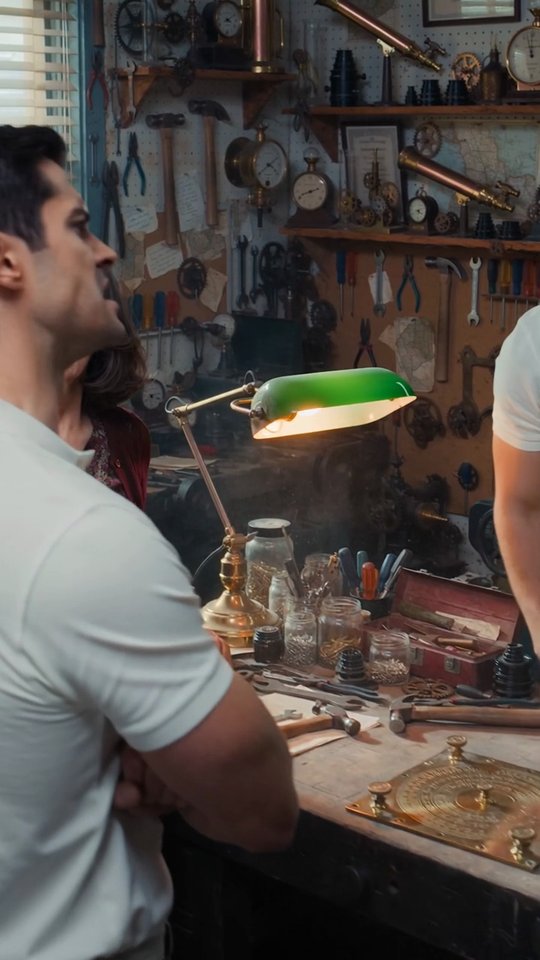
“Mrs. Lindholm,” he said quietly, “do you know what this is?”
I shook my head.
“Raymond called it a transit plate,” I said. “He bought it at an estate sale in Dubuque about fifteen years ago.”
Dr. Richter pulled a jeweler’s loupe from his briefcase and bent close to the engraved surface.
He was silent for a long time.
When he straightened, his eyes were bright.
“This isn’t just a transit plate,” he said. “This is a brass surveying instrument made by William J. Young in Philadelphia, circa 1848. Young only produced about thirty of these before his workshop burned down. Most were lost or melted for scrap during the Civil War.”
I stared at him.
“There are maybe five known examples in museum collections,” Dr. Richter continued. “Your husband found a sixth.”
My legs felt unsteady.
I sat down on Raymond’s stool.
“How much is it worth?” I asked.
Dr. Richter smiled gently.
“To a collector? Perhaps twelve to fifteen thousand dollars. To a museum or university? Priceless as a teaching instrument and historical artifact.”
The workshop seemed to tilt around me.
“But that’s not why I’m shaking,” Dr. Richter said.
He gestured to the shelves.
“Mrs. Lindholm, every instrument in this room is authentic. Your husband had an extraordinary eye. This sextant is an 1870s Troughton & Simms. That theodolite is a Gurley from the 1890s. The telescope by the window is a four-inch Clark refractor worth more than most people’s cars.”
I couldn’t speak.
“Raymond never told you?” Dr. Richter asked softly.
I shook my head.
“He just said he liked old instruments,” I whispered. “He’d come home from estate sales with something wrapped in newspaper, and he’d spend hours cleaning it, researching it. But he never talked about value. He just talked about how beautiful they were.”
Dr. Richter nodded.
“That sounds like Raymond,” he said. “He loved these instruments for what they represented—human beings reaching toward the stars with nothing but brass and glass and mathematics.”
My throat ached.
“Why are you here?” I asked. “Jenna said she ran into you at the coffee shop.”
Dr. Richter hesitated.
“Your daughter was upset,” he said carefully. “She said you’d had an argument with her fiancé about these instruments. She seemed confused. Hurt.”
I looked down at my hands.
“She thinks I care more about her father’s things than I care about her,” I said.
“Do you?” Dr. Richter asked.
The question was gentle, but it cut deep.
I thought about the last four years.
The silent house.
The Wednesday evenings in the workshop, polishing brass until my hands smelled like metal and oil.
“I don’t know how to let him go,” I said finally. “Every time I pick up one of these instruments, I feel like he’s still here.”
Dr. Richter pulled up Raymond’s old wooden chair and sat down across from me.
“Mrs. Lindholm,” he said, “Raymond didn’t collect these instruments to build a museum. He collected them because they connected him to something larger than himself.”
He paused.
“But he also had a family. A daughter. A wife. He didn’t love these instruments more than he loved you.”
I wiped my eyes.
“I don’t know how to share this with Jenna,” I said. “She thinks I’m clinging to junk. Her fiancé thinks I’m a foolish old woman.”
Dr. Richter leaned forward.
“May I make a suggestion?” he said.
I nodded.
“The college is building a new observatory,” he said. “We’re creating a small museum gallery to house historical instruments. We’ve been looking for a cornerstone donation, something with local significance.”
He gestured to the brass transit plate.
“If you were willing to donate this piece, we would display it with a plaque honoring Raymond’s memory. His name. His passion. His legacy. And we’d invite you and your family to the dedication ceremony.”
My heart clenched.
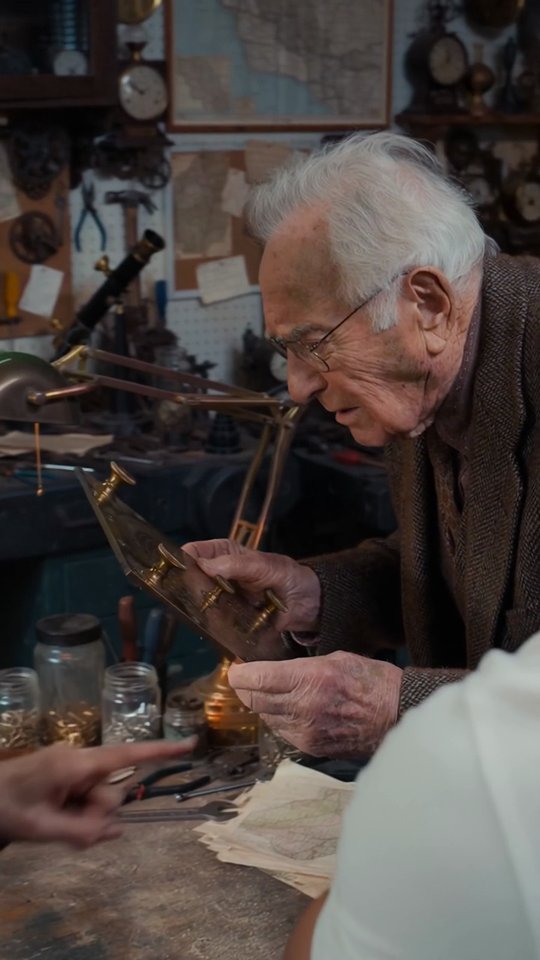
“You want me to give it away?” I whispered.
“I want you to let it do what Raymond would have wanted,” Dr. Richter said gently. “I want it to teach. To inspire.”
I looked at the transit plate gleaming under the lamp.
I thought about Trevor’s sneer, his dismissive laugh.
I thought about Jenna’s angry voice on the phone.
And I thought about Raymond standing in the field behind our house, his eye pressed to the telescope, his hand reaching back to pull me close so I could see Jupiter’s moons.
“Yes,” I said. “I’ll donate it.”
Three weeks later, I stood in the new observatory gallery with Jenna beside me.
She hadn’t spoken to me much since our argument.
Trevor hadn’t come to the ceremony.
Jenna had told me two days earlier that they were “taking a break.”
Now we stood in front of a glass case holding the brass transit plate.
The plaque beneath it read: “Donated in memory of Raymond Lindholm, 1947–2019. Machinist, astronomer, and seeker of light.”
Jenna’s eyes were wet.
“I didn’t know Dad collected things like this,” she said quietly. “I thought they were just old tools.”
I put my arm around her shoulders.
“He never talked about the value,” I said. “He just talked about the beauty.”
Jenna wiped her eyes.
“Trevor said you were wasting your time out in that workshop,” she said. “He said you were holding on to junk because you couldn’t move on. I think I believed him. I’m sorry, Mom.”
I pulled her close.
“You were worried about me,” I said. “That’s not something to apologize for.”
“But I should have trusted you,” Jenna said.
I looked at the transit plate behind the glass.
“Your father taught me that the things we love don’t have to make sense to other people,” I said. “They just have to matter to us.”
We stood there together, looking at the brass instrument that had traveled from a Philadelphia workshop in 1848 to a field in Iowa.
Dr. Richter approached with two glasses of sparkling cider.
“The students are already asking questions about the transit plate,” he said. “One young woman wants to write her senior thesis on nineteenth-century surveying instruments.”
He smiled at me.
“Raymond would be proud,” he said.
I thought about my husband in his workshop, polishing brass, filling notebooks, reaching toward the stars.
“Yes,” I said. “He would.”
That night, Jenna helped me sort through the rest of Raymond’s collection.
We decided to keep the telescope.
We donated three more pieces to the college.
We sold two instruments to a private collector Dr. Richter recommended, and used the money to establish a small scholarship in Raymond’s name for students studying astronomy.
And we kept the workshop intact—not as a shrine, but as a place to remember.
Last Wednesday evening, Jenna came by with takeout and a bottle of wine.
We sat in the workshop together, and she asked me to tell her stories about her father.
I told her about the night he showed me Saturn’s rings for the first time.
I told her about the estate sale in Dubuque where he found the transit plate, how he’d called me from the road, breathless with excitement.
And Jenna listened.
When I finished, she picked up one of Raymond’s old journals and opened it carefully.
“Mom,” she said, “can I come by next Wednesday? I want to learn what these instruments are called. I want to understand what Dad loved.”
I reached across the workbench and took her hand.
“Yes,” I said. “I’d like that very much.”
Outside, the Iowa sky was clear and full of stars.
And in the workshop, surrounded by brass and glass and the memory of a man who’d loved the heavens, I finally understood what Raymond had been trying to teach me all along.
The things we love are never junk.
They’re light we carry forward.
And if we’re lucky, we find someone willing to carry that light with us.