I spent Sunday morning in my workshop, the brass telescope sitting on a wool blanket beside my coffee mug. The leather scroll case had left a faint ring of oxidation inside the lens barrel—evidence it had been wedged there for years, maybe decades.
But my grandfather had died in 1987. The journal page referenced a timber sale dated six weeks ago.
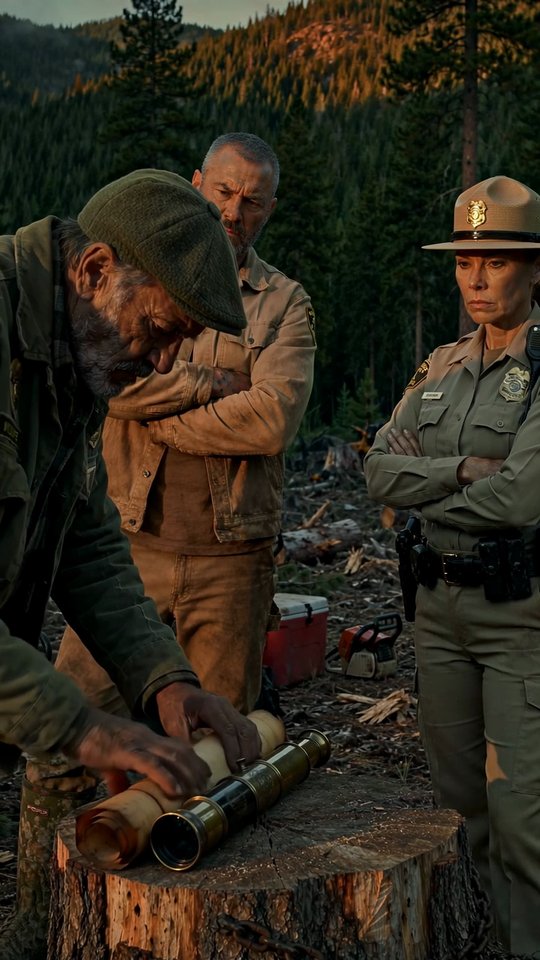
The math didn’t work.
I unrolled the scroll again, studying the handwriting under my desk lamp. The ink was iron-gall, the kind used in fountain pens before the 1990s. The paper had deckled edges, probably torn from a field notebook.
At the top, in careful block letters: “Parcel 14-C. Survey complete. Buyer: Cascade Timber LLC. Amount: $22,800.”
Below that, a hand-drawn map showing the clearing, the easement boundary, and a small X marked “cairn.”
And at the bottom, in faint pencil: “Echo returns home.”
I’d seen my grandfather’s handwriting a thousand times—field reports, birthday cards, margin notes in his Audubon guides. This wasn’t his hand. The letters were too modern, the spacing too even.
Someone else had written this page. But they’d known about Echo.
I called Iris.
“The forgery analysis came back,” she said. “Vincent Gallo’s signature was traced from a 2019 retirement letter. Someone scanned it and pasted it onto the contract.”
“Who filed the contract?”
“A junior acquisitions clerk named Wyatt Drummond. He left the agency three months ago. We’re trying to locate him.”
I hung up and drove back to the clearing. The morning was cold, the sky the color of wet slate. I parked beside the cairn and walked the perimeter again, looking for anything I’d missed.
That’s when I saw the second owl.
Smaller than Echo-7. Younger. Perched on a low branch about thirty feet away, watching me with that same unblinking stare.
No band on its leg.
I pulled out my field camera and zoomed in. The owl’s plumage showed the mottled brown-and-white pattern of a juvenile northern spotted—maybe two years old.
Then Echo-7 landed on the branch beside it.
Mother and offspring.
I lowered the camera slowly, my chest tightening. Spotted owls don’t migrate. They stay within a few square miles their entire lives, nesting in the same old-growth corridors generation after generation.
If Echo-7 was here, this was her territory. Which meant the logging had destroyed her nesting zone.
I spent the next hour searching the surrounding forest. I found three more fresh stumps, all outside the easement boundary but within Echo’s hunting range. Whoever had cut the trees had known exactly where the legal line was—and had stayed just inside it.
Almost.
I found the mistake a hundred yards west: a single ponderosa stump, massive and ancient, sitting five feet inside the easement marker.
I photographed it from every angle, then called Iris again.
“They crossed the line,” I told her. “One tree inside the easement. That voids the whole contract.”
She was quiet for a moment. “I’ll send a survey crew tomorrow. If you’re right, we can file for breach and demand restoration.”
I stayed in the clearing until dusk. Echo-7 and her juvenile hunted together, gliding silently between snags, their wingbeats soft as breath. I thought about my grandfather, spending forty winters in his fire tower, watching the forest for threats.
He’d known this land better than anyone. He’d filed the easement paperwork himself, walked every boundary line, documented every nesting pair.
And he’d left me the telescope.
That night, I spread the journal page on my kitchen table and studied it under a magnifying glass. The ink showed no signs of aging—no foxing, no UV fade. This page had been written recently, then artificially distressed.
But the information was accurate. The coordinates, the parcel number, the buyer’s name—all real.
Someone had wanted me to find this.
Tuesday morning, Iris called with an edge in her voice.
“We found Wyatt Drummond,” she said. “He’s in Missoula, working for a land trust. Says he never filed that timber contract—says his digital signature was stolen from the agency server.”
“Who had server access?”
“Fifteen people. We’re auditing all of them.”
I drove to the refuge headquarters that afternoon. Iris met me in the parking lot, holding a manila folder.
“Survey crew confirmed your find,” she said. “One tree inside the easement boundary. Contract’s void. We’re filing criminal charges against Cascade Timber for trespass and fraud.”
“What about the forged signature?”
She opened the folder and handed me a printout. “We traced the digital file back to an IP address in Bozeman. Registered to a property management company.”
I scanned the page. The company name was familiar: Gallo & Sons Property Trust.
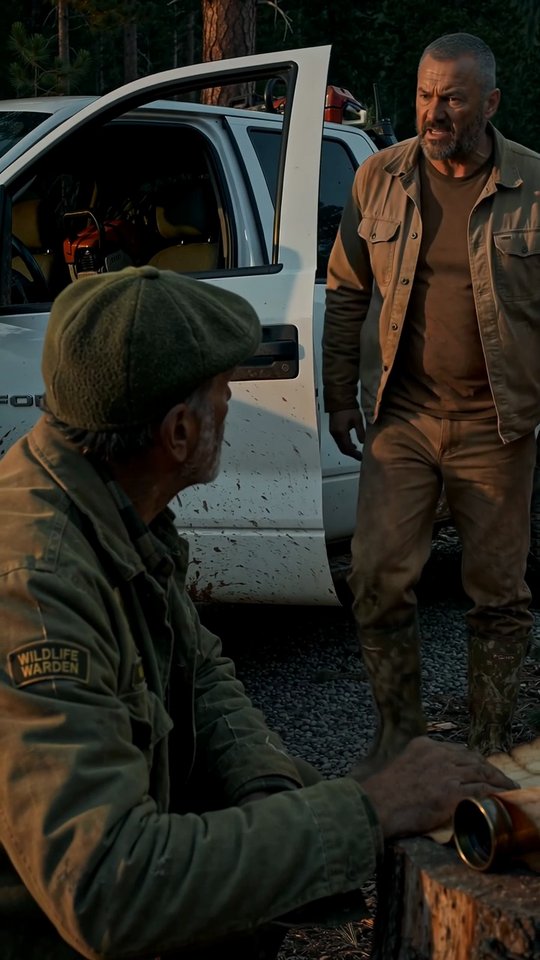
“Vincent Gallo’s family trust,” I said slowly.
Iris nodded. “His nephew runs it now. Guy named Marcus Gallo. We’re bringing him in for questioning.”
I thought about the journal page, the telescope, the cairn. “Marcus would have known about the easement. He grew up hearing his uncle’s stories.”
“That’s what we’re thinking,” Iris said. “He saw an opportunity—protected land, low oversight, forged his uncle’s signature to authorize the sale. Probably planned to pocket the cash and disappear before anyone noticed.”
“But someone noticed.”
She looked at me. “You noticed.”
I drove home in silence, the folder on my passenger seat. When I pulled into my driveway, I saw a white sedan parked across the street. A man in a gray suit stood beside it, watching my house.
I got out slowly.
The man walked toward me, hands in his pockets. Fifties, wire-rimmed glasses, the careful posture of someone used to courtrooms.
“Caleb Montgomery?” he asked.
“That’s me.”
He pulled out a business card. “I’m Leonard Voss. I represent the Gallo family trust. I’d like to talk about the telescope.”
I stared at him. “What about it?”
“It belonged to Vincent Gallo’s father,” Voss said. “When Vincent died last year, the estate couldn’t locate it. We believe it may have been misplaced during the refuge inventory transfer.”
“My grandfather owned that telescope,” I said. “He bought it in 1954.”
Voss shook his head. “Our records show it was a Gallo family heirloom, donated to the fire lookout program in 1961. Your grandfather may have used it, but it was never his personal property.”
I felt my jaw tighten. “You’re here to take it back.”
“We’re here to recover family property,” Voss said evenly. “But we’re also prepared to offer a settlement. Drop your involvement in the timber case, and we’ll let you keep the telescope.”
I looked at him for a long moment. Then I turned and walked into my house.
I came back out carrying the brass telescope and the leather scroll case.
Voss’s eyes lit up.
I handed him the telescope.
“Take it,” I said. “But I’m keeping this.”
I held up the scroll case.
Voss frowned. “That’s part of the estate—”
“This is evidence,” I said. “And it’s going to the prosecutor.”
His face went pale. He took the telescope and walked back to his car without another word.
I called Iris immediately.
“They just tried to buy my silence,” I told her. “Which means they know the journal page is real.”
“We arrested Marcus Gallo an hour ago,” she said. “He confessed to everything—forged the signature, bribed the contractor, filed the fake paperwork. He needed cash to cover gambling debts.”
“What about the journal page?”
Iris hesitated. “That’s the strange part. Marcus says he didn’t write it. Says he has no idea how it got into the telescope.”
I hung up and sat on my porch steps, watching the light fade over the mountains.
The next morning, I drove back to the clearing one last time. Echo-7 was there, perched on her favorite snag. The juvenile was gone—probably off establishing its own territory.
I stood beside the cairn and thought about my grandfather, alone in his fire tower, scanning the forest for smoke. For threats. For home.
And I thought about the journal page, written in modern ink on old paper, hidden inside a telescope that had passed through three generations.
Someone had known I would find it.
Someone had known I would follow Echo home.
I looked up at the owl.
She called once—a soft, descending whistle—and lifted off into the morning light.
I didn’t follow her this time.
I already knew the way.