I sat in my kitchen that night, staring at Otto’s email on my laptop screen.
The blue glow hurt my eyes.
Naomi Brenner had sent a photograph: Adelaide Kurz standing in a Munich conservatory hall in 1936, holding the same flamed-maple cello.
The resemblance was unmistakable—the hand-carved scroll, the honeyed varnish, the delicate purfling along the edges.
I zoomed in on Adelaide’s face.
She looked young, maybe twenty-five, with dark eyes and a serious expression.
I wondered what had happened to her.
Otto’s note said Adelaide had been forced to surrender the cello in 1937 when her family fled Germany.
She survived the war, emigrated to Canada in 1949, and died in 1983 without ever recovering the instrument.
Naomi had grown up hearing stories about her grandmother’s lost cello.
She had spent over a decade tracking provenance records, auction catalogs, estate sales.
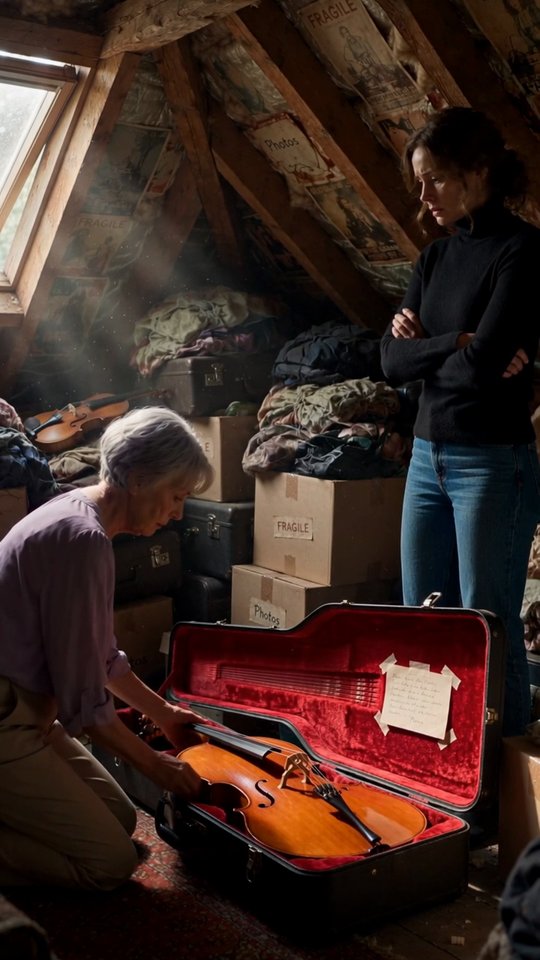
And now, by sheer accident, I had found it in a dead woman’s attic in Lawrenceburg, Indiana.
I closed the laptop and walked to the front parlor.
The cello stood in its open case against the wall.
I ran my fingers over the smooth wood.
I thought about Miriam, about her arthritic hands struggling through scales every Thursday.
I thought about the cream-colored card taped inside the lid: *For Gretchen, who never gave up on me.*
How had Miriam come to own this cello?
Had she known its history?
Or had she bought it innocently at some estate sale decades ago, never suspecting it was stolen?
I didn’t have answers.
But I knew what I had to do.
The next morning I called Naomi in Toronto.
Her voice was careful, guarded.
I explained everything—Miriam’s death, the attic discovery, Otto’s inspection, the handwritten label inside the f-hole.
Naomi was silent for a long moment.
Then she asked if I was certain it was the same instrument.
I read her the label word for word: *Property of Adelaide Kurz, Munich, 1937.*
She started crying.
I heard her set down the phone, blow her nose, pick it back up.
She said her grandmother had talked about that cello every single day.
She said Adelaide had taught music in a Toronto community center for thirty years, always using borrowed instruments, always missing the one that had been hers.
I told Naomi I wanted to return the cello to her.
She asked if I was sure.
I said yes.
Then I told her about Pauline’s accusation, about the lawyer’s letter threatening a lawsuit.
Naomi’s voice hardened.
She said she had documentation—photographs, letters, affidavits from Holocaust restitution researchers.
She said she would handle Pauline.
I felt a weight lift from my chest.
We agreed to meet the following week in Cincinnati.
Otto offered to facilitate the handover and authenticate the provenance officially.
On Thursday morning I drove to the conservatory.
Naomi was waiting in Otto’s workshop.
She was tall, late forties, with dark curly hair and Adelaide’s serious eyes.
I carried the cello case inside.
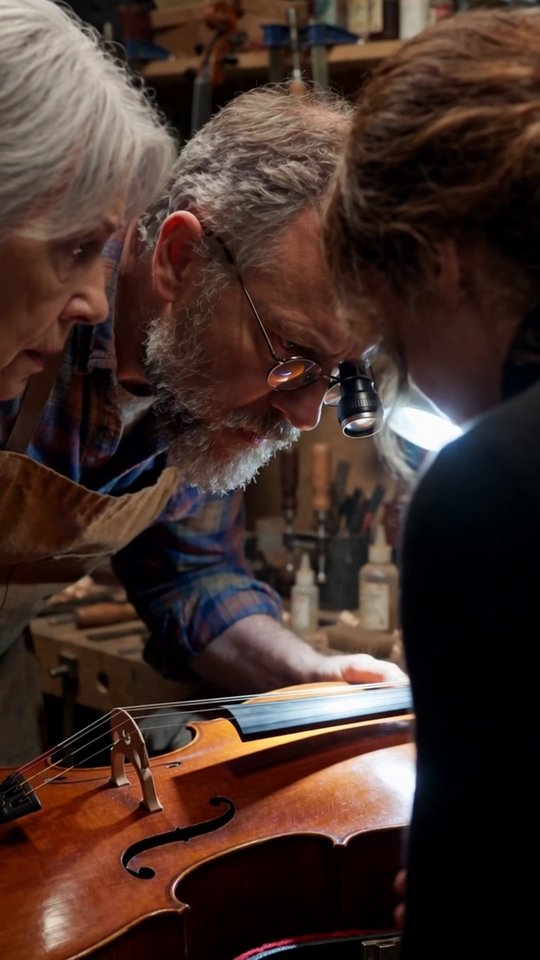
Otto opened it on his workbench.
Naomi stared at the instrument for a long time without speaking.
Then she lifted it carefully, cradled it against her shoulder, and drew the bow across the strings.
The sound filled the room—warm, resonant, impossibly alive.
She played a slow Bach prelude.
I recognized it from my teaching days.
Tears ran down her face, but she didn’t stop playing.
When she finished, Otto handed her a folder of documents.
He had traced the cello’s journey: confiscated in Munich, sold to a private collector in Zurich, resold in New York in 1954, purchased by a retired dentist in Cincinnati in 1958, and finally acquired by Miriam Schaefer at an estate auction in 1959.
Miriam had paid three hundred dollars for it.
She had no idea it was looted.
Naomi read the documents, then looked at me.
She said her grandmother would have liked me.
She said Adelaide always believed in teachers who showed kindness to struggling students.
I felt my throat tighten.
Naomi reached into her purse and pulled out a check.
She said she wanted to compensate me for the lessons I’d given Miriam, for the care I’d shown.
I shook my head.
She insisted.
The check was for five thousand dollars.
I tried to refuse, but Naomi folded my hands around it.
She said it was a gift from Adelaide, delivered seventy years late.
Later that afternoon, Pauline’s lawyer called.
His tone was clipped, aggressive.
He said Pauline was prepared to sue for wrongful conversion and undue influence.
I told him to contact Naomi Brenner’s attorney.
I gave him the number.
He hung up.
Three days later, Otto emailed me again.
Pauline had withdrawn her claim.
Naomi’s documentation was irrefutable.
The cello legally belonged to Adelaide Kurz’s estate, and Naomi was the sole heir.
Pauline sent me a terse apology via her lawyer.
I didn’t respond.
Last week I received a package from Toronto.
Inside was a framed photograph of Adelaide holding the cello in 1936.
Naomi had written on the back: *Thank you for bringing my grandmother home.*
I hung the photograph in my front parlor, next to the music stand where Miriam used to sit every Thursday at four o’clock.
Sometimes I look at Adelaide’s serious eyes and wonder if she knew, somehow, that her cello would find its way back.
That a retired teacher in a small Indiana town would open a case in a dusty attic and set in motion a journey across decades and continents.
That kindness, in the end, would be the thing that mattered most.
I still teach occasional lessons in my parlor.
I still charge less than I should.
And every time a student struggles through a scale, I think of Miriam’s arthritic fingers and Adelaide’s lost cello and the strange, beautiful way the past refuses to stay buried.