I sat in my car outside the tax office for twenty minutes, staring at the photograph of my father and George Whitman standing on the jetty in 1979.
The promise.
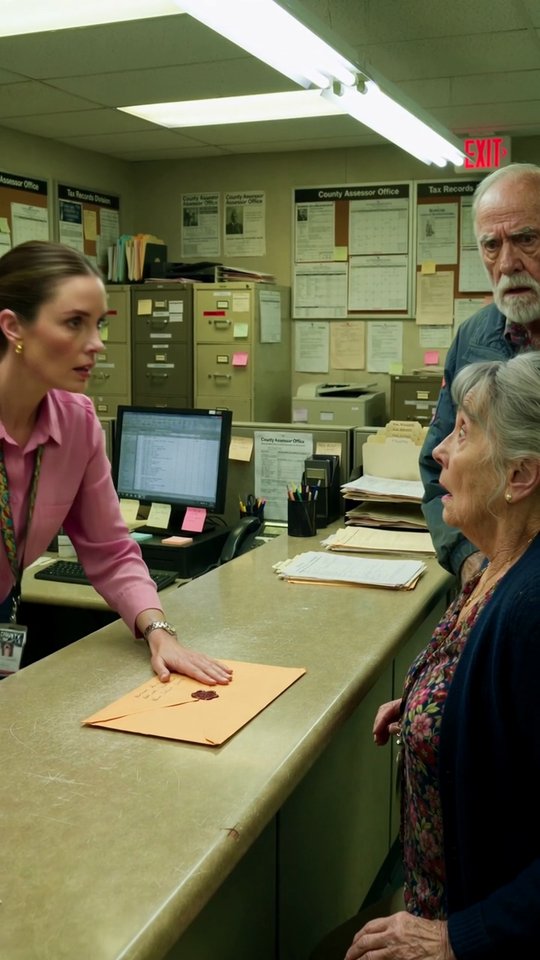
What promise had my father asked this stranger to keep for forty-five years?
I drove home to the old keeper’s cottage, the same house where I’d grown up watching my father climb the lighthouse stairs every evening to check the lamp.
The cottage smelled like saltwater and old pine boards.
I spread the logbook photocopy and the photograph on the kitchen table under the window that faced the marsh.
November 14, 1979.
I would have been twenty-eight that year, newly divorced, working at a cannery in Wilmington.
I rarely came home.
My father never mentioned a storm surge or a boundary survey.
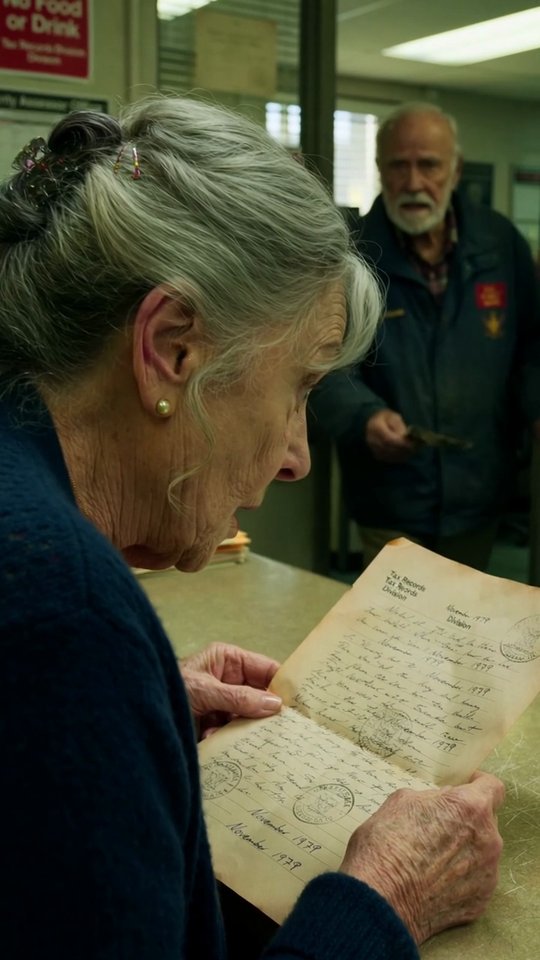
But here was his handwriting, clear and deliberate, documenting the exact moment he discovered Lot 14-B fell within the Federal Coastal Marsh Trust.
I pulled out the tin recipe box my mother had kept on the counter, the one I’d never thrown away even though most of the index cards inside were stained and illegible.
I dumped the cards onto the table.
Underneath them, folded into a tight square, was a Western Union telegram dated November 16, 1979.
Two days after the logbook entry.
It read: “Survey confirmed. Federal trust applies. Do not sell. Do not abandon. Whitman will hold proof. – USCG District Office.”
My hands shook.
My father had known for forty-five years that the land couldn’t be taken.
But he’d never told me.
He’d just left a note in his peacoat and trusted I’d keep paying the taxes.
Why?
I heard a knock on the front door.
I wasn’t expecting anyone.
I walked to the door and opened it.
George Whitman stood on the porch, the same man I’d seen on the museum bench three weeks ago.
He was older now, his face deeply lined, his white beard neatly trimmed.
He wore the same faded Coast Guard windbreaker.
“Mrs. Pendleton,” he said quietly. “May I come in?”
I stepped aside.
He walked into the kitchen and looked at the logbook page and the telegram spread on the table.
“You found them,” he said.
“You left the envelope at the tax office,” I said. “Why now?”
He sat down slowly in the chair my father used to occupy.
“Because the developer filed a quiet-title lawsuit last week,” he said. “I’ve been monitoring the county records online. When I saw his claim, I knew it was time.”
“Time for what?”
“To keep the promise I made to your father.”
He reached into his jacket and pulled out a second logbook page, this one in a plastic sleeve.
November 15, 1979.
My father’s handwriting again.
“George Whitman witnessed federal survey. Agreed to hold original boundary map in USCG archive until legal challenge arises. Payment: none. Condition: protect marsh access for public trust in perpetuity.”
Below that, both men had signed.
“Your father didn’t want the land for himself,” George said. “He wanted to make sure no one could ever block public access to the marsh. That whole stretch of coast was being bought up by private developers in the late seventies. The Coast Guard was shutting down small stations, selling off parcels. Your father found a loophole in an old 1938 treaty that classified certain coastal strips as federal marsh trust. He spent two years researching it.”
“Why didn’t he just tell me?” I whispered.
“Because he knew you’d try to fight it alone,” George said. “And he knew you’d lose. The developers had lawyers, money, political connections. But if you kept paying the taxes, kept acting like an owner, they’d assume the land was private. They wouldn’t dig into the treaty. And when they finally tried to take it, I’d have the proof ready.”
I felt tears sliding down my face.
“I’ve been paying taxes on land that was never taxable,” I said.
“You’ve been protecting a coastline,” George corrected. “Every dollar you paid convinced the county—and everyone else—that Lot 14-B was yours. It kept the developers away for thirty-one years. Your father knew you’d do it. He told me, ‘Shirley’s stubborn. She’ll pay even if she doesn’t understand why.’”
I laughed through my tears.
That sounded exactly like something my father would say.
“What happens now?” I asked.
George slid a business card across the table.
“I’ve already contacted a federal land-trust attorney in Asheville. She’s reviewed the 1938 treaty and the logbook entries. The developer’s quiet-title claim is invalid. Lot 14-B can’t be privately owned or sold. It’s protected marsh. The lawsuit will be dismissed, probably within sixty days.”
I stared at the card.
“And the taxes I paid?”
“The county will refund them,” George said. “All thirty-one years. With interest. You’re looking at around forty-two thousand dollars.”
I couldn’t breathe.
Forty-two thousand.
Enough to repair the cottage roof.
Enough to fund the lighthouse museum’s education program for a decade.
“Your father left you more than land,” George said. “He left you a legacy. That marsh is going to stay public forever because you trusted him.”
I looked out the window at the stretch of dunes and cordgrass my father had fought to protect.
For forty-five years, he’d carried this secret.
And for thirty-one of those years, I’d carried it without knowing.
“Why did you wait three weeks?” I asked. “You were at the museum. You saw me. Why not give me the envelope then?”
George smiled.
“I needed to make sure you were still the woman your father described. Stubborn. Loyal. Someone who’d keep paying even when it didn’t make sense. When I saw you that day, I knew. So I waited for the developer to make his move. And then I made mine.”
He stood up slowly.
“Your father was a good man,” he said. “And you’re his daughter.”
He walked to the door.
I followed him onto the porch.
The marsh stretched out before us, golden in the late afternoon light.
“Thank you,” I said.
George nodded.
“Thank your father,” he said. “I just kept a promise.”
He walked down the gravel drive and disappeared around the bend.
I stood there for a long time, holding the logbook pages.
Wednesday’s meeting with the developer’s lawyer was going to be short.
I’d walk in, hand him the federal trust documentation, and watch his case collapse.
But tonight, I just wanted to sit on the porch and watch the marsh grass bend in the wind.
The same grass my father had fought to protect.
The same coastline I’d been guarding without knowing it.
I thought about all the Novembers I’d walked into that tax office, handing over money I could barely afford.
All the times I’d wondered if I was foolish.
All the years I’d trusted a note in a peacoat pocket.
And I realized my father had given me the greatest gift a parent can give.
He’d trusted me to finish something I didn’t know I’d started.
I walked back inside and called my sister in Raleigh.
She answered on the second ring.
“You’re not going to believe what I just found out,” I said.
And I told her everything.