I stood between the volunteer and the donation box, my heart hammering against my ribs.
Ruth stared at me like I’d lost my mind.
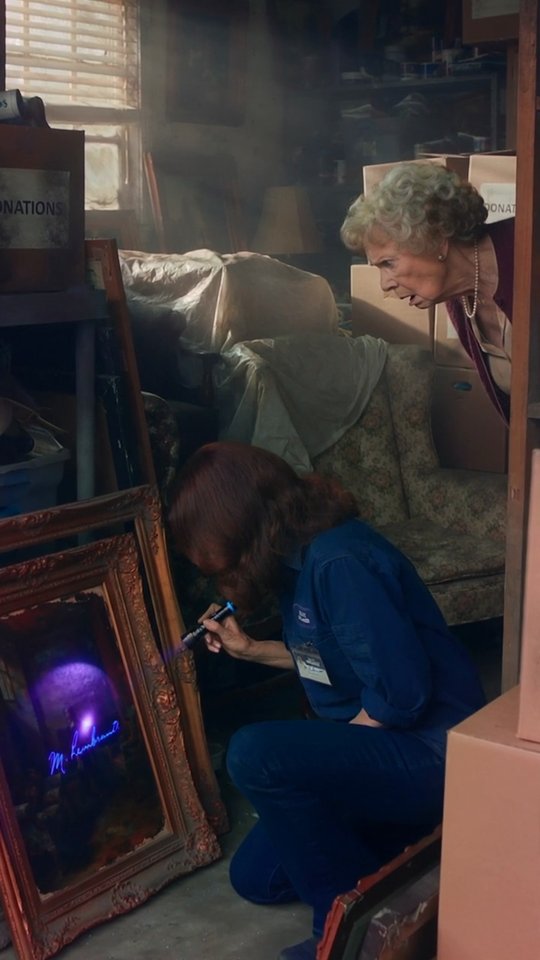
“Kendra, what are you doing?” she asked. “He needs to load the van.”
I pulled the painting out of the box and set it carefully on the workbench.
“Ruth, I need you to look at this,” I said.
She crossed her arms, impatient.
The volunteer shifted his weight, glancing at his phone.
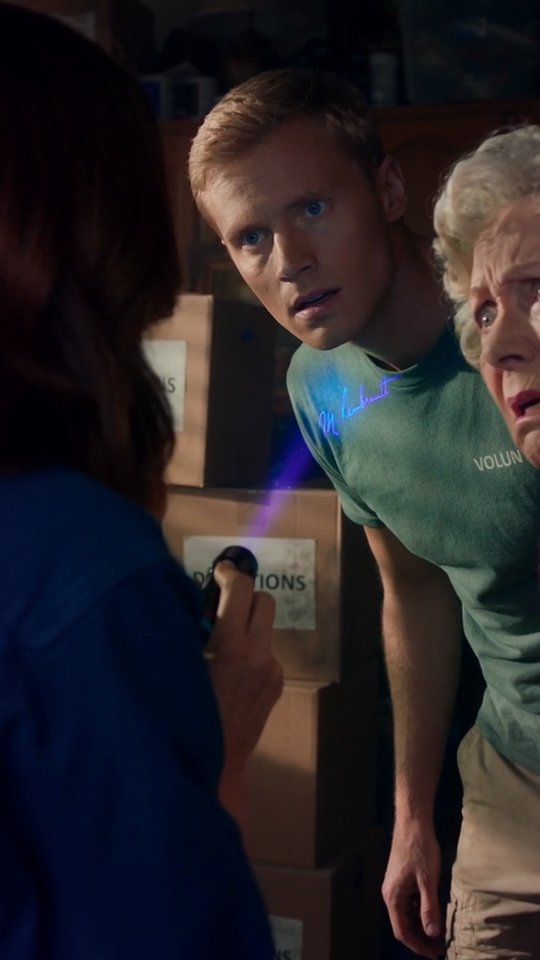
I switched on the UV penlight and held it over the canvas corner.
The blue signature glowed faintly in the dim garage.
Ruth squinted at it.
“What am I looking at?” she said.
“A signature,” I said quietly. “Hidden under UV light. It says W. Hennings.”
Her face didn’t change.
“I don’t know who that is,” she said.
I took a slow breath.
“William Hennings was a Nebraska painter,” I explained. “He died in 1966. His landscapes sell at auction for two hundred thousand dollars and up.”
Ruth blinked.
The volunteer’s eyes widened.
“You’re saying that painting is worth money?” Ruth whispered.
I nodded carefully.
“I can’t authenticate it here,” I said. “But if this is real, it could be worth half a million. Maybe more.”
Ruth sat down hard on an old folding chair.
Her hands were shaking.
“Leonard bought that for five dollars,” she said. “At a yard sale in Grand Island.”
I nodded.
“He took it to an appraiser once,” I said. “I found his journal entry. The appraiser said it was a copy.”
Ruth looked up at me, her eyes wet.
“So it’s worthless?”
“No,” I said. “I think the appraiser missed the UV signature. A lot of forgers in the 1950s copied Hennings. But they couldn’t replicate his anti-forgery watermark. He used a special pigment that only shows under ultraviolet light.”
The volunteer cleared his throat.
“Should I, uh, come back later?” he asked.
Ruth nodded slowly.
“Yes, please,” she said. “Leave the other boxes. Just not this one.”
He loaded the curtains and lamps into the van and drove away.
Ruth and I sat in the quiet garage, staring at the painting.
“What do we do now?” she asked.
I pulled out my phone and called the Sheldon Museum.
My friend connected me to their chief curator, a woman named Dr. Marianne Cross.
I explained the situation.
Dr. Cross was silent for a long moment.
“Bring it to Lincoln,” she said finally. “Tomorrow morning. I’ll clear my schedule.”
We wrapped the painting in acid-free paper and loaded it into my truck.
Ruth rode with me the next morning, her hands folded tightly in her lap.
The museum was a low brick building on the university campus.
Dr. Cross met us in the conservation lab, a bright room filled with magnifying lamps and microscopes.
She examined the painting under UV light for twenty minutes.
Then she took samples of the pigment and ran them through a spectrometer.
Ruth sat rigid in a plastic chair, barely breathing.
Finally, Dr. Cross looked up.
“It’s authentic,” she said quietly. “The pigment matches Hennings’ known work. The UV watermark is consistent with his technique. This is a previously unknown piece from his late period.”
Ruth made a small sound.
I reached over and gripped her hand.
“What’s it worth?” I asked.
Dr. Cross adjusted her glasses.
“Conservatively, at auction, I’d estimate between eight hundred thousand and one point two million dollars.”
Ruth started crying.
Not loud, just quiet tears running down her cheeks.
“Leonard always said that painting made him happy,” she whispered. “He didn’t care if it was valuable. He just liked the colors.”
Dr. Cross smiled gently.
“He had excellent taste,” she said.
We arranged for the museum to broker the sale through a specialized auction house in Chicago.
Three weeks later, the painting sold for one million, forty thousand dollars.
After fees and taxes, Ruth netted nine hundred and twelve thousand.
She paid off her mortgage, set up a trust for her grandchildren, and donated fifty thousand to the church.
Then she called me.
“I want to pay you more,” she said. “You saved my life.”
I told her the contract was the contract.
But she insisted on giving me a ten-thousand-dollar bonus.
“You could have just let that van drive away,” she said. “No one would have known.”
I thought about that.
She was right.
I could have stayed quiet.
Let the painting disappear into a church thrift store.
But I didn’t become an estate organizer to take advantage of grieving families.
I did it because I believe people’s lives have value, even after they’re gone.
Leonard Holloway spent five dollars on a painting that made him happy.
He never knew it was worth a fortune.
And honestly, I don’t think he would have cared.
But his wife needed that fortune.
And I’m grateful I was there, holding a borrowed UV light in a dim garage, ninety seconds before a million-dollar masterpiece rolled away in a church van.
Sometimes the smallest decisions change everything.
Sometimes a five-dollar yard-sale painting saves a widow’s home.
And sometimes, if you’re lucky, you get to be the person who stops the van just in time.