Martin Colby arrived at noon in a white government SUV with Fish and Wildlife decals on the doors.
I watched from the porch as he climbed out, carrying a metal briefcase and a camera with a telephoto lens.
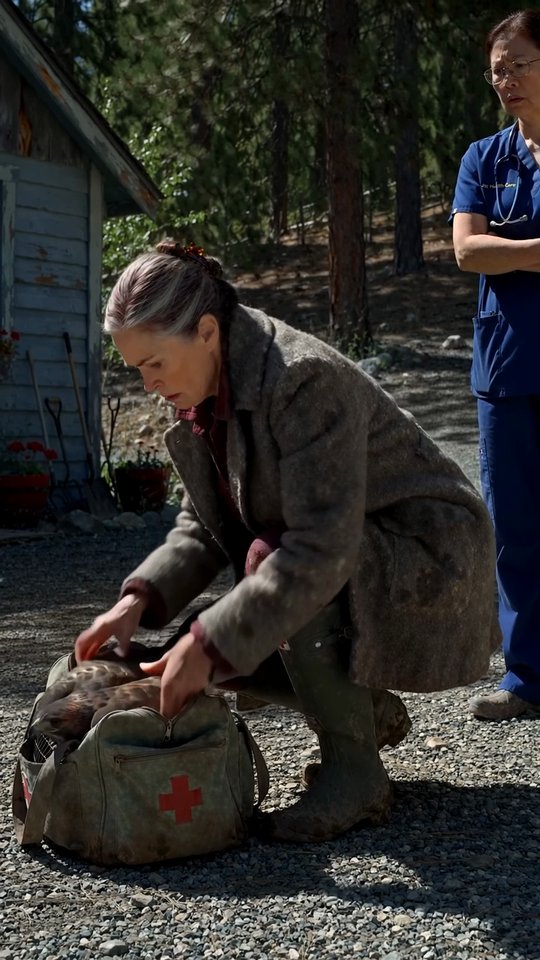
He was tall, maybe forty-eight, with short brown hair and a gray field jacket zipped to his throat.
His badge glinted in the sunlight.
“Ms. Weatherby,” he said, extending a hand. “Thanks for the call.”
I shook it. His grip was firm, professional.
“The hawk’s inside,” I said. “Still sedated from the surgery.”
He followed me into the cottage, his boots heavy on the pine floor.
The hawk lay in the wire crate, breathing slowly, wing wrapped in white gauze.
Martin knelt and photographed the leg band from six angles, adjusting the lens between shots.
Then he opened his briefcase and pulled out a tablet.
“This bird was banded three years ago near a timber ranch called Pinecrest Holdings,” he said quietly. “About sixty miles northeast of here.”
I nodded. I knew the area—dense forest, old logging roads, private land.
“Two months ago, we received an anonymous tip that Pinecrest was illegally clearcutting protected nesting habitat,” Martin continued. “Bald eagles, northern goshawks, red-tailed hawks. All federally protected.”
My stomach tightened. “And this bird?”
“Was nesting there,” he said. “We’ve been monitoring the site with trail cameras, but we couldn’t get close enough for solid evidence. The ranch owner, Victor Landis, has lawyers and political connections. He’s been blocking our access for weeks.”
He swiped through photos on the tablet—images of massive clearcut zones, splintered trees, empty nests.
“If we can prove this hawk nested at Pinecrest and was displaced by illegal logging, we can force a federal injunction,” Martin said. “But we need the bird alive and documented.”
I stared at the hawk, its chest rising and falling under the fleece.
“Why didn’t you just tell me this on the phone?” I asked.
Martin’s expression darkened. “Because Victor Landis has been trying to locate this bird for six weeks. He knows it’s evidence. If word gets out that you have it, he’ll come after you.”
A cold shiver ran down my spine.
“Come after me how?”
“Legally, at first,” Martin said. “Restraining orders, property claims, nuisance complaints. But Landis doesn’t play fair. Two months ago, a forest ranger who tried to document the clearcuts found his truck tires slashed and his mailbox stuffed with dead songbirds.”
I felt my hands go numb.
“I’m just a wildlife handler,” I said quietly. “I don’t have money for lawyers.”
“I know,” Martin said. “That’s why I’m asking you to let me move the hawk to a federal facility in Boise. We can protect it there, finish the case, and keep you out of the line of fire.”
I looked at the bird again, its yellow eye half-open, watching me.
I thought about the $3,470 vet bill sitting on my desk.
I thought about the hundreds of raptors I’d released over twenty-three years, each one a small victory against the forces that tried to erase wild places.
“No,” I said.
Martin blinked. “Excuse me?”
“This bird came to me,” I said. “I’m the one who found it, paid for its surgery, kept it alive. If it’s evidence, then it stays here where I can care for it properly. You can document whatever you need, but I’m not handing it over.”
Martin exhaled slowly. “Ms. Weatherby, you don’t understand what you’re risking.”
“I understand perfectly,” I said. “And my answer is no.”
He stared at me for a long moment, then nodded.
“All right,” he said. “But I’m stationing an agent nearby. And you call me if anything unusual happens.”
He left twenty minutes later, taking his briefcase and camera.
I sat on the porch and watched the SUV disappear down the gravel road.
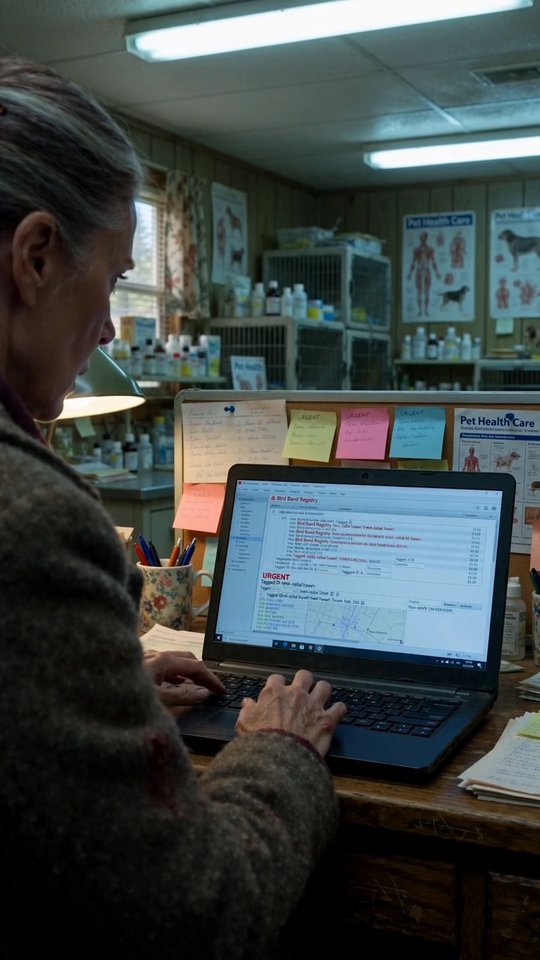
That night, I couldn’t sleep.
I kept thinking about Victor Landis, about dead songbirds in mailboxes, about the way Martin’s voice had dropped when he said “doesn’t play fair.”
The next morning, I found a note tucked under my windshield wiper.
It was written in neat block letters on plain white paper: “Drop the bird at the county animal shelter by Friday or your sanctuary permit gets reviewed.”
No signature.
I called Martin immediately.
He arrived within an hour, this time with a female agent named Simone Ruiz.
They photographed the note, dusted the windshield for prints, and installed a motion-activated camera on my porch.
“We’re escalating this,” Martin said grimly. “Landis just made a direct threat.”
Over the next three days, the hawk’s wing began to heal.
I changed the dressing twice a day, administered antibiotics, kept him hydrated.
Lorna came by to check his progress and nodded approvingly.
“He’s a fighter,” she said.
On Thursday afternoon, Martin called.
“We got a warrant,” he said, voice tight with controlled excitement. “The note triggered probable cause. We’re raiding Pinecrest tomorrow at dawn.”
“And the hawk?” I asked.
“Will be entered as evidence the moment we file charges,” he said. “You did it, Janice. You saved that timber ranch.”
I didn’t understand until he explained.
The leg band database had logged the hawk’s nesting coordinates at Pinecrest three years ago.
When I scanned the band and reported the injury, the system automatically cross-referenced the location with Martin’s investigation.
The hawk’s displacement—injured, sixty miles from its nesting site—proved the habitat destruction was severe enough to force protected raptors out of their territory.
Combined with the trail camera footage and the threatening note, it was enough to halt all logging operations and trigger a full environmental review.
Victor Landis was arrested Friday morning.
The charges included illegal clearcutting, destruction of protected habitat, witness intimidation, and federal wildlife violations.
Pinecrest Holdings was fined $890,000 and ordered to restore forty acres of forest.
Three weeks later, Martin came by with a check from Fish and Wildlife.
“Reward fund,” he said, handing me an envelope. “For critical evidence leading to a federal conviction.”
I opened it. The check was for $3,470—exactly the amount of the vet bill.
I started to cry.
Martin smiled. “That bird saved a forest. You saved the bird. Seems fair.”
Two months later, I released the red-tailed hawk at dawn.
His wing had healed perfectly, feathers glossy and strong.
I opened the carrier on a ridge overlooking the sanctuary.
He perched on my gloved hand for a moment, yellow eyes sharp and clear.
Then he launched into the sky, wings slicing the cold mountain air.
I watched him spiral upward, a dark silhouette against the pale pink sunrise.
And I thought about how a single aluminum band, a $3,470 vet bill, and eleven acres of Idaho pine had been enough to stop a man who thought money could erase wild places.
The hawk circled once, then flew northeast—back toward Pinecrest, where forty acres of new saplings were already beginning to grow.