I didn’t sleep that night. The transom window sat on my kitchen table under a quilted blanket, and Father Paul’s letter lay beside my cold coffee mug as October rain drummed against the cottage roof.
At dawn, I made a decision that went against every professional instinct I’d developed in thirty years of salvage work. I wasn’t calling the diocese yet. Not until I understood what Father Paul had been protecting.
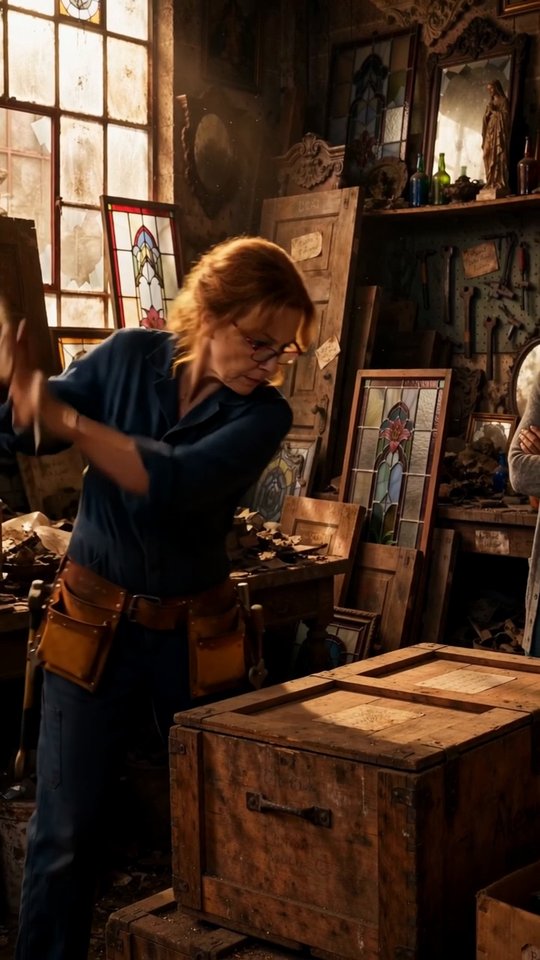
I started where all research begins in small New England towns—the local historical society.
The Lenox History Center opened at nine. Martha Brennan, the volunteer archivist, greeted me with her usual warm smile and a cup of terrible coffee.
“Phoebe! Haven’t seen you since the preservation gala. What brings you in?”
“Research on St. Michael’s Church in Stockbridge. Specifically, Father Paul Whitmore. He served there in the nineties.”
Martha’s smile faded slightly. “Oh. Father Paul. That was a sad situation.”
She led me to the newspaper archive room, pulling out bound volumes from 1996 and 1997.
“He died unexpectedly in April 1997. Heart attack. Only fifty-three years old. The whole community was devastated.”
I flipped through the Berkshire Eagle obituaries until I found his memorial notice. Standard language. Beloved pastor. Devoted servant. Survived by his sister Margery.
But tucked in the March 1996 editions, I found something else.
A small article about controversy at St. Michael’s. The diocese had ordered a “comprehensive renovation” that included removing several original architectural features.
The parish council had objected. Father Paul had written a letter to the bishop asking for reconsideration.
The diocese rejected his appeal.
“Martha, do you remember what features they wanted to remove?”
She thought for a moment. “I’m not Catholic, so I didn’t follow it closely. But I remember people being upset about the stained glass. Something about it not meeting modern liturgical standards.”
My pulse quickened. “Liturgical standards?”
“After Vatican II, some bishops got very particular about sacred art. Certain imagery was considered too ornate or not theologically correct. I think St. Michael’s had some windows that depicted flowers instead of traditional saints.”
Crimson lilies.
The diocese had ordered the Hargrove transom destroyed.
Father Paul had saved it.
I spent the next two hours photographing every article I could find about the St. Michael’s renovation controversy. The more I read, the clearer the picture became.
In early 1996, a new bishop had taken over the diocese. He’d launched a campaign to “modernize and purify” church architecture across the Berkshires.
Dozens of historic churches lost original features. Hand-carved altars replaced with minimalist concrete. Victorian stained glass removed in favor of plain panels.
Preservationists were furious, but the bishop had canonical authority.
Father Paul had tried to fight it. When he lost, he’d done the only thing he could—he’d hidden the transom at his sister’s house and reported it stolen.
The diocese collected insurance money. The window survived. And Father Paul carried the secret until his sudden death a year later.
I left the historical society with my head spinning and drove to Great Barrington to find Margery’s granddaughter.
Lauren Whitmore met me at a coffee shop, looking exhausted from estate settlement.
“Thanks for seeing me. I need to ask about something I found in the donation.”
I showed her photos of the transom on my phone, careful not to reveal its full significance yet.
“Did your grandmother ever mention where this came from?”
Lauren studied the images. “No. But Grandma had a storage room in the basement she never let anyone enter. After Uncle Paul died, she became really protective of it. Made me promise when I was little that I’d never open it until after she was gone.”
“Did she say why?”
“She said Uncle Paul had asked her to keep something safe. That someday the truth would matter.” Lauren looked up at me. “Is this valuable?”
I chose my words carefully. “It’s a significant piece. But its value is complicated.”
That afternoon, I contacted the one person I trusted to understand the full situation—Dr. Raymond Chen, an art historian at Williams College who specialized in ecclesiastical architecture.
He drove to my workshop within an hour of my call.
When I uncovered the transom, he went pale.
“Phoebe. This is the St. Michael’s window.”
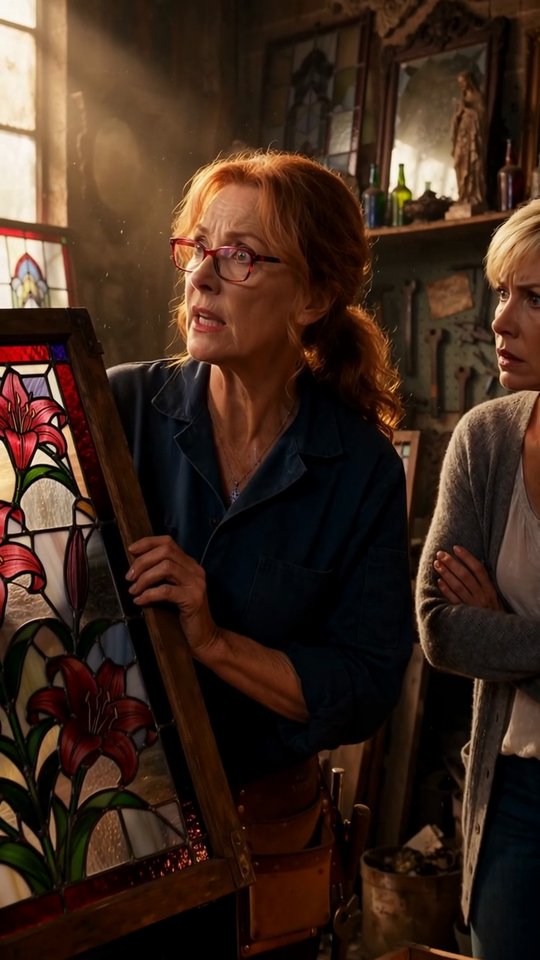
“I know.”
“Do you understand what you’re holding? The diocese—”
“Ordered it destroyed. Father Paul saved it.”
I handed him the letter.
Raymond read it twice, then sat down heavily on my workshop stool. “This changes everything. The bishop who ordered those renovations was removed in 2003 for financial misconduct. The current diocese has been trying to restore historical features to churches for fifteen years.”
“So the window wouldn’t be destroyed now?”
“Destroyed? They’d be thrilled to have it back. The current bishop has publicly apologized for the architectural damage done in the nineties. This window is exactly the kind of treasure they’ve been trying to recover.”
Relief washed over me, followed immediately by a more complicated emotion.
Father Paul had died believing he’d committed a sin to save sacred art. He’d never known that history would prove him right.
That evening, I called the diocese.
The woman who answered transferred me three times before I reached Monsignor William Thorne, the diocese’s vicar for cultural heritage.
I explained everything. The estate donation. The letter. The truth about 1996.
There was a long silence on the other end of the line.
“Ms. Caldwell, can you bring the window to our offices tomorrow morning? And bring Father Paul’s letter.”
The next day, I loaded the transom carefully into my truck and drove to the diocese headquarters in Springfield.
Monsignor Thorne met me in the lobby with two other priests and a woman I recognized from preservation conferences—the diocese’s art restoration consultant.
They examined the window for twenty minutes in reverent silence.
Finally, Monsignor Thorne looked up at me with tears in his eyes.
“Father Paul Whitmore saved a masterpiece. Thomas Hargrove only created twelve windows in his lifetime. Seven have been destroyed. This is the eighth surviving example, and the only one depicting his signature lily pattern.”
“What happens now?” I asked.
“We install it in St. Michael’s sanctuary where it belongs. We issue a formal statement acknowledging Father Paul’s courage in preserving it against unjust orders. And we present you with the $54,900 reward that’s been waiting twenty-eight years to be claimed.”
I thought about refusing the money. It felt wrong to profit from Father Paul’s secret sacrifice.
But Monsignor Thorne anticipated my hesitation.
“The reward is yours by right. But if you’re willing, we’d like to propose something. We’ll match your reward dollar for dollar—$109,800 total—to establish the Father Paul Whitmore Sacred Arts Preservation Fund. Any architectural salvage professional who saves historical church features from destruction can apply for grants to restore and protect them.”
My throat tightened. “He’d have loved that.”
Three weeks later, I stood in St. Michael’s sanctuary for the transom’s rededication ceremony.
Lauren Whitmore was there, crying quietly as she saw her uncle’s rescued treasure glowing above the altar.
The current bishop spoke about the mistakes of the past and the courage of those who’d resisted them.
And when morning light poured through those crimson lilies for the first time in twenty-eight years, I understood what Father Paul had known all along.
Some things are worth saving, even when saving them costs you everything.
The light falling through Thomas Hargrove’s glass painted the congregation in shades of amber and ruby and cobalt—the same colors that had illuminated prayers in that sanctuary since 1882.
Father Paul had made sure those colors would shine long after he was gone.
And standing there in that sacred light, I knew his sister Margery had kept her promise.
She’d kept it safe until the truth mattered.
Until someone came along who’d understand why a good man might steal from his own church to save it from itself.
The preservation fund would launch next month. My workshop already had three applications from salvage professionals who’d rescued architectural fragments from threatened churches.
And every time I approved a grant, I’d think of Father Paul’s shaky handwriting on that yellowed letter.
“Please keep this safe until I can make things right.”
Twenty-eight years later, we finally had.