I didn’t sleep that night.
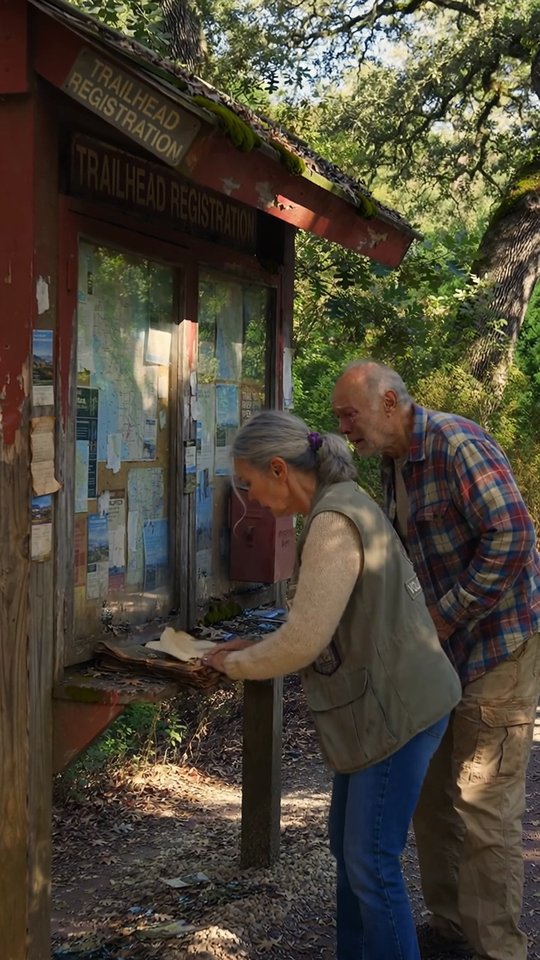
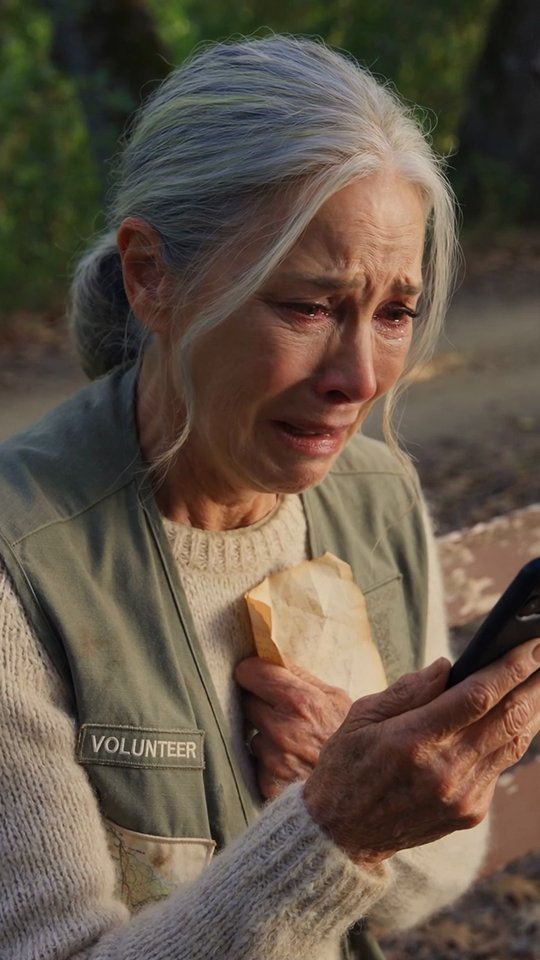
I sat at my kitchen table with Mitchell’s note spread flat under the lamp, reading it over and over until the words blurred.
Tom had carried that grudge for thirty-one years.
He’d believed his brother was a liar and a gambler who’d thrown away a loan on poker tables and racetrack bets.
He’d died believing that.
And all along, Mitchell had been protecting him from the truth about their mother’s illness.
I made coffee at five in the morning and drove to the trailhead an hour early.
The parking lot was empty except for a pair of crows picking at a discarded sandwich wrapper.
I sat on the bench near the kiosk, watching the sky turn from charcoal to pale gold.
At seven forty-five, a dusty blue pickup truck pulled into the lot.
The driver sat inside for a long time before the door finally opened.
Mitchell Pomeroy stepped out slowly, like a man approaching a cliff edge.
He was shorter than I’d imagined, his shoulders rounded, his flannel shirt wrinkled as if he’d slept in it.
He saw me and stopped.
“Gail?”
I stood. “Mitchell.”
We looked at each other across twenty feet of gravel.
He walked toward me with careful steps, hands shoved deep in his pockets.
“I wasn’t sure you’d really be here,” he said quietly.
I pulled the note from my jacket and held it out.
He stared at it like it might catch fire.
“You kept it,” he whispered.
“I found it yesterday,” I said. “Tucked behind the spine of the old guestbook.”
He took it with shaking hands, unfolded it, and his face crumpled.
“I put it there in April of ’94,” he said. “Right after Mom passed. I couldn’t face Tom in person. I thought maybe if he found it here, in a place we used to love, he’d understand.”
“He never found it,” I said gently.
Mitchell closed his eyes. “I know. I used to come back every few months and check the guestbook. The note was always there. After a while, I stopped checking. I figured he’d seen it and decided he still didn’t want anything to do with me.”
I sat back down on the bench. “Tom never knew your mother was sick.”
“She made me swear not to tell him. She didn’t want him to worry or feel guilty about not visiting more. The surgery cost $1,530 out of pocket after insurance. I didn’t have it. So I asked Tom for a loan and told him I needed it for a car repair.”
“And he believed you’d gambled it away?”
Mitchell nodded. “A buddy of his saw me at the hospital and told Tom I’d been acting secretive. Tom put two and two together wrong. When he confronted me, I couldn’t tell him the truth because of my promise to Mom. So I just stood there and took it. Let him think the worst.”
He sat down beside me, still holding the note.
“After Mom died, I wrote this and hid it in the guestbook. I thought it was a safe middle ground. He’d find it eventually, read it, and maybe we could fix things without a big confrontation.”
“But he stopped hiking here,” I said.
“Yeah. I didn’t know that until years later. By then, it felt too late.”
We sat in silence for a while, listening to the crows and the distant rush of the river.
“Tom talked about you,” I finally said. “Not often. But when he did, I could tell he missed you.”
Mitchell’s voice broke. “I missed him every damn day.”
I reached into my other pocket and pulled out a small photo I’d brought from home.
It was Tom and Mitchell as young men, standing at this very trailhead, arms slung over each other’s shoulders, grinning at the camera.
“He kept this on his dresser,” I said. “Even after you stopped speaking.”
Mitchell took the photo with trembling fingers and stared at it for a long time.
Then he broke.
He bent forward, shoulders shaking, and sobbed into his hands.
I put my arm around him and let him cry.
When he finally straightened, his face was red and wet.
“I should’ve just told him the truth,” he said hoarsely. “Promise or no promise.”
“You were honoring your mother,” I said. “Tom would’ve understood that if he’d known.”
Mitchell wiped his eyes with the heel of his hand. “Can I see his grave?”
“Of course.”
We drove separately to the cemetery on the south edge of town.
I led him to the plot under the big magnolia tree.
The headstone was simple gray granite: Thomas Edward Pomeroy, 1954–2019, Beloved Husband and Friend.
Mitchell knelt in the grass and placed the note on top of the stone.
“I’m sorry, Tom,” he whispered. “I’m sorry I waited so long. I’m sorry you never knew.”
He stayed there for a long time, one hand resting on the granite.
Finally, he stood and turned to me.
“Thank you,” he said. “For calling me. For showing me this. For not letting him be forgotten.”
“He’s not forgotten,” I said. “And neither are you.”
Mitchell looked back at the grave, then at the note still resting on the stone.
“Can I leave it here?”
“I think he’d like that.”
We walked back to the parking lot together.
Before he got into his truck, Mitchell turned to me one last time.
“If you ever need anything, Gail—anything at all—you call me. I owe Tom that much.”
I nodded. “I will.”
He drove away slowly, and I stood there in the sunlight, thinking about brothers and silence and the things we carry too long.
The next week, I went back to the trailhead kiosk.
I opened the new guestbook and wrote on the first page: In memory of Tom and Mitchell Pomeroy, who walked these trails together and apart, and who both loved this place.
Then I tucked a laminated copy of the photo—two brothers grinning at the trailhead—inside the clear pocket on the kiosk bulletin board.
People ask me sometimes why I keep volunteering here.
I tell them it’s because trails connect things.
Places. People. Past and present.
And sometimes, if you’re paying attention, they connect the truth to the people who need it most.