The call came on a Thursday morning in early March, three weeks after I’d found Sarah Colfax’s remains and sent most of the surgeon’s money to the search-and-rescue foundation.
Sheriff Ortega’s voice on my landline sounded different this time. Tight. Careful.
“Nadine, I need you for something unusual. Can you come to the station?”
I drove into town with Huck in the passenger seat, his black nose pressed against the window.
The sheriff’s office smelled like burnt coffee and pine cleaner.
Ortega met me in the conference room.
Sitting across the table was a young woman I recognized immediately.
Elena Marsh. A wildlife biologist from the Colorado Parks department.
I’d worked with her twice before on animal-tracking projects.
She looked exhausted. Dark circles under her eyes. Hands wrapped around a paper cup.
“Nadine,” Ortega said, “Elena has a situation. She thinks you’re the only one who can help.”
Elena looked up at me.
“There’s a woman living in the wilderness,” she said quietly. “Up near Tincup Pass. She’s been there for at least six months, maybe longer. Living in a snow cave. Surviving on foraged plants and trapped rabbits.”
I sat down slowly.
“Is she in danger?”
Elena shook her head.
“That’s the thing. She’s not lost. She’s not injured. She’s choosing to be there. But her family reported her missing eight months ago. They think she’s dead. And legally, we can’t force her to come back if she doesn’t want to.”
Ortega leaned forward.
“But we need to verify she’s okay. And she won’t talk to anyone. She runs whenever she sees people. Elena spotted her twice from a distance. She’s… feral, Nadine. Like a wild animal.”
I looked at Huck.
He was sitting calmly at my feet, watching Elena with intelligent brown eyes.
“Why me?” I asked.
Elena smiled faintly.
“Because you understand what it’s like to want to disappear into the mountains. And because Huck doesn’t judge. Animals never do.”
She was right.
I took the assignment.
Elena gave me coordinates and a description. The woman’s name was Victoria Landry. Forty-two years old. Former accountant from Denver.
Her family said she’d had a breakdown after her husband died in a car accident.
She’d emptied her bank account, bought survival gear, and vanished.
No note. No goodbye.
Just gone.
I spent two days studying the terrain around Tincup Pass.
Remote. Brutal. Eleven thousand feet elevation.
The kind of place where you could disappear for years if you knew what you were doing.
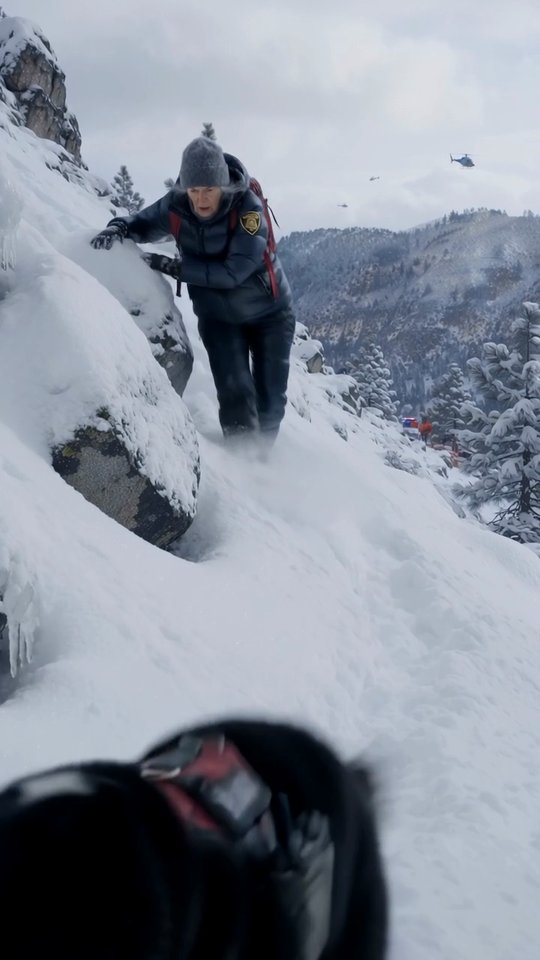
On Saturday morning, Huck and I drove up the old mining road as far as my truck could go.
Then we walked.
The snow was crusty and hard. Perfect for tracking.
I wasn’t looking for boot prints this time.
I was looking for signs of habitation.
Disturbed ground. Broken branches. Scat from trapped animals.
Huck found the first clue two hours in.
A rabbit snare made from braided willow bark, set beside a game trail.
Professional work. Someone who knew what they were doing.
We followed the trail.
More snares. A cache of dried mushrooms hidden under a rock overhang.
A fire pit carefully concealed under a fallen spruce.
And then, just before sunset, I saw her.
She was crouched beside a frozen creek, breaking ice with a sharpened stick.
Her hair was long and matted. Her face was sunburned and wind-chapped.
She wore a patchwork of animal hides stitched together with sinew.
She looked like something out of a history book.
I stopped walking.
Huck sat beside me, silent.
The woman looked up.
Her eyes were clear and sharp.
Not crazy. Not confused.
Just… free.
We stared at each other for a long moment.
Then she stood up slowly.
I didn’t move.
“I’m not here to take you back,” I said quietly. “I just need to know you’re okay.”
She tilted her head, studying me.
“They sent you to find me,” she said. Her voice was hoarse from disuse.
“Your family is worried. They think you’re dead.”
She laughed. A short, bitter sound.
“I was dead. In Denver. In that office. In that life. Out here, I’m alive.”
I nodded slowly.
“I understand.”
She looked at Huck.
“Can I touch him?”
“If he lets you.”
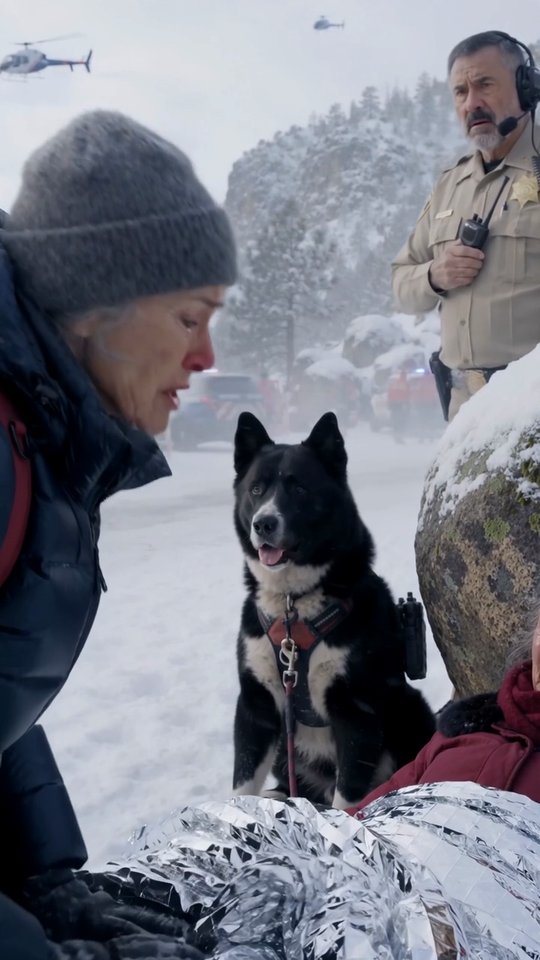
She approached slowly, hands open.
Huck stood up and walked toward her.
She knelt in the snow.
He sniffed her hand, then licked her face.
She wrapped her arms around him and started crying.
Not sad crying. Relief crying.
The kind of crying that comes when you realize you’re not alone anymore.
We sat together beside the creek as the sun set.
She told me about her husband. About the accident. About the panic attacks and the medication and the therapists who didn’t understand.
About the day she walked into the mountains and decided to stay.
“I don’t want to go back,” she said finally. “But I don’t want my family to suffer. Can you tell them I’m okay?”
I thought about it.
“I can tell them you’re alive and safe. But they’ll want proof.”
She pulled a small leather pouch from inside her hide coat.
Inside was a wedding ring and a folded letter.
“Give them this. It’s for my sister. She’ll understand.”
I took the pouch.
“Will you stay here forever?” I asked.
She smiled.
“I don’t know. Maybe. Maybe not. But right now, this is where I need to be.”
I understood that better than anyone.
Before I left, I gave her something.
A satellite emergency beacon from my pack.
“If you ever need help,” I said, “press this button. Someone will come.”
She took it carefully, like it was made of glass.
“Thank you,” she whispered.
Huck and I walked back down the mountain in the dark.
The next day, I met with Victoria’s family at the sheriff’s office.
Her sister read the letter and cried.
Her mother held the wedding ring and didn’t say anything for a long time.
Finally, her sister looked at me.
“Is she happy?”
I thought about Victoria’s face when she hugged Huck. About the clarity in her eyes. About the way she moved through the mountains like she belonged there.
“Yes,” I said. “She’s happy.”
They decided not to pursue it further.
Victoria was an adult. She had the right to choose her own life.
Even if that life looked nothing like what anyone expected.
That night, I sat at my kitchen table and looked at my map with seventy-four red thumbtacks.
I thought about adding a seventy-fifth.
But this wasn’t a rescue.
This was something else.
A reminder that sometimes, the people we think are lost are exactly where they need to be.
And sometimes, the greatest act of love is letting them stay there.
I looked at Huck, asleep by the woodstove.
I thought about the surgeon’s check. About Sarah Colfax. About Victoria Landry.
About all the ways we save each other.
And I realized something.
The mountains don’t just take.
Sometimes, they give back.
They gave Victoria her freedom.
They gave Sarah’s family closure.
They gave me purpose.
And that $44,300 check?
It didn’t just fix my truck.
It reminded me why I do this work.
Not for the money.
Not for the recognition.
But because every person matters.
Every life has value.
Even the ones who choose to disappear.
Three months later, I got a postcard with no return address.
Just a picture of Tincup Pass at sunrise and four words written on the back.
“Still here. Still free.”
I pinned it to my wall next to the map.
And I smiled.
Because some rescues don’t end with bringing someone home.
Some rescues end with letting them stay exactly where they are.
And that’s okay.
That’s more than okay.
That’s perfect.