The lab tech—her badge said Sandra—stared at her computer screen like she’d seen a ghost.
“What?” I managed, my voice barely above a whisper. “What is it now?”
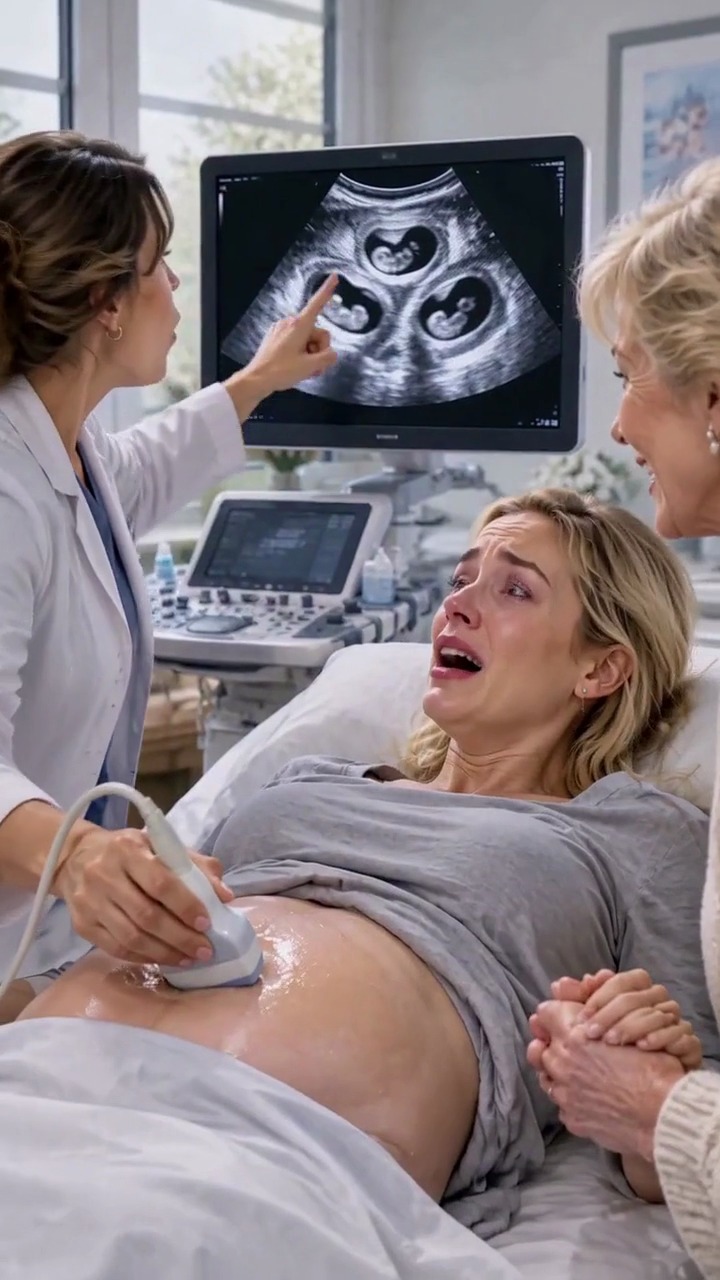
Dr. Chen was still pointing at the ultrasound monitor, at those three perfect sacs, three impossible heartbeats that shouldn’t exist.
Triplets.
I was carrying triplets when I wasn’t supposed to be able to carry anything.
“Ms. Foster,” Sandra said slowly, “I need to ask you something. Have you ever had genetic testing done? You or your husband?”
My mother’s grip on my hand tightened. “Why would that matter?”
“Because according to your medical history, you have severe endometriosis with bilateral tubal scarring. The statistical probability of natural conception is less than one percent.” Sandra swiveled her screen toward Dr. Chen. “But there’s a genetic marker here that—”
“That what?” I sat up too fast, gel still cold on my stomach.
Dr. Chen’s eyes widened as she read the screen. “Jenna, did your mother ever tell you about your biological father?”
The room tilted.
Mom went rigid beside me. “What does that have to do with anything?”
“Mrs. Foster, your daughter carries a rare genetic variant—HFE C282Y homozygous mutation. It’s associated with hemochromatosis, but more importantly for our purposes, it’s also linked to spontaneous fertility restoration in cases of endometrial scarring.” Dr. Chen looked between us. “It’s incredibly rare. Less than point-three percent of the population carries the homozygous variant.”
“I don’t understand,” I said.
“It means your infertility might have reversed itself naturally. Your body essentially healed enough to conceive—not just once, but released multiple eggs.” Dr. Chen pulled up another screen. “But here’s what’s interesting. This genetic marker? It’s almost exclusively found in people of Northern European descent, specifically Scandinavian. And it typically requires both parents to be carriers for this kind of spontaneous fertility restoration.”
My mother stood abruptly. “We should go.”
“Mom?” I stared at her. “What’s going on?”
Her face had gone pale. “Nothing. This is just—it’s a lot of information.”
“Mrs. Foster,” Sandra said gently, “I pulled up the genetic screening your daughter’s husband submitted last month for the paternity test he requested. Ryan Foster doesn’t carry this marker. In fact, his genetic profile is primarily Mediterranean and West African.”
The air left my lungs.
“But that doesn’t mean anything about paternity,” Dr. Chen added quickly. “The babies could absolutely still be his. This genetic trait could have come from your side of the family, Jenna. From your biological father.”
I looked at my mom, who’d raised me alone since I was two. Who always said my father was “just someone who didn’t stick around.”
“Mom?” My voice shook. “Who was he?”
She closed her eyes. “His name was Erik Lindgren. He was Swedish. We had a summer together before he went back to Stockholm.” Her voice cracked. “I never told you because he died in a car accident three months after you were born. I thought it would be easier if you just didn’t know.”
“But this means—” I looked back at the ultrasound screen, at those three tiny heartbeats. “Ryan’s genetic test. When he submitted it for the paternity test—”
“The lab would have flagged the discrepancy,” Sandra said quietly. “If the babies carry this Scandinavian marker strongly, and Ryan doesn’t carry it at all, but you do…”
“It proves they’re mine,” I breathed. “It proves I didn’t cheat.”
Dr. Chen nodded. “Combined with your medical history and the spontaneous fertility restoration, it actually creates a very clear genetic picture. These babies are the result of a near-miraculous biological event—your body healing itself because of a genetic inheritance from your father.”
I started crying then, huge gasping sobs that shook my whole body.
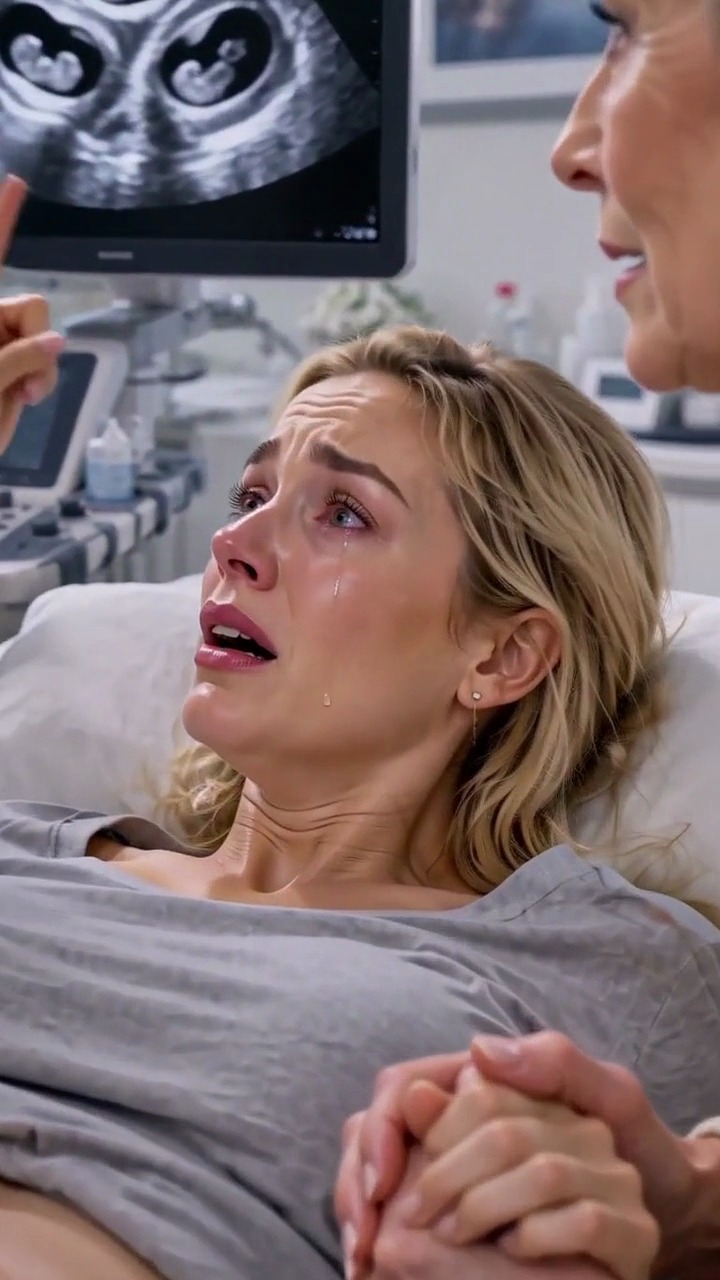
Two months of Ryan’s cold silence. Two months of him looking at me like I was a liar and a cheat. Two months of divorce papers and accusations.
And now I had proof—scientific, undeniable proof—that I’d been telling the truth all along.
“I need copies,” I said, wiping my eyes. “I need copies of everything. The genetic reports, the ultrasound, all of it.”
“Of course,” Dr. Chen said gently. “Sandra, can you print the full genetic comparison?”
While Sandra printed, my mother sat back down beside me, tears streaming down her face. “I’m so sorry, baby. I should have told you about Erik years ago. I should have—”
“You gave me a gift,” I whispered, touching my belly where three impossible miracles were growing. “You gave me him. And he gave me this.”
Twenty minutes later, I walked out of that office with a folder full of documents that would change everything.
I sat in my car in the parking lot and pulled out my phone.
Ryan had blocked my number, but I still had his work email.
I photographed every page. The genetic reports highlighting the Scandinavian markers. The comparison showing the statistical impossibility of infidelity. The ultrasound images of three perfect babies.
My fingers trembled as I typed: “You called me a liar. You said I cheated. You walked away from our marriage because you couldn’t believe in a miracle. Here’s your proof. All of it. Scientific. Undeniable. I’m carrying YOUR triplets—three babies that exist because my body did something medically impossible. I hope these documents help you sleep at night. Don’t bother responding. My lawyer will be in touch about updating the divorce petition. You’re still listed as the father, and DNA will prove it. But you’ll do it from a distance, because you gave up the right to be part of this miracle the night you called me a liar.”
I hit send before I could second-guess myself.
Then I drove to my lawyer’s office with my mother beside me, those ultrasound images of three tiny heartbeats tucked safely in my purse, and for the first time in two months, I let myself believe that maybe—just maybe—I was going to be okay.
My phone rang as I pulled into the parking lot.
Ryan’s number flashed across the screen.
He’d unblocked me.
I stared at it for three rings, four, five.
Then I answered, my voice steady: “Yes?”
“Jenna.” He sounded broken. “Jenna, I—God, I’m so sorry. I’m looking at the reports and I—”
“You’re sorry?” I laughed, but there was no humor in it. “You’re sorry for abandoning your wife? For calling her a liar and a cheat? For serving her with divorce papers while she was carrying your children?”
“Children?” His voice cracked. “The email said triplets, but I thought—”
“Three babies, Ryan. Three. And you weren’t there to hear their heartbeats because you decided your pride was more important than your marriage.”
Silence on the other end.
Then: “Can I come home?”
I looked at my mother, who was watching me with fierce pride in her eyes.
I thought about those three tiny lives growing inside me, about the miracle that had cost me everything and given me everything all at once.
“No,” I said softly. “No, Ryan, you can’t. Because home isn’t just a place you come back to when you finally have proof. Home is built on trust. And you proved you never really trusted me at all.”
I hung up before he could respond, and walked into my lawyer’s office with my head held high, ready to fight for the family I was building—just me, my mom, and three impossible miracles who would never doubt they were wanted.