Odessa said, “Because it wasn’t supposed to be in there,” and then she stopped, and the porch got very quiet around us.
I sat down on the top step with the pouch in my lap and turned it inside out, the way Mom used to turn out her pockets before laundry.
Loose powder puffed into the October light. A blush brush rolled off the step and landed in the petunias, and nobody moved to get it.
I laid every scrap of paper flat on the boards in a line, oldest to newest, and started reading the dates out loud.
“September second,” I said. “September twenty-eighth. October fourth. October ninth.” Odessa’s jaw worked like she was chewing something she couldn’t swallow.
She picked at the cuff of Mom’s cardigan until a thread came loose, and she wound it around her finger and pulled it tight.
“I don’t like your tone,” she said. “I called you for help. I didn’t call you to be a detective on my porch.”
“You didn’t call me for help either,” I said. “You called me to witness a story. Those are different phone calls.”
The item descriptions were in a thin carbon-copy hand, and not one of them said emerald. They said things like “gold band, worn” and “silver locket, no chain.”
**I looked at the ring in that pouch again and understood, with a cold drop in my stomach, that I was holding a stone that had never been inside a drain in its life.**
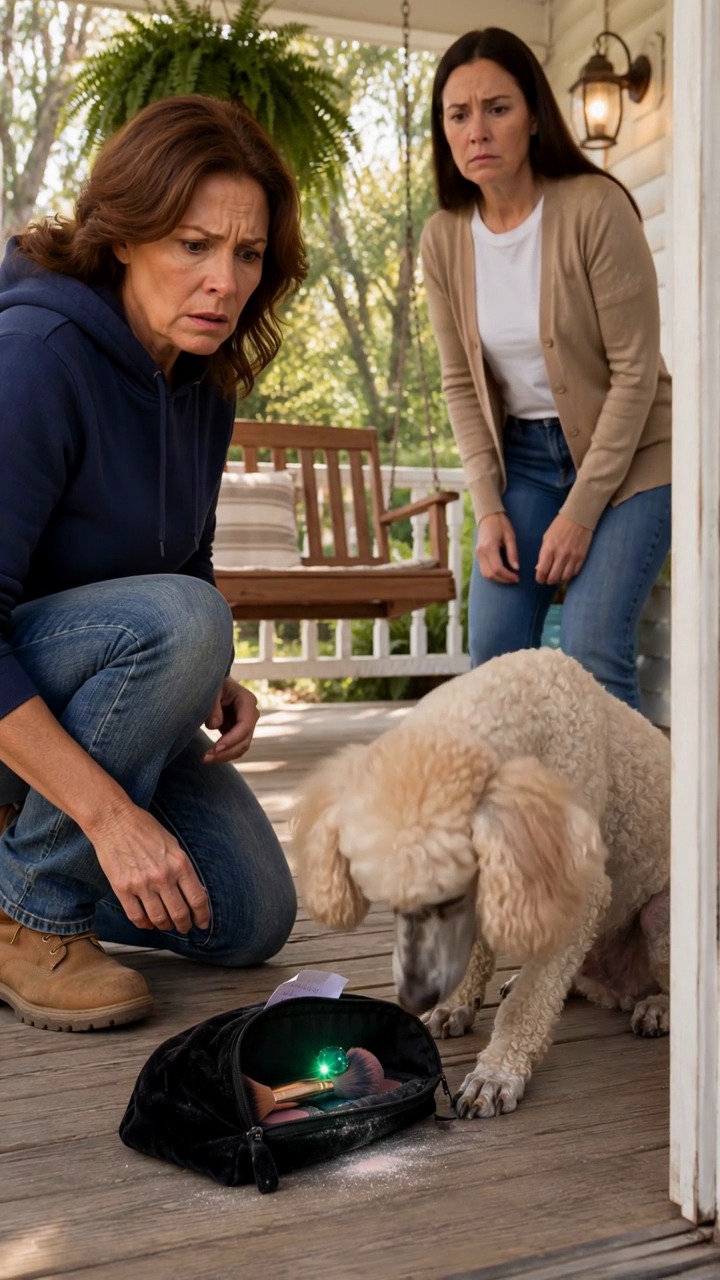
The Pocket Biscuit Wouldn’t Leave Alone
Biscuit had not moved from her spot between us, but she had started doing something with her nose against the pouch, a short insistent nudge, over and over.
I turned it over and ran my thumb along the lining, and there it was: a seam that didn’t match the others, sewn shut by hand with thread too bright to be original.
“That’s the pocket,” Odessa said quickly. “That’s nothing. That’s an old repair. Mom did that years ago.”
Biscuit pushed her muzzle into my wrist, hard, the way she does when she wants the back door opened and you’re not moving fast enough.
I pinched the seam and it gave, and a folded stub slid out onto the boards, thinner and older than the others, gold-edged and soft at the corners.
Mom wrote like she was signing a birthday card, every letter leaning forward like it wanted to get somewhere.
“That’s her hand,” I said. “That’s Mom’s hand. Why is Mom’s handwriting on a pawn ticket?”
Odessa looked at the field instead of at me, at the neighbor’s yellow maple dropping leaves on a lawn nobody had raked since August.
“I don’t know,” she said. “I never saw that. I swear to you I never saw that.”
Biscuit lay down with her chin on her paws and let out a long breath through her nose, and somehow that felt like a verdict.
What Odessa Finally Said Out Loud
I gave her the silence. I’ve learned in eleven years of this work that most people will fill it, and whatever they put in the gap is usually the truth.
It took her about forty seconds. She sat on the porch swing and pushed off with one bare foot and let it creak back and forth.
“The ring got switched,” she said. “In June. Right after the memorial, when everybody was still sending casseroles and nobody was looking at anything.”
“Switched with what?” I asked, and she said, “A paste. A good one. The jeweler on Division said it was a good one.”
“So the green thing in this pouch—” “—is the fake,” she said. “The real one has been in a safe deposit box since June. That’s the whole point of it.”
“You said it,” I repeated. “To me. On the phone. With the crying.”
“The crying was real,” she said, and had the nerve to look wounded. “I’ve been crying for a year and a half. You just never answer my calls.”
She wiped her face with the cardigan sleeve and said, “I was going to put it back. I had a plan. I always have a plan.”
“You have a plan,” I said, “and then you have a receipt, and those are two different things.”
She stopped the swing with her heel and looked at me, and for one second she wasn’t my little sister performing. She was just tired.
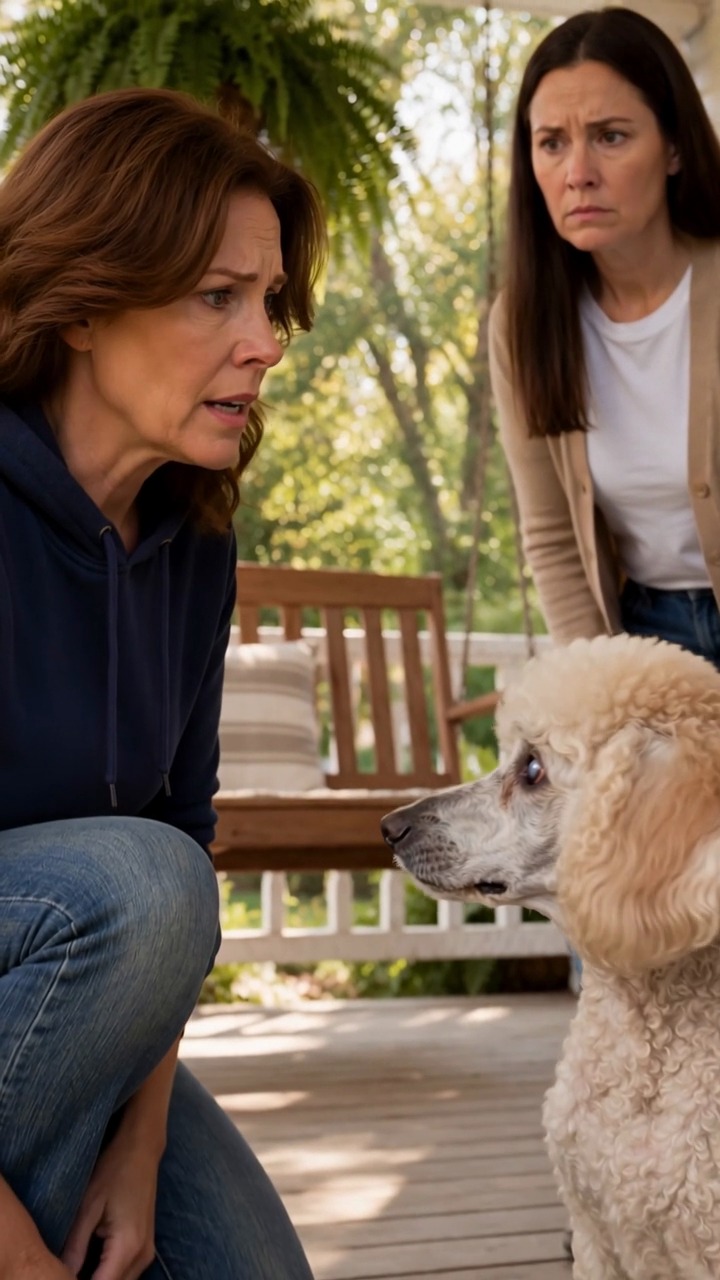
The Number in Mom’s Handwriting
I called it from the porch with the speaker on, because I wanted her to hear whatever came back.
A man answered on the fourth ring. “Halloway Fine Jewelry, this is Arthur.” He sounded old and patient, like someone who had been waiting on a call.
I said my name, and I said Mom’s name, and there was a pause long enough that Odessa sat up straight.
“Renata,” he said. “Your mother told me you’d call eventually. She said you were the one who’d read the paperwork.”
He explained it slowly. Mom had brought the emerald in during the spring, before the hospital, and asked him to reset it into a smaller band for her granddaughter.
Then he said the part that made the porch swing stop moving entirely: “The balance came in two weeks ago. I’ve been holding the finished piece since then.”
I looked at Odessa. She had gone the color of the porch boards, and her mouth was open and nothing was coming out of it.
**Odessa hadn’t been hiding a sale. She’d been hiding a gift, and she’d spent the money Mom set aside to finish it, and she’d built a whole sinking drain on top of that to bury it.**
“Mr. Halloway,” I said, “did my sister ever come to your shop?” He said, “Once. In June. She asked if the stone could be sold outright, and I told her no, it was spoken for.”
The line went quiet. Odessa put her face in both hands, and Biscuit got up and walked a slow circle around her, the way she does when someone is crying and she can’t fix it.
What Mom’s Trust Actually Protects
She told me the rest on the porch, in the flat voice people use when they’ve run out of story.
She had borrowed against the reset money in August. Not gambling, she insisted, and then admitted it was a business she’d started and buried, a boutique that never took a single customer.
“I was going to replace it before anyone noticed,” she said. “Then the boutique fell apart, and then you came over, and then the dog— the dog had to bring out the pouch.”
“The dog,” I said, “is fourteen and blind and still the most honest witness on this property.”
I told her the truth then, because someone had to: the ring wasn’t hers to sell and it wasn’t mine to sell either. Mom had already decided whose hand it fit.
“I’ll pay Arthur the balance,” I said. “Out of my own account. Not because you deserve it, but because Mom already paid most of it and I’m not letting that go into a drawer.”
“You owe me the truth going forward,” I said. “Not the version that makes you look sad. The one that makes you look like a person.”
I stood up with the pouch and the receipts and the gold-edged stub, and I called Biscuit to the door.
“The stone goes to your daughter on her birthday,” I said. “You’re going to be the one to hand it to her, and you’re going to tell her who paid for it and why. That’s the whole condition.”
She didn’t argue. That was how I knew she’d actually heard me. I went inside with the old dog leaning against my leg and shut the screen door soft.
The porch swung empty behind us, and somewhere in the kitchen the tea she never drank had gone cold in the mug, and I left it there on purpose.