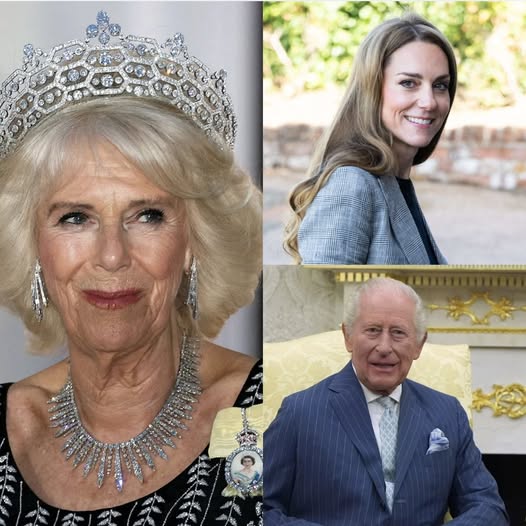
 Recent claims circulating online have suggested tension within the British Royal Family following the reading of Queen Elizabeth II’s will. According to these unverified reports, Queen Camilla was allegedly left out of key inheritances, with certain personal items and heirlooms instead said to have been passed to Catherine, Princess of Wales.
The narrative has quickly gained attention, with some outlets describing an emotional reaction and suggesting internal conflict. However, there is no official confirmation of these claims, and longstanding royal protocols make such details highly unlikely to be publicly disclosed.
Traditionally, the contents of a British monarch’s will are sealed and kept private, often for decades. This practice is intended to protect the dignity of the Crown and prevent precisely the kind of speculation now circulating online. As a result, any detailed descriptions of specific bequests—particularly involving jewelry or personal treasures—should be approached with caution.
Much of the confusion stems from a broader misunderstanding about how royal assets are passed on. Many of the most valuable items associated with the monarchy are not privately owned in the conventional sense. Instead, they are held in trust as part of the Royal Collection, meaning they are transferred from one sovereign to the next rather than distributed through a personal will.
This distinction is important when evaluating claims about who “inherits” certain items. While personal belongings can indeed be passed down to family members, high-profile pieces tied to the institution typically remain within the framework of the monarchy itself. As such, the idea of a dramatic redistribution of major royal heirlooms—especially in a way that would exclude a senior figure like Queen Camilla—does not align with established practice.
The absence of any statement from Buckingham Palace has also fueled speculation. Yet historically, the Palace does not comment on private family matters, particularly those involving inheritance. Silence in this context is not unusual and should not be interpreted as confirmation of circulating rumors.
Public reaction to the story has been mixed. Some view the claims as plausible given the evolving dynamics within the Royal Family, while others see them as another example of how quickly unverified information can spread. The prominence of figures like Queen Camilla and Catherine, Princess of Wales, means that even minor suggestions of disagreement can attract disproportionate attention.
At a broader level, the situation reflects ongoing public fascination with the personal relationships behind the monarchy. As the institution adapts to a modern media environment, stories—whether confirmed or not—can shape perception in significant ways. Social media in particular has accelerated the speed at which such narratives emerge and gain traction.
It is also worth noting that both Queen Camilla and Catherine, Princess of Wales, continue to carry out their public roles without any visible indication of discord. Official engagements and appearances remain focused on their respective duties, offering little evidence to support claims of internal conflict.
In the absence of verified information, the most reliable conclusion is a cautious one. While the story has captured attention, it rests largely on speculation rather than confirmed fact. The traditions governing royal wills, combined with the lack of official comment, suggest that the full details—if ever disclosed—will remain private for years to come.
For now, the reports serve as a reminder of how easily narratives can take shape around high-profile figures, even when the underlying information is uncertain.