They arrived in a rented SUV just after noon, sun flashing off the windshield. I watched through the sliver of space between my steering wheel and dashboard, the way you watch a storm you’ve already named.
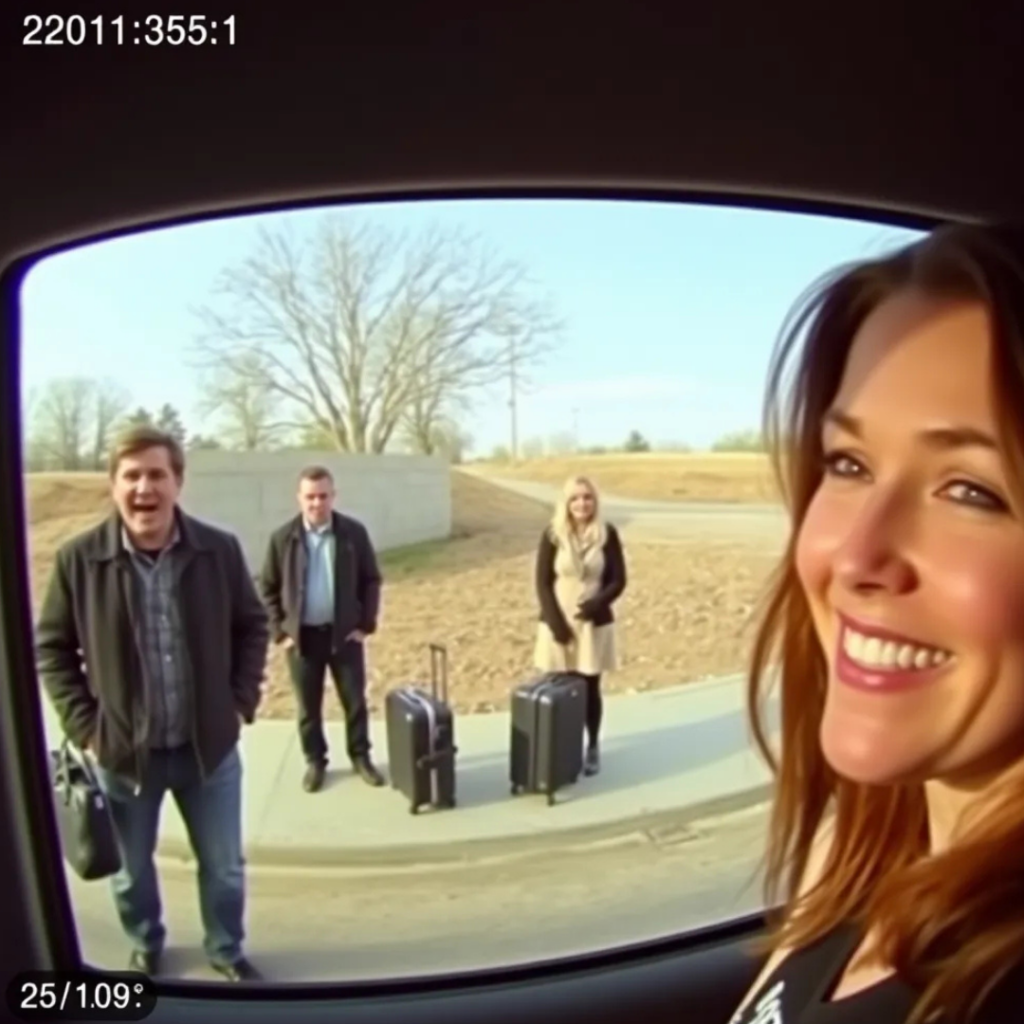
Ethan was driving. Of course he was. His hands on the wheel like he still owned everything he looked at. Sienna sat in the front seat wearing oversized sunglasses and a smug little smile that belonged on a magazine cover. In the back, my son Caleb stared out the window with the exhausted expression of a kid who’d been told to clap on cue. My daughter Lily hugged a sweatshirt to her chest like a shield.
Ethan turned onto our street—and slowed.
I saw the exact moment the world didn’t match the picture in his head.
He braked hard. The SUV rocked. He leaned forward, peering as if the house might be hiding behind a tree.
But there was no tree line to hide anything.
Where our home had been, there was only a rectangle of raw land—freshly leveled dirt, a few stakes with surveyor tape, and the pale scar of a driveway that now led to nothing.
Sienna’s head snapped left and right. Her sunglasses slid down her nose.
“What is this?” she mouthed.
Ethan shoved his door open so hard it bounced, and he staggered out onto the gravel shoulder. For a second he just stood there, arms hanging, staring at the empty lot like it was a magic trick he hadn’t consented to.
Then the sound came—raw, ugly.
“No. No—NO!” Ethan shouted, and his voice cracked on the last word.
His parents climbed out behind him, faces tightening. His mother raised a hand to her mouth. His father looked around as if expecting a camera crew to jump out laughing.
Caleb stepped out slowly, eyes darting to the neighboring houses. Lily followed, her face pale. She looked straight down the road—and met my eyes through my windshield.
I didn’t wave. I didn’t smile at her. I just held the gaze. Not as punishment. As a message: I’m here. I’m real. I’m not what he told you.
Ethan pulled out his phone with shaking hands and called me. My screen lit up with his name.
I answered calmly. “Hello, Ethan.”
“Where is it?” he demanded, voice too loud, too panicked. “Where’s the house?”
“It’s not your house,” I said.
A stunned silence, like he’d never heard that sentence before.
“You—what did you do?” he hissed. “Natalie, you can’t—my stuff is in there!”
“I packed what belonged to the kids,” I replied. “Their essentials are in storage. You’ll get the unit number through Gloria.”
“Gloria who?”
“My attorney,” I said, and let the words land.
On the lot, Ethan paced like a trapped animal, phone pressed to his ear, jaw working. Sienna hovered behind him, her face a mask of disbelief turning into anger.
“This is insane,” Ethan snapped. “You think you’re being clever? I’ll call the police. I’ll sue you. You can’t just take our home.”
I watched him from the safety of my parked car, my pulse steady.
“I didn’t take it,” I said. “I relocated it. Legally. The land is in my name. The house was purchased with funds from my inheritance and my income. You never added yourself to anything because you didn’t think you had to.”
“You’re lying,” he spat, but his voice thinned.
“I’m not,” I said. “And your text—telling me to ‘be gone’—helped establish abandonment and harassment. Thank you for putting that in writing.”
He made a choking sound, halfway between fury and fear.
“You went through my emails,” he accused.
“You emailed your itinerary to the shared account,” I reminded him. “You made it easy.”
Sienna snatched at his arm, trying to get the phone. “Let me talk to her.”
Ethan pulled away from her instinctively, like even now he didn’t want her to see the full mess.
From inside my car, I watched Lily drift closer to the edge of the lot. She knelt and picked up a piece of broken ceramic—one of the old planters that had cracked during the move. She turned it over in her hands like evidence.
Caleb stood behind her, frozen.
Ethan’s voice dropped. “Where am I supposed to live?”
The entitlement was so pure it almost sounded like a child’s.
“You can live with your new wife,” I said softly. “Isn’t that the point of a new life?”
I ended the call before he could answer.
And then—finally—I let the smile stretch across my face, quiet and unstoppable, as their laughter from the airport turned into white panic on an empty patch of American dirt.
Ethan didn’t leave the lot for nearly an hour.
He walked the perimeter, kicking at clumps of soil, as if anger could conjure walls. His parents argued in urgent whispers. Sienna stood apart, arms crossed, her wedding-ring hand flashing as she checked her phone like there might be a customer service number for humiliation.
Eventually, Ethan marched up to the nearest neighbor’s porch—the Morrisons—knocking so hard the glass rattled. Mrs. Morrison opened the door a crack, took one look at his face, and shook her head before he even spoke.
“I can’t help you,” she said firmly. “Natalie already told us you might show up. Please leave our property.”
He tried the next house. Same result. I’d done what Gloria advised: I’d told two trusted neighbors what was happening, not as gossip, but as protection. Ethan liked to perform. I wasn’t giving him an audience.
Finally, he returned to the SUV, grabbed the luggage from the roof rack, and threw it down onto the grass. His father started talking with his hands, furious. His mother looked like she might faint.
Sienna leaned in close to Ethan’s face, and even from down the road I could see the sharpness in her mouth as she hissed something. Her posture screamed betrayal—not because he’d hurt me, but because he’d failed to keep his promises to her.
That was the part Ethan never understood. He thought his new life was a reward. But rewards come from someone else’s approval. And Sienna’s approval had conditions.
I drove away before they could spot my car, then headed to Gloria’s office for the next step.
Gloria didn’t celebrate. She simply organized.
“Here’s what we’ve accomplished,” she said, sliding a stack of documents toward me. “Divorce filed. Temporary orders served. Your credit and accounts secured. The relocation contract is airtight. And your husband’s threats are documented.”
“What about the kids?” I asked, the one question that still scraped at my ribs.
Gloria softened. “We request temporary primary custody. His overseas wedding with them present, plus the harassment text, plus instability today—this helps. But you need to be careful. No gloating. No provocation. Let his behavior speak.”
That evening, Lily called me from a friend’s house. Her voice was small, tired.
“Mom,” she said. “Dad’s freaking out.”
“I know,” I replied.
“He says you’re trying to ruin him.”
I closed my eyes. “No, sweetheart. I’m trying to save us.”
A pause. “Where did the house go?”
“It was moved,” I said gently. “To a place where we can be safe and start over.”
“You did that… by yourself?” Lily asked, like she couldn’t fit the idea into her world yet.
“I had help,” I admitted. “But yes. I did it.”
She was quiet for a long time, then whispered, “He told us you’d be gone.”
“I’m not gone,” I said. “I’m right here.”
When Ethan called later, I didn’t answer. I let Gloria’s email do the talking: all communication through counsel, pick-up schedules for the kids arranged through the court, and a warning that any attempt to access my accounts or the storage unit would be reported.
Two days after their return, Ethan’s tune changed. I heard it in the voicemail he left—lower voice, careful words.
“Natalie… we can negotiate,” he said, as if the last decade could be reduced to percentages.
He was learning the rules too late.
A week later, the modular home was set on a new foundation in a quieter county, on land leased under my maiden name. The kids’ rooms were painted the colors they chose. The locks were new. The air felt different—less like walking on glass.
I drove past the old lot once more, not to rub it in, but to close the chapter.
A “For Sale” sign had already appeared. Ethan couldn’t stand to look at emptiness without trying to profit from it. But the sign didn’t change the truth: the only thing he’d really owned was my patience.
And that was the one thing I’d finally stopped giving away.
The legal battle that followed was less of a fight and more of a systematic dismantling. Ethan had spent twenty years believing his charisma was a legal currency, but in a courtroom presided over by a judge who had seen a thousand “new lives” built on the wreckage of old ones, his charm was worthless.
Ethan tried to claim “theft of property,” but the judge looked at the deed—solely in my name—and the text messages where Ethan explicitly told me to “be gone.”
“Mr. Caldwell,” the judge said, peering over her spectacles during the first hearing, “you told your wife to be gone. You abandoned the marital residence to marry another woman overseas while your divorce wasn’t even finalized. My question is: why are you surprised she took her house with her?”
Ethan’s face went a shade of purple I’d never seen before. Sienna sat in the gallery, her designer handbag clutched like a life preserver. She had married a “wealthy developer,” but she was quickly realizing she had actually married a man who had outsourced his entire life to his wife. Without my credit score, my inheritance, and my management, Ethan was just a man with a lot of expensive suits and no place to hang them.
The “new life” Ethan promised Sienna began to rot from the inside out. Since I had frozen the joint accounts and documented his financial abuse, he was forced to live off his liquid assets—which were dwindling fast under the weight of two sets of lawyers and the high-priced hotel rooms he was forced to book.
A month later, Lily told me the news. “Sienna’s gone, Mom. She took the jewelry he bought her in Paris and went back to her parents’ house in Florida. She told Dad he lied to her about being ‘settled.’”
I felt a brief flash of pity for her—not because she was a victim, but because she had been a fool. She had looked at a man who was willing to discard twenty years of history with a text message and thought, He’d never do that to me. ### The New Foundation
My house—our house—sat on its new lot, surrounded by ancient oaks and a view of a lake that didn’t know the name Caldwell. It felt lighter. The “heavy” air Ethan used to bring into a room had vanished.
One Saturday, Caleb and Lily were in the backyard, helping me plant a new garden. Caleb was quiet, but he was no longer looking at the ground. He was looking at the horizon.
“Mom,” he said, wiping dirt from his jeans. “Why didn’t you ever tell us the land was yours?”
“Because when you love someone, you don’t keep a tally of who owns what,” I said. “But when someone stops loving you, you have to remember where you stand.”
He nodded, a newfound respect in his eyes. He was seeing his mother not as the “old thing” his father had labeled me, but as the architect of our survival.
The divorce was finalized on a Tuesday in November. Ethan lost his claim to the house, the land, and most of the retirement accounts. He was left with a leased SUV he couldn’t afford and a reputation in town that was effectively scorched earth.
I was sitting on my porch, wrapped in a blanket, watching the first frost settle on the grass, when my phone buzzed.
Ethan: I’m at the old lot. I just wanted to say… you win. Happy?
I looked at the message. For years, I would have replied with a defense, an explanation, or an olive branch. But I didn’t want to win. I just wanted to be free.
I didn’t type a single word. Instead, I took a photo of the view from my new porch—the sun setting over the lake, the kids’ bikes leaning against the house, and the porch light glowing warmly. I didn’t send it to him. I just saved it as my wallpaper.
I blocked his number.
Epilogue: The View from the Dirt
Ethan stood on the empty lot one last time. The “For Sale” sign had fallen over in the wind. He looked at the rectangle of dirt where his bed used to be, where his kids had grown up, and where a woman he thought he knew had quietly outplayed him.
He had wanted a new life. He had wanted to shed “old things.”
As he stood in the cold, realized that he was now the oldest thing he knew—discarded, outdated, and standing on a piece of earth that no longer recognized his footsteps.
I walked back inside my home, closed the door, and turned the lock. It was a new sound. It didn’t sound like a trap. It sounded like a promise.