The porcelain coffee cup slipped from Chelsea’s hand. It hit the concrete driveway with a heavy crack, sending dark coffee splashing across her bare ankles and expensive slippers.
She didn’t even react. Her eyes were locked on the first sheet of paper. It was an official notice from the bank.
Revocation of mortgage guarantee.
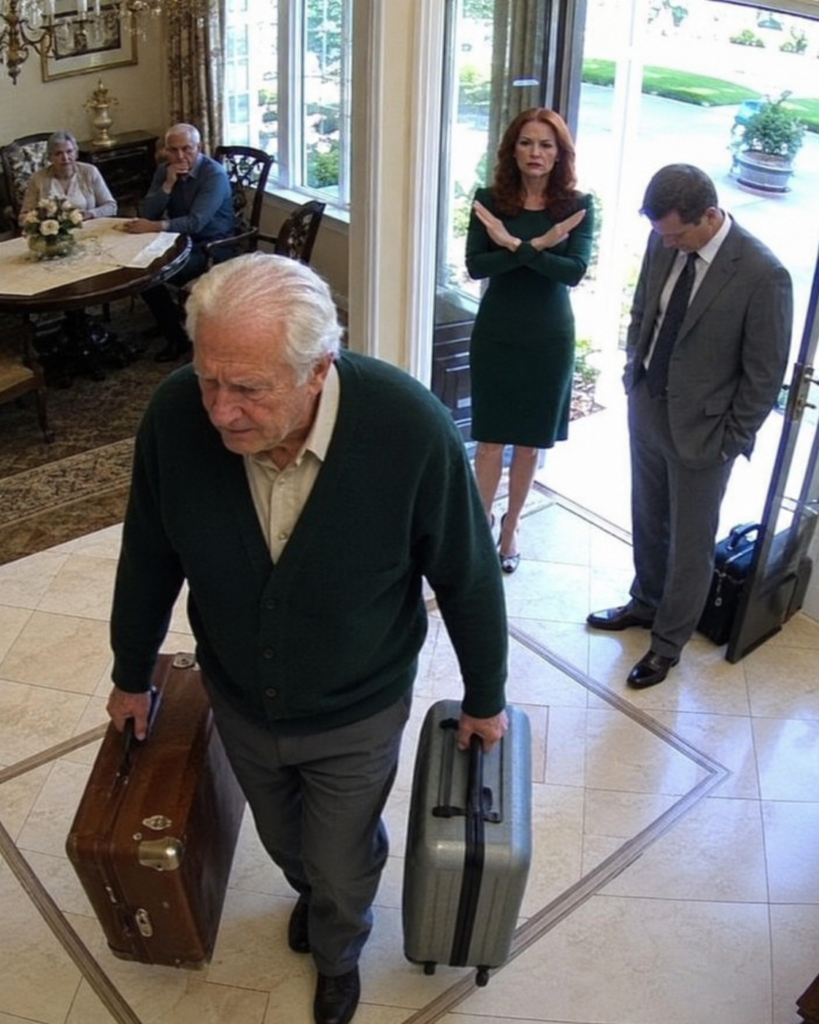
When Logan and Chelsea bought that large, beautiful house, my son’s credit had not been strong enough. Quietly, I had co-signed the loan. In fact, I was the primary guarantor.
The document stated that I was removing my name from the agreement under the breach-of-trust clause Fiona had wisely included.
The bank was giving them thirty days to refinance.
If they failed, foreclosure proceedings would begin immediately.
Chelsea swallowed hard and opened the second envelope with shaking fingers.
Notice of payment termination and vehicle return.
The luxury SUV parked right in front of her—the one she loved showing off to her friends—was financed in my name.
I had agreed to “help them get started.”
Now the notice demanded that the vehicle be returned immediately because it was no longer properly insured under their names.
Chelsea’s breathing quickened.
She tore open the third envelope in a panic.
This one was a formal demand letter printed on the heavy letterhead of Fiona Cartwright’s law office.
It required immediate repayment of $65,000.
That was the money used for their house down payment.
They had always believed it was my gift to them.
But accountants do not give away money without paperwork.
I had recorded it as a loan payable on demand, signed by Logan three years earlier.
Chelsea released a muffled cry.
The front door flew open.
Logan appeared half-dressed for work, his tie hanging loose around his neck.
“Chels? What happened? I heard something break.”
Chelsea turned toward him, her normally polished, arrogant face twisted with pure terror.
She handed him the papers without saying a word.
Logan read them.
The color drained from his face.
In one second, he went from confident businessman to frightened little boy.
“Dad…” he whispered.
He pulled out his phone and called me.
It rang once, then went straight to voicemail.
I had blocked his number the night before.
Across the street, parked beneath the shade of a wide oak tree, I watched everything through my windshield.
I did not smile.
I did not feel cruel satisfaction.
I simply felt the quiet relief of an account finally balanced.
I started the car and drove away slowly, leaving them standing in the wreckage of their own selfishness.
But I knew the real blow had not landed yet.
Three days later, on Friday morning, Chelsea hosted brunch for her neighborhood friends.
She was trying to keep up appearances. Trying to act as if her life was not falling apart.
But at exactly 10:15 a.m., the low growl of a diesel engine disturbed the calm of Thunderbird Road.
A large yellow tow truck stopped directly in front of their driveway.
Part 3
The tow truck driver wasted no time.
He jumped from the cab and began unwinding a heavy steel chain.
The metallic sound rang down the street.
Clack.
Clack.
Clack.
Inside the house, the laughter of Chelsea’s friends died instantly.
Chelsea appeared at the dining room window.
Her face turned pale with shock.
She dropped her mimosa and rushed toward the front door.
“Hey! What are you doing?” she shouted as she ran across the lawn.
The driver did not even look at her.
He hooked the chains beneath the luxury SUV.
“Vehicle repossession, ma’am,” he said flatly.
“You can’t do that! That’s my car!”
“The vehicle is registered under Albert Higgins,” the driver replied. “The repossession order came through his attorney.”
By then, all of Chelsea’s friends had stepped onto the porch.
They whispered among themselves, wide-eyed at the scandal unfolding in front of them.
The woman who loved presenting herself as perfectly wealthy was now watching her car get taken in front of the entire neighborhood.
The humiliation was complete.
The SUV lifted off the ground.
Chelsea burst into tears as the tow truck drove away with her prized symbol of status.
At the same time, Logan was facing his own nightmare at the dealership.
The bank manager had already called his boss.
Rumors about personal bankruptcy were spreading.
Logan’s carefully polished image was collapsing.
By two o’clock that afternoon, they had no choice.
They had to find me.
They expected to discover me in some cheap bed-and-breakfast.
Instead, the address Fiona gave them led to the most respected law firm downtown.
When they pushed open the heavy glass doors of Cartwright’s office, they looked exhausted.
They were led into a large conference room with glass walls.
I was already seated at the far end of the table.
My back was straight. My suit was flawless.
I was no longer the old retired man they had pushed into a back room.
I was the creditor.
Fiona sat to my right, arranging papers with surgical precision.
Logan and Chelsea sat across from me.
Neither one could meet my eyes.
“Dad…” Logan began, his voice shaking. “Please. Stop this.”
Chelsea leaned forward, trying to sound emotional.
“Albert, we were just stressed that night. You misunderstood. We’re family.”
I looked at her coldly.
“I misunderstood nothing, Chelsea.”
I folded my hands on the polished table.
“You told me to stay in my room. So I chose a bigger room.”
Fiona took control.
“Mr. and Mrs. Higgins, the situation is simple.”
She slid three folders toward them.
“The bank requires a new co-signer by the end of the week.”
“The $65,000 loan is due today at 5:00 p.m.”
Logan buried his face in his hands.
“We don’t have that kind of money, Dad. You know we’re living paycheck to paycheck. If you do this, we’ll lose everything. The house. Everything.”
I looked at my son.
He had chosen the arrogance of a cruel woman over the respect owed to his own father.
“That is the nature of accounting, Logan,” I said quietly. “In the end, everything balances.”
Chelsea’s fake sadness vanished, replaced by rage.
“You’re a monster,” she hissed. “You lived under our roof for free.”
I let out a short, dry laugh.
Then I nodded to Fiona.
She opened the final file.
A slim black folder, elegant and simple.
From it, she removed one bank statement and placed it in the center of the table.
Logan leaned forward.
Chelsea did too.
Their eyes went straight to the balance line.
$804,312.45
Chelsea’s breath caught.
Logan seemed to stop breathing entirely.
“What… what is this?” he stammered.
“My personal account,” I replied calmly.
Chelsea’s panic changed instantly into horrified greed.
“Eight hundred thousand dollars?” she whispered. “You’re rich?”
“I’m comfortable,” I corrected.
I leaned forward and met their stunned eyes.
“That money represents a lifetime of savings with my late wife.”
Then I looked directly at Logan.
“My plan was to leave it all to you.”
The realization struck him like a physical blow.
“I lived modestly so I could observe you,” I said. “I wanted to see how you handled what you already had.”
I pointed to the bank statement.
“This account was once a trust fund in your name.”
The word hung in the room.
“Was?” Chelsea repeated, her voice suddenly sharp.
“Yes,” Fiona confirmed without looking up from her notes. “Mr. Higgins dissolved the trust last Tuesday.”
Then she looked at them with a cold, professional smile.
“All funds have been transferred into private accounts and charitable foundations. You are no longer beneficiaries.”
Chelsea slowly turned toward Logan.
The truth ate through her expression.
She had thrown away over eight hundred thousand dollars because she didn’t want an old man in her kitchen.
“You let this happen!” she suddenly screamed at Logan.
She struck his shoulder hard.
“You let him leave! You idiot!”
Logan did not react.
He was frozen.
Their perfect marriage cracked open before my eyes.
Money had been the glue holding their lies together.
Now the money was gone.
Only the debts remained.
I stood slowly and adjusted my suit jacket.
“The documents are all here, Logan. I suggest you read them carefully.”
I did not wait for an answer.
I turned and walked toward the glass door.
“Dad, wait!” Logan begged, his voice breaking.
I did not stop.
I pushed the door open and stepped into the quiet corridor.
The air outside the conference room was cool and clean.
The next month, I bought a small cottage by a lake.
No unnecessary guest rooms.
No loud parties I never wanted.
Just golden morning light, good coffee, and complete peace.
I later heard that the house on Thunderbird Road was foreclosed.
Chelsea filed for divorce.
Logan had to move into a small apartment in the suburbs.
The calculations were finished.
The ledger was closed.
And for the first time in years, my personal balance was finally positive.

Epilogue
Six months later, a letter arrived in my mailbox.
The envelope was thin.
The handwriting on the front was familiar.
Logan.
For several minutes, I simply stared at it while sitting on my porch overlooking the lake.
The water was calm that morning.
A pair of ducks drifted across the surface.
Everything in my life had become wonderfully quiet.
Eventually, I opened the envelope.
Inside was a single sheet of paper.
No excuses.
No demands.
No requests for money.
Just a letter.
Dad,
I spent months trying to decide whether I should write this.
At first, I hated you.
Then I blamed Chelsea.
Then I blamed the bank, the lawyers, and everyone else I could think of.
But eventually, I ran out of people to blame.
The truth is that I failed you.
You spent years helping me, and I spent years pretending not to notice.
The night you left, I saw the look on your face.
I knew I should have stood up for you.
I knew it, and I did nothing.
That silence cost me everything.
I don’t expect forgiveness.
I just wanted you to know that I finally understand.
Love,
Logan.
I read the letter twice.
Then I folded it carefully and placed it beside my coffee cup.
For a long time, I sat there listening to the wind move through the trees.
Age teaches many lessons.
One of them is that regret always arrives late.
Sometimes years late.
Sometimes a lifetime late.
The phone rang three days later.
I almost ignored it.
Then I saw Logan’s name.
For several seconds, I considered letting it go to voicemail.
Instead, I answered.
Neither of us spoke immediately.
Finally, my son cleared his throat.
“Dad?”
“Hello, Logan.”
His voice sounded different.
Smaller.
Not because he had lost money.
Because he had lost certainty.
“I got a job,” he said.
“That’s good.”
“It doesn’t pay much.”
“Most honest work doesn’t.”
A weak laugh escaped him.
Then silence returned.
“Dad,” he said quietly. “I wasn’t calling about money.”
“I know.”
Another pause.
“I just wanted to hear your voice.”
Something tightened in my chest.
Not anger.
Not forgiveness.
Something in between.
The kind of feeling that only exists between parents and children.
A wound that never completely closes.
We talked for twenty minutes.
About ordinary things.
The weather.
His apartment.
The lake.
Nothing important.
And somehow, everything important.
Before hanging up, he hesitated.
“Do you think someday we could have lunch?”
I looked out across the water.
The answer would have been easy six months earlier.
Back then, I would have said no.
But people are not spreadsheets.
Life is not accounting.
Some balances cannot be settled with numbers.
“Maybe,” I said.
His breathing caught.
“Maybe?”
“One lunch, Logan.”
For the first time, I heard genuine emotion in his voice.
“Thank you, Dad.”
When the call ended, I sat quietly for a long time.
The following spring, we met at a small diner halfway between the city and the lake.
Logan arrived early.
His suit was gone.
So was the expensive watch.
The arrogance had disappeared too.
What remained was simply my son.
Older.
Wiser.
Sadder.
Human.
When the waitress brought our coffee, he looked down at the table.
“I miss Mom.”
The words surprised me.
For a moment, neither of us spoke.
Then I nodded.
“So do I.”
His eyes filled with tears.
Mine nearly did too.
Because beneath every fight, every betrayal, every disappointment, there was one truth neither of us could escape.
We had both lost her.
And grief had shaped us in different ways.
We spent three hours talking.
Not about the house.
Not about the foreclosure.
Not about the money.
We talked about fishing trips.
Family vacations.
The time he broke his arm riding a bicycle.
The stuffed mushrooms he loved as a child.
By the time lunch ended, nothing had been fixed.
But something had begun.
As we stood in the parking lot, Logan looked at me.
“Do you think you’ll ever trust me again?”
The question lingered between us.
I thought carefully before answering.
“Trust isn’t inherited, son.”
He lowered his eyes.
“It has to be earned.”
He nodded slowly.
“I understand.”
For the first time in years, I believed he actually did.
That evening, after returning home, I walked down to the dock behind my cottage.
The sunset painted the lake gold.
My wife used to love sunsets.
Sometimes I still imagined her sitting beside me.
Watching.
Listening.
Waiting.
I smiled toward the water.
Not because everything had turned out perfectly.
It hadn’t.
Not because every wound had healed.
Some never do.
I smiled because peace had finally returned.
And because somewhere along the way, my son had started finding his way back.
The ledger was no longer closed.
But for the first time, a new page had begun.
And unlike the last one, this chapter would not be measured by money.
Only by what remained after it was gone.