That morning in Cancun, I thought I was looking at a stain.
What I was really looking at was the first crack in a truth big enough to split open everything I thought I understood about my ex-wife, my marriage, and the night that had just made me believe the past could come back to life.
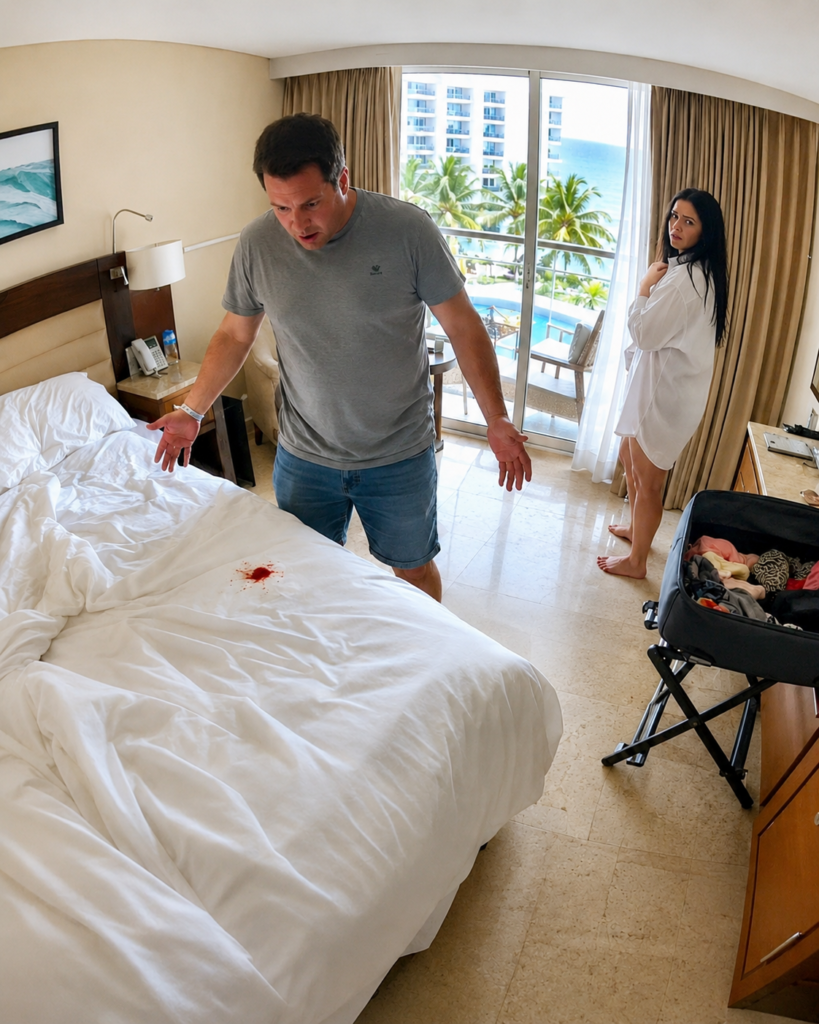
I had just stepped out of bed when I saw it: a small red mark against the white hotel sheet.
Not much.
Just enough.
Enough to stop me cold.
Elena was standing by the window in my white shirt, the curtains breathing in and out with the Caribbean wind.
For a second she looked almost exactly the way she used to look on Sunday mornings in our apartment in Mexico City, before work swallowed us whole, before resentment became our second language, before silence became easier than tenderness.
Then she turned, saw where I was staring, and all the softness left her face.
‘Elena, are you hurt?’ I asked.
She blinked too quickly.
‘No.
It’s nothing.’
Her answer came fast, almost rehearsed.
She crossed the room, grabbed the edge of the sheet, and folded it over the stain as if hiding it would erase what I had already seen.
‘It’s probably just my cycle coming early,’ she said, not quite meeting my eyes.
That should have settled it.
It didn’t.
Because I knew Elena.
Or at least I used to.
I knew the difference between embarrassed and afraid.
What I saw in her face that morning was fear.
There was a tremor in her fingers.
Her lips had gone pale.
And when she bent to pick up her purse from the chair, a white envelope slipped halfway out from under it.
I caught only a glimpse before she shoved it back inside, but it was enough to see the printed logo of a private clinic in Cancun.
I looked at her.
She looked away.
‘Are you sure you’re okay?’
She forced a smile that didn’t belong on her face.
‘Carlos, really.
I’m fine.’
But she wasn’t fine.
I felt it in the room the way you feel a storm before the first drop falls.
To understand why that moment hit me so hard, you need to understand what Elena and I had been to each other, and what we had failed to remain.
We were married for six years.
There had been no spectacular betrayal, no screaming match with flying glasses, no third person waiting in the shadows.
Our marriage died in smaller ways.
Long workdays.
Delayed dinners.
Stress that followed us home and sat at the table with us.
Petty arguments that never seemed important until they had piled high enough to bury everything underneath.
By the time we divorced, we were both exhausted.
We signed the papers with a kind of numb politeness that felt almost more tragic than if we had cried.
No one fought.
No one begged.
We just stopped.
I stayed in Mexico City and threw myself deeper into work at a construction firm that developed hotel properties.
Elena moved to Quintana Roo and built a new life in tourism.
Mutual friends occasionally mentioned her name, usually to tell me she was doing well, that she looked good, that she seemed busy.
I always nodded like it didn’t matter.
For three years, we didn’t speak.
Then my company sent me to Cancun to evaluate land and financing details for a resort project along the Caribbean coast.
I checked into a hotel near Kukulcan Boulevard, dropped my suitcase in the room, answered a few late emails, and went outside because the air-conditioned silence was making me restless.
Cancun at night can trick you into believing life is lighter than it is.
The salt in the air, the warm wind, the sound of waves striking the shore with maddening calm, the lights from hotels reflected against black water—it all feels cinematic, the kind of setting where you expect something beautiful to begin.
Instead, I walked into a small bar and saw the woman I had once promised forever.
Elena was standing at the counter in a pale blue dress, her back to me.
I knew her instantly from the slope of her shoulders alone.
When she turned and saw me, the surprise in her face looked so real that I believed, without question, that fate had simply chosen to be cruel and generous at the same time.
‘Carlos?’ she said.
I smiled, suddenly thirty different versions of myself at once.
‘It’s been a long time.’
We sat together.
At first we spoke like diplomats from countries that had once gone to war.
Careful.
Polite.
Measuring every word.
She asked if I was there on vacation.
I told her it was work.
I asked about her job, and she told me she was managing operations at a nearby resort.
Then we started talking about people we used to know, places we had gone, stupid old memories that had somehow survived the divorce intact.
The strangest part was how easy it became.
Three years earlier, we couldn’t discuss groceries without turning it into evidence in a private trial.
But that night there were no accusations.
No scorekeeping.
Time had rubbed the sharp corners off our history.
Near midnight she asked where I was staying.
I told her.
She smiled in a way that, at the time, I read as simple coincidence.
‘I know that hotel,’ she said.
Then she looked toward the dark line of the sea and asked, ‘Do you want to walk on the beach for a while?’
We did.
The shore was almost empty.
Waves moved over the white sand with a sound like someone whispering behind a door.
Elena walked barefoot for a stretch, carrying her shoes in one hand.
The wind kept moving her hair loose from where it was tied, and every few minutes she pushed it back with a gesture that made my chest tighten with memory.
We spoke more honestly there than we had in years.
Not about the divorce itself, not directly, but around it.
About how fast life had moved.
About how strange it was to become a stranger to someone who once knew your every habit.
About the versions of ourselves we had lost.
Then the words ran out.
She looked at me.
I looked at her.
There are silences that are empty, and there are silences so full they feel dangerous.
That one was the second kind.
She came back to the hotel with me.
I won’t dress it up as destiny.
At the time, I told myself it was a
lapse, a collision between memory and loneliness, one night stolen from a life that no longer belonged to either of us.
But it didn’t feel casual.
Not really.
It felt like two people stepping into an old room and discovering all the furniture was exactly where they had left it.
The next morning proved how wrong I was.
After Elena hid the sheet and insisted she was fine, she moved around the room with odd urgency.
She got dressed quickly.
She kept checking her phone.
When I offered to order breakfast, she refused too fast.
‘I’ve got to go,’ she said.
‘At least let me drive you.’
‘No.’
The force of that answer made us both pause.
She softened her tone immediately.
‘I have to be somewhere soon.
Please don’t worry.’
She kissed my cheek before leaving.
It was a light, almost formal kiss, but her lips lingered just enough to confuse me.
At the door she stopped, still facing away from me, and said something I didn’t understand until much later.
‘Please don’t make this harder than it already is.’
Then she left.
I stood alone in the hotel room with the ocean beyond the glass and a feeling in my stomach that wouldn’t settle.
The stain on the sheet wasn’t large, but it had rearranged the air in the room.
I told myself she had explained it.
I told myself I was being dramatic.
I told myself a hundred reasonable things on the way to my morning meetings.
None of them worked.
I couldn’t concentrate that day.
Numbers blurred.
Site plans meant nothing.
Between meetings I opened my phone and stared at our newly reactivated message thread.
Are you okay?
I sent it around noon.
Her reply came almost an hour later.
I’m fine.
Don’t worry.
That was all.
I tried calling that evening.
No answer.
The next day, between appointments, I stopped near a pharmacy across from a private medical building to grab a bottle of water.
I was halfway back to the car when I saw Elena coming out of the clinic entrance.
She was wearing sunglasses even though the sky had turned cloudy.
In one hand she carried a folded paper, and in the other a small bag from a pharmacy.
She walked carefully, as if every step needed to be negotiated with her body.
My chest tightened.
I called her name.
She froze for a second before turning toward me.
The smile she gave me was impressive in the saddest way.
It was the smile of someone trying to hold a wall in place with bare hands.
‘What are you doing here?’ I asked.
‘Nothing important,’ she said.
‘Just a checkup.
I’ve had migraines.’
‘Migraines?’
‘Carlos.’ She looked around, almost pleading.
‘Please.’
I wanted to push harder.
I wanted to take the paper from her hand and force the truth into daylight.
But something in her expression stopped me.
Not because I believed her.
Because I could see how badly she needed me to pretend that I did.
Before I left Cancun, I went to the resort where she worked.
I told myself I needed closure, or at least clarity.
A receptionist called her, and Elena came out through a service corridor instead of the main lobby, as if she didn’t want anyone to
see us together.
She looked tired.
More than tired.
Hollowed out.
‘I was worried about you,’ I said.
‘I know.’
‘And I still don’t believe you’re fine.’
She crossed her arms over herself against a breeze that wasn’t cold.
‘Then let me ask you something.
If I’m not fine, what exactly are you going to do?’
The question irritated me because I didn’t have a clean answer.
‘I don’t know,’ I admitted.
‘But disappearing is not an answer either.’
For a second her eyes softened in a way that almost undid me.
Then she looked down.
‘What happened between us that night was real,’ she said quietly.
‘But that doesn’t mean you should pull it into your life and break yourself open over it.’
‘Elena—’
‘Please,’ she said again, and this time there was pain in it.
‘Let it stay one night.’
She kissed my cheek and walked back inside before I could stop her.
I flew back to Mexico City with a weight in my chest I couldn’t explain to anyone.
For weeks I told myself she regretted sleeping with me.
That she was embarrassed.
That I was inventing drama because seeing her had stirred up things I had no right to feel anymore.
Then, almost a month later, my phone rang after midnight.
The name on the screen was Lucía, one of Elena’s old friends.
I hadn’t spoken to her in years.
The moment I answered, I knew something was wrong.
Her voice had that fragile steadiness people use when they’re trying not to make a situation sound as bad as it is.
‘Carlos, are you alone?’
My hand went cold around the phone.
‘Yes.
What happened?’
She took a breath.
‘Elena collapsed at work this evening.
They took her to the hospital.’
For a second I couldn’t speak.
‘Why are you calling me?’ I finally asked.
‘Because when they went through her bag, your number was the only one she had marked as an emergency contact.’
That hit me almost as hard as what came next.
Lucía told me Elena had been diagnosed months earlier with cervical cancer.
I sat down on the edge of my bed because my knees stopped trusting me.
The bleeding in the hotel room hadn’t been her period.
The clinic envelope I saw, the way she moved, the strain in her face, her sudden disappearances—none of it had been random.
She had known.
She had been in the middle of appointments, tests, and treatment decisions.
She had hidden it from almost everyone except Lucía and one other coworker.
And then Lucía told me the part that truly rearranged the story in my mind.
My reunion with Elena had not been entirely by chance.
A few days before I arrived in Cancun, Elena had seen my name on a vendor and project document connected to the resort expansion.
She knew my company was involved.
She knew there was a good chance I would be staying in that area.
She had gone to that bar because she thought she might see me there.
She had not planned the night exactly as it happened.
But she had gone there hoping for me.
I booked the first flight I could.
By the time I reached the hospital in Cancun, dawn was starting to thin the darkness
outside.
Lucía met me in the corridor near oncology.
Her face told me she hadn’t slept.
‘Is she—’
‘Alive,’ she said quickly.
‘She’s stable.
But she had severe bleeding.
The doctors had already been pushing for surgery.’
My throat felt raw.
‘Why didn’t she tell me?’
Lucía gave me a look that wasn’t cruel, just tired.
‘Because Elena would rather break than let someone watch it happen.
You know that.’
She was right.
I hated that she was right.
When I finally saw Elena, she was in a hospital bed with an IV in her arm and the kind of exhaustion on her face that strips a person down to their most honest self.
She looked smaller than I had ever seen her.
Her eyes opened when I stepped in.
For a moment she just stared at me, and something like defeat passed through her expression.
‘Lucía called you,’ she said.
‘You put me as your emergency contact.’
Her gaze shifted toward the blanket.
‘I forgot to change it.’
‘No,’ I said, more sharply than I intended.
‘You didn’t.’
Silence gathered between us.
Then I moved closer to the bed and let the anger I had been holding come through.
‘You let me stand there thinking I had hurt you.
You let me ask what was wrong, and you looked me in the face and lied.’
Her eyes filled, but she didn’t look away.
‘I know.’
‘Why?’
She swallowed hard.
When she answered, her voice was thin but steady.
‘Because I didn’t want you to look at me like this.’
I said nothing.
She drew in a careful breath.
‘I saw your name on the project papers and thought about ignoring it.
Then I thought about seeing you one last time.
Just once.
Somewhere outside a hospital.
Somewhere I could still pretend I was myself.’
The words hit me harder than any dramatic confession could have.
‘I didn’t want pity, Carlos,’ she said.
‘I didn’t want to become your obligation.
I didn’t want the first real conversation we’d had in three years to happen with me explaining test results and treatment options.
I wanted one night where I wasn’t sick.
One night where I wasn’t afraid.
One night where I could feel normal with the only person who had ever really known me.’
I sat down beside the bed because I no longer had the strength to stand.
‘You should have told me,’ I said.
‘I know.’ A tear slipped into her hairline.
‘But I was terrified that if I told you, the night would stop being ours and start becoming about mercy.’
The truth was, I didn’t know what hurt more: that she had hidden the illness, or that she had felt so alone she believed hiding it was her only dignified choice.
I stayed.
At first because I was angry, and worried, and there was no version of me that could walk back out of that hospital after learning the truth.
Then I stayed because anger exhausted itself and left behind something older and harder to deny.
Love does not always return as fireworks.
Sometimes it returns as a chair pulled close to a hospital bed.
As paperwork signed with shaking hands.
As coffee gone cold in a waiting room.
As learning, too late, how much of another
person’s fear you had mistaken for distance.
Elena underwent treatment.
There were ugly weeks.
Pain.
Exhaustion.
Nights when she snapped at me and apologized an hour later.
Mornings when she didn’t want me to see her.
Afternoons when she did nothing but sleep while I sat by the window answering work emails with the sound off.
We talked more honestly in those months than we had in the last years of our marriage.
About why we had failed.
About how work had become a shield for both of us.
About how pride can look respectable while it quietly destroys everything warm in a room.
About how she had learned to carry fear alone, and how I had learned to call emotional absence discipline.
None of it was cinematic.
None of it was easy.
But it was real.
Months later, when her scans finally came back clear enough for the doctor to use the word remission, Elena cried the way she hadn’t cried when we divorced.
I cried too, right there in a hallway that smelled like antiseptic and coffee.
A week after that, we went back to the beach.
The same stretch of coast.
The same wind.
The same low sound of waves sliding over sand.
This time there were no lies between us.
Elena stood barefoot near the water and looked at me with that direct, searching expression I had loved and feared for years.
‘I’m not asking you to erase what happened,’ she said.
‘I’m not asking us to pretend this fixes everything.’
I walked toward her until there was almost no space left between us.
‘Good,’ I said.
‘Because I don’t want to pretend anymore.’
She laughed then, a small, broken, relieved laugh, and for the first time since Cancun, the future didn’t feel like a threat.
We didn’t rush into a fairy tale.
We didn’t run to remarry just because fear had reminded us how much we could lose.
We did something harder.
We started again carefully, honestly, without pretending love by itself can repair what silence once damaged.
Even now, when people hear the story, they divide quickly.
Some say what Elena did was cruel—that she had no right to pull me into one final night while hiding something so serious.
Others say fear makes people choose desperate forms of tenderness, and that all she wanted was one memory untouched by illness.
I still don’t know which judgment is fairer.
I only know that when I think about that morning in Cancun, I no longer see the stain first.
I see Elena by the window, trying to hold herself together for one more minute, and I understand how lonely a person has to be to choose silence over being seen.
Maybe what she did was selfish.
Maybe it was the saddest kind of love.
Maybe, in the end, it was both.