On my first business trip with my boss, I woke up in his bed.
That was the first thought that hit me.
The second was worse.
I was naked.
I lay perfectly still under a sheet that was far too soft and far too expensive to belong to the standard hotel room I had booked for myself.
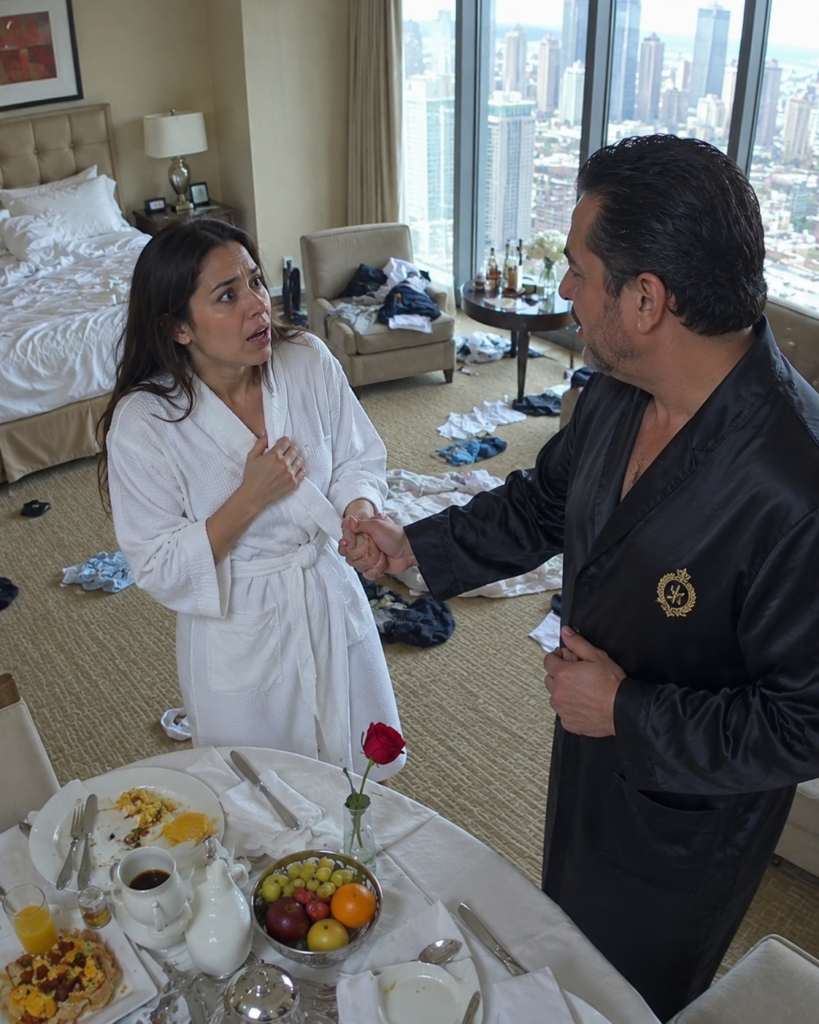
My eyes tracked slowly across the ceiling, then to the wall of glass overlooking Paseo de la Reforma, then to the dark robe hanging over a chair, then to the man standing near the window with a cigarette between his fingers.
Rafael Alcázar.
My boss.
The CEO everyone in the company feared.
The man the directors called brilliant to his face and terrifying behind his back.
The man I had spent the last eleven months trying not to think about in any personal way whatsoever.
He turned slightly when he heard the sheet move.
“Awake already?” he asked.
His voice was calm, low, controlled.
Mine barely existed.
“Sir…”
He flicked ash into a tray.
“You should eat.
I ordered breakfast.”
I stared at him.
Breakfast was not a normal response to finding your assistant naked in your bed.
Breakfast was what people discussed after marriages, after affairs, after mistakes they intended to repeat.
Not after a disaster.
Not after something that could destroy both our careers.
Then I looked around and saw the clothes.
My blouse near the sofa.
My skirt twisted into his belt.
His shirt beside the bed.
One heel under the armchair.
My earring by the minibar.
Nothing about that room suggested a misunderstanding.
I grabbed the robe he tossed toward me and locked myself in the bathroom before I could humiliate myself further.
My reflection made the situation worse.
I looked kissed, not merely disheveled.
My lips were full, my hair wild, and there were faint marks on my neck that made my hands shake when I touched them.
Real.
Undeniable.
Intimate.
Something had happened.
I just couldn’t remember enough of it to know whether I should be ashamed, furious, heartbroken, or all three.
I splashed cold water on my face, but memory refused to come back in a straight line.
The previous evening had started professionally enough.
We had flown to Mexico City for a contract negotiation with a major hospitality group.
It had been my first trip alone with Rafael, and I had spent most of the day trying to ignore how unfairly good he looked in a black suit while also reminding myself that he was my boss, not a fantasy.
The meeting had gone brilliantly.
The clients signed.
Everyone was thrilled.
They insisted on celebrating over dinner at the hotel restaurant.
Rafael hated long dinners.
I knew that much.
He hated performative toasts even more.
But the clients kept raising glasses in his honor, and each refusal would have looked rude, so I stepped in more than once, smiling and taking a glass that had been meant for him.
I remembered laughter.
Music.
The city lights outside the windows.
His hand on the back of my chair when I stood.
The private elevator.
His voice close to my ear.
Then fragments.
Heat.
A hallway.
My pulse racing.
Darkness.
When I finally came out of the bathroom, determined to save whatever remained of my dignity, Rafael was pouring coffee at the dining table as if the world hadn’t shifted under my feet.
I told him we should pretend nothing had happened.
Everything changed when I said it.
His expression closed and opened at the same time, like a door slamming on a storm.
He crossed the room, took my wrist, and said, “What do you mean, nothing happened?”
I froze.
Then came the sentence that made my blood run cold.
“After what happened between us last night… you’re really going to run from your responsibility to me?”
“Responsibility?” I whispered.
His gaze sharpened.
“You don’t remember.”
It wasn’t a question.
I shook my head.
His grip loosened immediately, and that small gesture told me more than his words had.
Whatever Rafael Alcázar was, he was not careless.
Not with power.
Not with boundaries.
Not with me.
He stepped back and ran a hand over his mouth.
For the first time since I’d known him, he looked unsettled.
“You were dizzy before we left the restaurant,” he said.
“More than dizzy.”
My stomach dropped.
“What does that mean?”
He hesitated, as if choosing his words mattered more than anything else in the room.
“I thought you were drunk.
Then I realized your speech was slurring too suddenly.
You could barely focus your eyes.
You kept saying you only had two glasses.”
I had.
Maybe three.
Certainly not enough to black out.
My skin went cold again.
“I took you upstairs,” he continued.
“I was going to call hotel security and a doctor.”
“Then why didn’t you?”
His jaw tightened.
“Because when we got to the suite, you asked me to lock the door.”
My mouth parted.
“And then you said a name.”
I stared at him.
“What name?”
He held my gaze for a long second.
“Valeria Moreno.”
The room vanished.
No one at work knew that name.
No one.
Valeria Moreno had been my mother’s legal name before she changed it after leaving Madrid twenty-eight years ago.
She never used it.
I had heard it only in whispered conversations, in old documents, and once, in a voice message she made me promise to keep sealed unless something happened to her.
My mother had died eight months earlier.
Only then did I understand why Rafael had looked wounded when I suggested pretending.
This wasn’t just about sex.
This was about something buried much deeper.
“How do you know that name?” I asked.
His face changed.
Some of the coldness fell away, leaving exhaustion behind.
“Because she was my mother too,” he said.
I laughed.
Not because it was funny, but because my brain rejected it so violently that laughter was the only sound it could produce.
Then I stopped.
Because he wasn’t joking.
The suite went silent except for the city noise far below.
“No,” I said.
“No.”
“She left Spain when she was nineteen,” he said quietly.
“She left me with my father’s family.
They told me she’d abandoned me for another life.
Years later I found out she had been sent away because she was pregnant again and because my grandfather wanted to erase the scandal.”
I couldn’t move.
“My investigators found her years ago,” he continued.
“I knew she was in Mexico.
I knew she had another child.
I knew your name long before
your résumé ever reached my office.”
The floor seemed to tilt under me.
“You hired me because you knew?”
“I hired you because you were qualified.” His voice sharpened.
“I kept you because you were exceptional.
And I kept my distance because I didn’t know how to tell you the truth without destroying your life in a different way.”
I could only stare at him.
Eight months earlier, a week before she died, my mother had called me into her room with a small envelope in her hand and tears in her eyes.
She told me there was one thing she had never had the courage to fix.
One person she had betrayed before she ever betrayed herself.
A son.
She hadn’t said his name.
She said only this: If fate ever puts you in front of him, don’t judge too quickly.
He grew up hearing a lie about me.
And you grew up hearing my silence.
I had thought grief was making her speak in riddles.
I had hidden the envelope in my apartment and never opened it.
I couldn’t bear to.
After the funeral, I returned to work and poured myself into surviving.
And Rafael had been there the entire time.
Watching.
Knowing.
Keeping that secret between us like a loaded weapon.
“I don’t understand,” I said, my voice trembling.
“If you knew, why bring me here? Why be alone with me? Why let any of last night happen?”
Pain crossed his face so quickly I almost missed it.
“I didn’t plan any of it.”
I folded my arms tighter under the robe.
“Then explain it.”
He nodded once, like he’d expected that.
“After dinner, you were disoriented.
In the elevator, you started crying.
You said your mother’s real name.
You said she made you keep a secret.
You said you were tired of looking at me every day without understanding why being near me felt familiar.” He paused.
“I thought you needed medical help.
I had already called downstairs for a doctor.”
My mind raced, trying to fit pieces together.
“What changed?”
“The room service attendant delivered water before the doctor arrived.” His expression hardened.
“You looked at the attendant and called him by the name of one of the clients at dinner.
That was when I knew something was wrong.
I told security to review the restaurant footage and bar service.
One of the junior client reps was seen tampering with your drink.”
I gripped the back of a chair so hard my fingers ached.
The world narrowed.
Someone had drugged me.
Rafael saw the realization hit and took a step toward me, then stopped when I flinched.
“You were never left alone after that.”
I swallowed hard.
“Then why…” I looked down at the marks on my neck, then at the scattered clothes.
His voice dropped.
“Because after the doctor examined you, she said the dosage appeared low and would likely wear off in a few hours.
She also said adrenaline, stress, and alcohol could make your memory uneven.
You were terrified, Lucía.
You refused to let anyone take you to another room.”
My breath caught.
“Why?”
“Because by then I had told you who I was.”
The chair nearly slipped from my hands.
“I told you I was your brother.” He said the word
with visible difficulty.
“I thought it was cruel to let you wake up confused later without context.
You looked at me for a very long time.
Then you asked if I had proof.”
I stared.
He reached into the pocket of his robe and took out a small keycard wrapped with a thin gold chain.
My chain.
The one my mother gave me when I was sixteen.
The one she told me never to lose.
“I found this around your neck after you were sick,” he said.
“You made me open the locket.”
My hand flew to my throat.
The locket.
I had forgotten the locket.
Inside were two tiny photographs pressed back to back.
On one side, my mother at eighteen.
On the other, a baby boy I had never been able to identify.
“I showed you the same picture,” he said quietly.
“In my wallet.
The original.”
My knees weakened.
And there it was, a memory returning not in pieces but in one violent wave.
The elevator mirror.
My own tears.
Rafael saying, Lucía, look at me.
The suite door closing.
My shaking hands opening the locket.
Him taking out a worn leather wallet.
The same photograph.
My mother younger than I had ever known her.
A baby in her arms.
My voice breaking on the word hermano.
Not lover.
Brother.
I sat down hard in the nearest chair.
Nothing intimate had happened between us.
Nothing physical beyond what was necessary to help me when I got sick and half-conscious and frightened.
The marks on my neck were from an allergic flush, the doctor later confirmed.
My blouse had been changed because I had vomited on it.
The room looked chaotic because I had insisted on walking unassisted, tripped over my own heel, knocked a lamp sideways, cried, argued, demanded proof, then fallen asleep in the middle of a sentence while Rafael sat fully clothed in an armchair beside the bed.
I looked up at him, horrified by a whole new shame.
“You let me believe…”
“I let you speak first,” he corrected.
I pressed a hand over my mouth.
“Why did you say responsibility?”
His face was unreadable again, but his voice wasn’t.
“Because before you fell asleep, you made me promise something.
You said if I was telling the truth, then neither of us had the right to walk away just because the truth was inconvenient.
You said our mother had already done enough running for an entire family.”
I remembered that too.
My hand in his.
My words thick but fierce.
Don’t disappear in the morning.
Don’t make me carry this alone.
I had laughed at him.
Accused him of being too cold to be related to me.
Then I’d cried and told him if he was really my brother, then he had a responsibility to stay.
And I had said I did too.
That was what he meant.
Not obligation born from desire.
Responsibility born from blood.
I closed my eyes and let out a broken sound that was half sob, half laugh.
When I opened them again, Rafael was still standing exactly where he had stopped himself, as if he didn’t know whether he had permission to move closer.
“You could have just said that,” I murmured.
“I tried.”
He wasn’t wrong.
I looked at the breakfast table, the cigarettes, the rumpled bed, the city beyond the glass, and suddenly the whole morning looked different.
Not like the aftermath of a scandal.
Like the wreckage of a secret so large it had no graceful way to enter daylight.
Then another memory returned, one that made my stomach clench again.
“The client rep,” I said.
“The one who tampered with my drink.
What happened?”
Rafael’s expression chilled instantly.
That familiar corporate ice returned, and for the first time that morning I understood why people feared it.
“He’s been detained,” he said.
“Security reviewed the footage.
The hotel preserved the glasses.
The police were called before you woke up.”
I blinked.
“The police?”
“Yes.”
I had never heard so much violence in such a controlled tone.
“He won’t touch you again.
He won’t touch anyone again, if I can help it.”
Something in me softened and recoiled at the same time.
Protected.
Angry.
Grateful.
Overwhelmed.
I stood slowly.
“Did you stay awake all night?”
A pause.
“Yes.”
“Why?”
That time he did move, but only enough to rest a hand on the back of the chair opposite mine.
“Because twelve hours ago I thought I had no family left,” he said.
“Then you were suddenly here.
Drugged, terrified, calling our mother by her real name and asking me not to leave.
I didn’t trust myself to sleep.”
The force of that honesty broke the last of my resistance.
I started crying in a way that was humiliating and impossible to stop.
Not pretty tears.
Not cinematic tears.
The kind that make your whole face ache.
Rafael looked alarmed, which would have been funny under any other circumstances.
“Lucía—”
“I’m crying because this is insane,” I said through tears.
“And because I thought I slept with my boss, and now apparently I found a brother instead, which is not an improvement emotionally.”
Something happened then that I had never seen before.
Rafael smiled.
It was brief.
Disbelieving.
Tired.
But real.
The sight of it undid me more than everything else had.
I laughed in spite of myself.
He looked at me for a second, then asked quietly, “May I?”
I nodded.
He came around the table and held me.
Not like a lover.
Not like a man testing a line.
Like someone who had been standing outside a locked house for years and had finally been let in.
We stayed that way for a long time.
Later that afternoon, after statements to the police and a visit from the doctor and three cups of coffee I barely tasted, I asked Rafael to come to my apartment the following weekend.
I opened the envelope my mother had left me with him sitting across from me at the kitchen table.
Inside was a letter and two old legal documents.
One was a birth certificate from Madrid with Rafael’s full name.
The other was a private settlement agreement signed by my grandfather.
The letter was written in my mother’s hand.
She confessed everything.
She had been forced to leave her first son behind after a powerful family buried a scandal to protect their name.
Years later, when she learned where Rafael was and tried to contact him, the letters were intercepted.
By then she was already married again and pregnant with me.
Fear and shame did the rest.
She wrote that the greatest sin of her life was not the secrecy itself, but allowing time to turn cowardice into permanence.
Rafael read the letter in silence.
When he reached the final page, he folded it so carefully it looked like the paper might break him if he moved too quickly.
We did not forgive her in the same way.
That surprised me at first.
I wanted to defend her because I had known her tenderness, her sacrifices, the way she worked herself to exhaustion to give me a safe life.
Rafael, who had known only absence, had no tenderness available for the version of her he inherited.
To him, she was a woman who heard her child crying through a closed door and walked away.
Neither of us was entirely wrong.
That was the hardest part.
Family secrets always ask someone innocent to pay.
In the months that followed, everything changed slowly and all at once.
Human Resources was informed that I would no longer report directly to Rafael.
The official explanation was a departmental restructuring after the contract expansion.
No one questioned it.
People always assume corporate shifts are more boring than they are.
We began having dinner once a week, awkwardly at first.
We compared childhood photos.
We discovered the same stubbornness, the same habit of rereading messages before sending them, the same way of going silent when hurt instead of asking for comfort.
He told me about Madrid, boarding schools, and a father who respected discipline more than affection.
I told him about my mother’s migraines, her habit of dancing barefoot while cooking, and the way she used to stop at mirrors and stare as if trying to recognize herself.
We argued too.
About whether she deserved peace.
About whether regret counts if it comes too late.
About whether blood automatically creates love or whether love must still be chosen.
Some nights I left furious.
Some nights he did.
But neither of us disappeared.
That was the promise.
The police case moved quickly because the hotel footage was clear.
The client representative claimed it was a joke, then a misunderstanding, then an accident.
None of it held.
He was charged.
The hospitality group severed ties with him publicly and sent a formal apology.
I read it once and deleted it.
Some things do not become clean because the right people panic on letterhead.
A year later, Rafael came to my apartment carrying a small box.
Inside was the original photograph from his wallet, restored and framed.
Our mother at eighteen.
Rafael as a baby in her arms.
And beside it, another frame.
A picture of me at six, missing a front tooth, grinning at the camera while my mother crouched behind me with both hands on my shoulders.
“We should keep both on the wall,” he said.
I looked up at him.
“Even after everything?”
He considered that.
“Yes,” he said.
“Because the truth doesn’t become easier by cutting out the parts that hurt.”
So we hung them side by side.
Sometimes when I look at those photographs, I still think about that morning in the hotel suite and feel the old rush of panic.
I remember waking under the wrong sheets, seeing my boss at the window, and thinking my life was over.
I was wrong.
My life as I knew it was over.
But something else had started in its place.
Not a romance.
Not a scandal.
Not a fantasy.
A reckoning.
A brother.
A truth my mother buried so deeply that it had to erupt in the ugliest possible way before either of us could finally see it.
And even now, after all the explanations, all the letters, all the dinners and arguments and repaired silences, I still don’t know whether my mother deserves forgiveness or whether regret is just the softer face of cowardice.
I only know this:
The biggest red flag in our story was never that I woke up in my boss’s bed.
It was that an entire family had been built on secrets so carefully preserved that when the truth finally surfaced, it looked at first like shame.
Maybe that is what the worst lies do.
They don’t just hide the truth.
They teach you to fear it when it finally arrives.